Skip to content
GrainGS: Gradient-Decoupled Gaussian Splatting for Efficient Dynamic Novel View Synthesis

GrainGS: Gradient-Decoupled Gaussian Splatting for Efficient Dynamic Novel View Synthesis

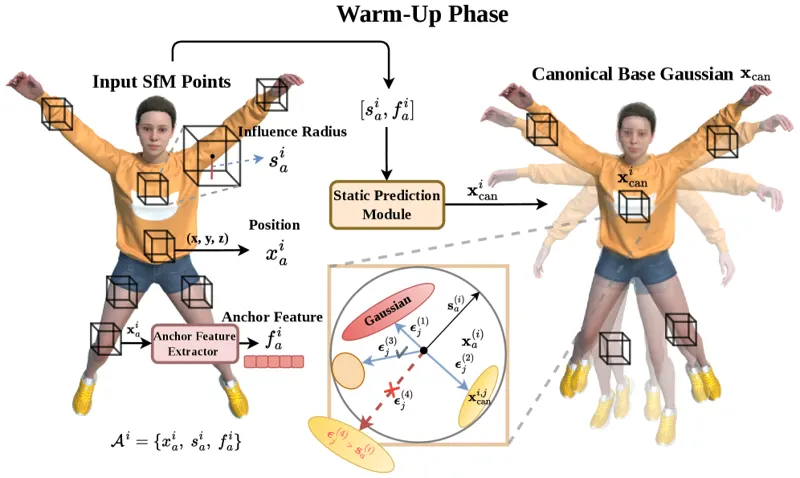
Dynamic scene reconstruction with 3D Gaussian Splatting requires a balance between fine-grained motion modeling, structural stability, and compact representation. Existing per-primitive methods provide flexible local deformation but often suffer from redundant primitive growth, while anchor-based methods improve spatial regularity at the cost of suppressing locally varying motion. To address these issues, we present GrainGS, a dynamic Gaussian framework that combines a hierarchical anchor scaffold with per-Gaussian deformation. A static warm-up stage first establishes a time-invariant canonical representation from observations across all timestamps. During joint training, a stop-gradient operation blocks the deformation-mediated gradient pathway to the canonical positions while preserving their direct refinement through the reconstruction objective. Each Gaussian then predicts independent temporal offsets for position, rotation, and scale, enabling detailed local motion within a structurally constrained scaffold. A canonical-residual appearance decomposition further models frame-dependent photometric changes without forcing them into geometric deformation. Experiments on synthetic monocular and real-world multiview benchmarks show that GrainGS achieves high reconstruction quality, real-time novel view synthesis, and compact storage. Under the synthetic benchmark setting, it reaches an average peak signal-to-noise ratio of 36.98 decibels, renders at 435.6 frames per second, and requires 4.67 megabytes of storage.

3D Gaussian SplattingDynamic SceneNovel view synthesisJiahao He, Yihua Shao, Zhengkai Zhao · 279 views · Jul 23, 2026
GS-Agent: Creating 4D Physical Worlds With Generative Simulation

GS-Agent: Creating 4D Physical Worlds With Generative Simulation

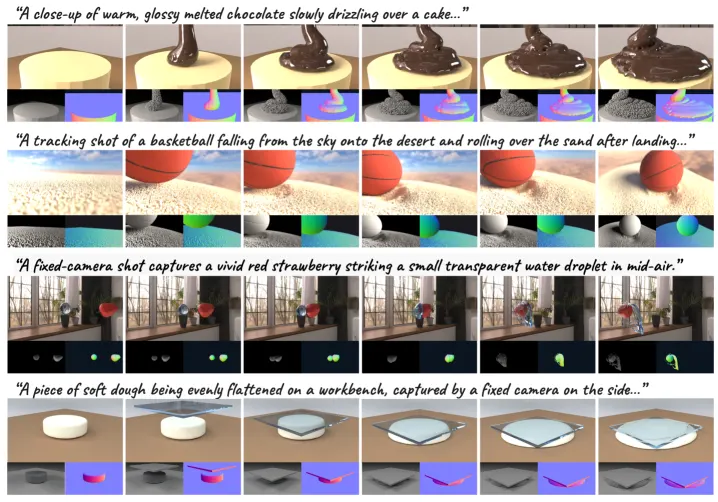
Creating dynamic and physically realistic 4D worlds from natural language descriptions is both fascinating and challenging. Traditional computer graphics methods rely on manual creation, requiring extensive human effort to fine-tune materials, motions, and visual fidelity. Recent advances in generative foundation models have sparked interest in learning to generate such 4D worlds from large-scale data; however, existing methods still struggle to ensure physical plausibility and controllability. In this work, we take a different path by leveraging foundation models to construct an agentic system that emulates how humans traditionally create 4D worlds, yet automates the entire process. We present GS-Agent, an end-to-end multi-agent framework that integrates physics engines in the loop to generate realistic, dynamic, and controllable 4D physical worlds from natural language. Inspired by how humans build 4D worlds, GS-Agent decomposes the task into entity management, covering 3D asset curation, material tuning, placement, and motion control, and rendering configuration, including camera and lighting manipulation. Multiple agents with distinct expertise interact with the physics engine via code, seek multimodal feedback, and collaborate to iteratively construct 4D worlds that align with the given descriptions. Experimental results show that GS-Agent effectively converts natural language into diverse and physically plausible 4D worlds exhibiting rich interactions among liquids, deformable objects, and rigid bodies, while achieving cinematic camera and lighting control. We envision GS-Agent as a foundation for a new paradigm in 4D world generation, empowering creative content creation and physical AI. Project page at https://umass-embodied-agi.github.io/gs-agent/

3D Gaussian Splatting4D GenerationWorld ModelsHongxin Zhang, Chunru Lin, Junyan Li · 405 views · Jul 23, 2026
World Translation: Minimizing Sim-to-Real Gap with Backward Dynamics Extraction and Unpaired Domain Translation

World Translation: Minimizing Sim-to-Real Gap with Backward Dynamics Extraction and Unpaired Domain Translation

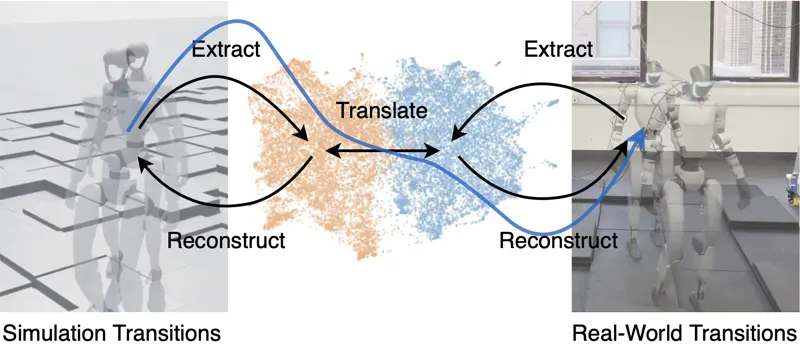
The gap between simulation and reality remains a fundamental challenge in deploying simulation-trained robotic policies in the real world. Real-to-sim methods narrow this gap from the real side, learning transition dynamics from real data to build a more realistic digital world. Learned dynamics models are their dominant instance. Such methods, however, face a partial observability problem: the same observation may branch to different transitions due to unobservable factors. Existing methods assume these factors can be recovered from observation history. However, this may fail whenever observation history is uninformative, such as a sudden contact event with no prior warning. To address this limitation, we propose World Translation, which exploits a complementary strength of simulators and learned dynamics. Simulators are deterministic but physically imperfect, while learned models are accurate but underdetermined under partial observability. Rather than predicting transitions forward from history, we extract the unobservable dynamics information backward from an observed transition, then translate this feature across simulation and reality as an unpaired domain-translation problem that preserves dynamics content while transferring domain style. Experiments across humanoid, quadruped, and manipulator platforms show that our method achieves more accurate dynamics modeling than baselines, with the largest gains when unobservable factors cannot be recovered from observation history. Real-robot deployment on Go2 quadruped confirms improved policy transfer.

Sim-to-RealDomain AdaptationWorld ModelsXinchen Yao, Leixin Chang, Hua Chen · 367 views · Jul 20, 2026
Learning Adaptive Safety Margins for Visual Navigation

Learning Adaptive Safety Margins for Visual Navigation

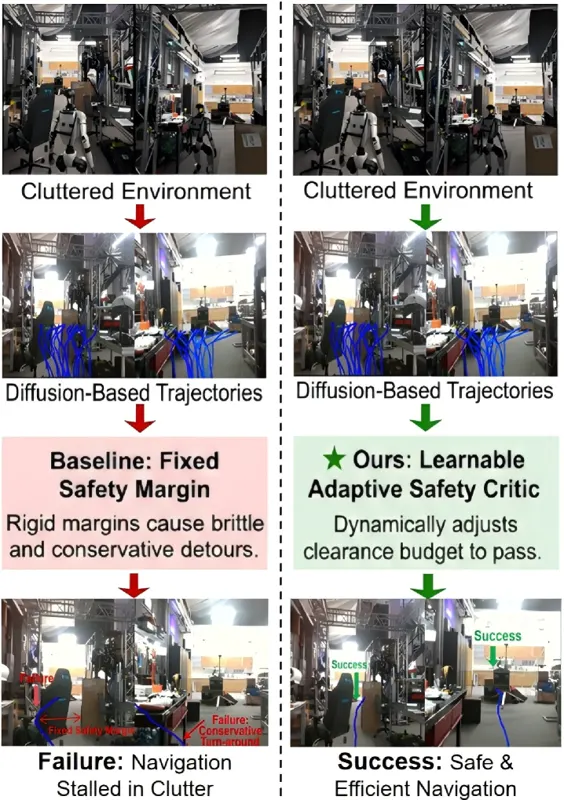
Robots in cluttered indoor spaces often fail not because they cannot generate collision-free paths, but because a fixed safety margin is mis-calibrated: conservative margins cause detours and timeouts, while permissive margins lead to near-boundary shortcuts under perception bias. Diffusion-based planners propose diverse trajectory candidates from egocentric RGB-D, yet reliable selection remains the bottleneck. We propose a context-conditioned safety critic that learns an adaptive clearance preference for ranking diffusion proposals, decomposed into three complementary terms: (i) a safety term with a clearance-budget penalty and a control-barrier-function residual for waypoint- and transition-wise safety, (ii) an efficiency term combining a smoothness penalty with a safety-gated detour-ratio penalty that avoids detours without incentivizing risky shortcuts, and (iii) a distance-constraint matching term that anchors the learned budget to realized ESDF clearances to prevent margin collapse. We train the critic with privileged ESDF geometry in simulation and distill it into a perception-only selector via a two-stage teacher-student procedure. On PointGoal navigation in HM3D and MP3D, including cross-dataset transfer, our method achieves the highest success rate (SR) and success weighted by path length (SPL) among strong diffusion, optimization, and RL baselines. Trained purely in simulation, it transfers to a Unitree G1 humanoid and navigates cluttered indoor scenes without task-specific tuning.

Visual navigationSafety MarginPath PlanningJunyi Hu, Shuaihang Yuan, Geeta Chandra Raju Bethala · 331 views · Jul 20, 2026
Agentic Real2Sim: Physics-based World Modeling with Vision-Language Agents

Agentic Real2Sim: Physics-based World Modeling with Vision-Language Agents

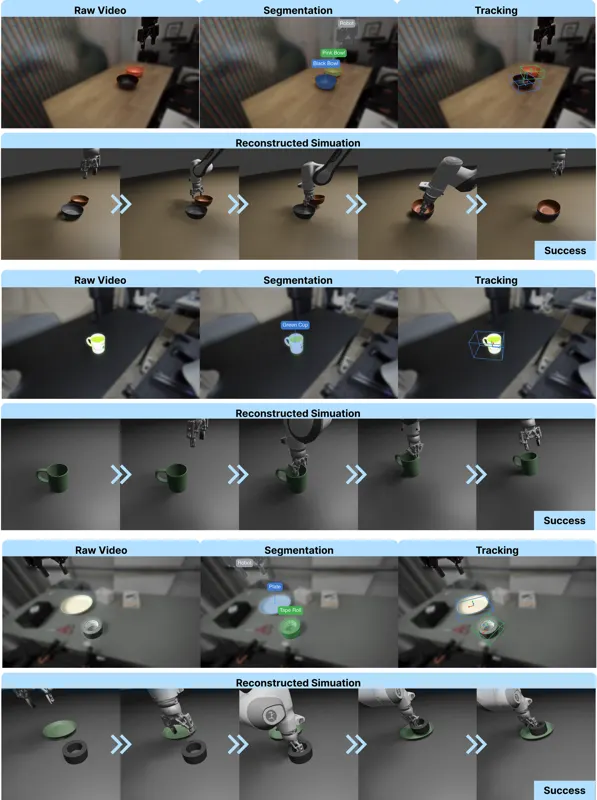
Real-to-sim conversion for robotic interaction with objects remains labor-intensive because it requires more than visual reconstruction: a streamlined real2sim process must recover scene geometries and object states, infer physical parameters, and assemble actors, objects, cameras, poses, and trajectories into a runnable physical simulation. Today this process still depends on manual tuning of visual foundation models, mesh cleanup, coordinate-frame alignment, and brittle workflow glue across visual perception tools and simulators. We introduce Agentic Real2Sim, a framework for generalized physical world modeling with vision-language agents, converting a real-world recording of object-robot interaction into a simulatable episodic twin which preserves observations, geometries, robot interactions, and object states. We evaluate Agentic Real2Sim on rigid-object manipulation, deformable-object interaction, and humanoid motion scenes, spanning domains that are usually handled by separate Real2Sim pipelines, marking a first step toward scalable conversion. The framework's agentic decisions can be driven by an open-weight VLM backend at a small fraction of the cost of frontier models, while attaining comparable conversion success rate. We aim to use the resulting real-world-aligned twins for downstream robotics tasks, specifically policy learning and evaluation. The project site is available at https://agentic-real2sim.github.io/.

Sim-to-RealWorld ModelsVision-language modelsGuanxiong Chen, Qianjun Xia, Jiawei Peng · 339 views · Jul 21, 2026
What Matters in Humanoid General Motion Tracking? An Empirical Study

What Matters in Humanoid General Motion Tracking? An Empirical Study

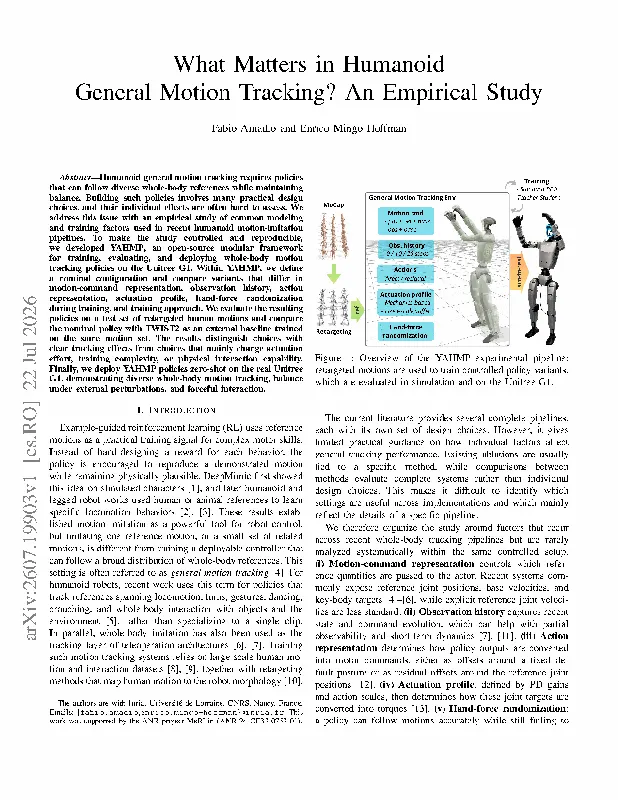
Humanoid general motion tracking requires policies that can follow diverse whole-body references while maintaining balance. Building such policies involves many practical design choices, and their individual effects are often hard to assess. We address this issue with an empirical study of common modeling and training factors used in recent humanoid motion-imitation pipelines. To make the study controlled and reproducible, we developed YAHMP, an open-source modular framework for training, evaluating, and deploying whole-body motion tracking policies on the Unitree G1. Within YAHMP, we define a nominal configuration and compare variants that differ in motion-command representation, observation history, action representation, actuation profile, hand-force randomization during training, and training approach. We evaluate the resulting policies on a test set of retargeted human motions and compare the nominal policy with TWIST2 as an external baseline trained on the same motion set. The results distinguish choices with clear tracking effects from choices that mainly change actuation effort, training complexity, or physical interaction capability. Finally, we deploy YAHMP policies zero-shot on the real Unitree G1, demonstrating diverse whole-body motion tracking, balance under external perturbations, and forceful interaction.

HumanoidMotion TrackingEmpirical StudyFabio Amadio, Enrico Mingo Hoffman · 289 views · Jul 22, 2026
Extreme-RGMT: Continual Learning of Highly Dynamic Skills for Robust Generalist Humanoid Control

Extreme-RGMT: Continual Learning of Highly Dynamic Skills for Robust Generalist Humanoid Control

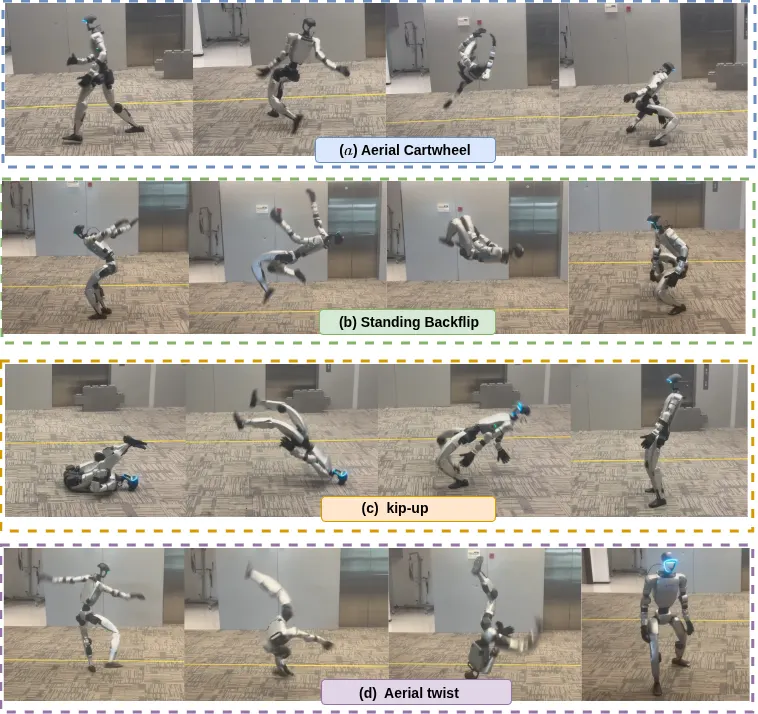
Humans can progressively acquire highly dynamic motor skills while preserving reliable everyday motor abilities. In contrast, existing humanoid controllers face a trade-off between generalist and specialist capabilities: generalist motion tracking policies struggle to reliably execute rare highly dynamic motions, whereas specialist training can degrade previously acquired behaviors. We introduce Extreme-RGMT, a two-stage continual learning framework for robust generalist humanoid control. The method first learns a generalist motion-tracking base policy from diverse multi-source motion data, then employs an asymmetric skill acquisition and capability consolidation mechanism to constrain policy drift on mastered motions while emphasizing difficult dynamic segments. To address the scarcity of highly dynamic motions, their high failure rates, and the resulting shortage of informative samples, Extreme-RGMT combines difficulty-aware sampling with advantage-prioritized trajectory resampling to emphasize critical segments. Experiments show that Extreme-RGMT achieves state-of-the-art generalist whole-body motion-tracking performance, including substantially improved completion of challenging highly dynamic motions. The resulting controller directly executes diverse unseen highly dynamic motions under fixed references and online inertial motion-capture inputs, advancing generalist whole-body motion-tracking controllers toward highly dynamic motor capabilities at the human-expert level.

HumanoidContinual learningMotion ControlYubiao Ma, Han Yu, Kai Guo · 345 views · Jul 22, 2026
STeP: Signal Temporal Logic for Precise Specifications for Action Generation with Vision Language Models

STeP: Signal Temporal Logic for Precise Specifications for Action Generation with Vision Language Models

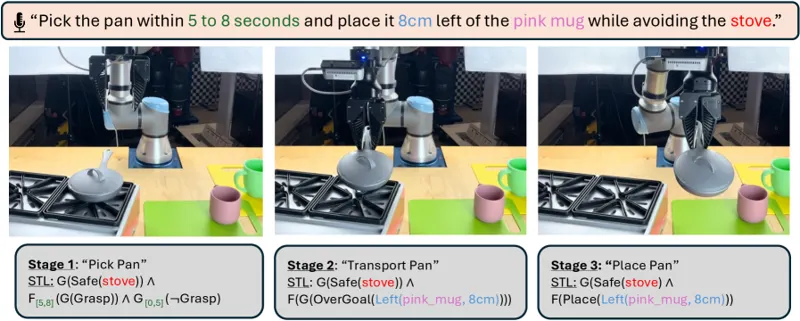
Vision-language-action (VLA) models have shown impressive generalization, but often lack interpretability and can struggle to follow precise natural language instructions that encode spatial, temporal, and logical requirements. We propose a hierarchical framework that uses Signal Temporal Logic (STL) as a shared representation connecting high-level language understanding with low-level robot execution. A high-level policy leverages a VLM to decompose language instructions into high-level subtasks, generate STL specifications for each subtask, and choose a low-level policy for executing each subtask. The STL specifications translate language-derived intent into precise constraints, and the low-level policy selection determines whether those constraints are enforced directly through STL-guided model-predictive control or monitored during execution of a learned policy for perceptually complex, or contact-rich behaviors. By integrating STL into plan validation, low-level policy, subtask monitoring, and replanning, our framework enables language-derived plans to be checked, optimized, and revised at runtime using a common formal structure. We evaluate the approach on a real-world tabletop domain, demonstrating how formal specifications can improve the precision, reliability, and interpretability of language-conditioned robot planning.

Vision-language modelsTemporal LogicMotion GenerationKasra Torshizi, Anukriti Singh, Sidharth Mathur · 337 views · Jul 20, 2026
RoboInter1.5: A Holistic Intermediate Representation Suite for Embodied World Modeling and Robotic Manipulation

RoboInter1.5: A Holistic Intermediate Representation Suite for Embodied World Modeling and Robotic Manipulation

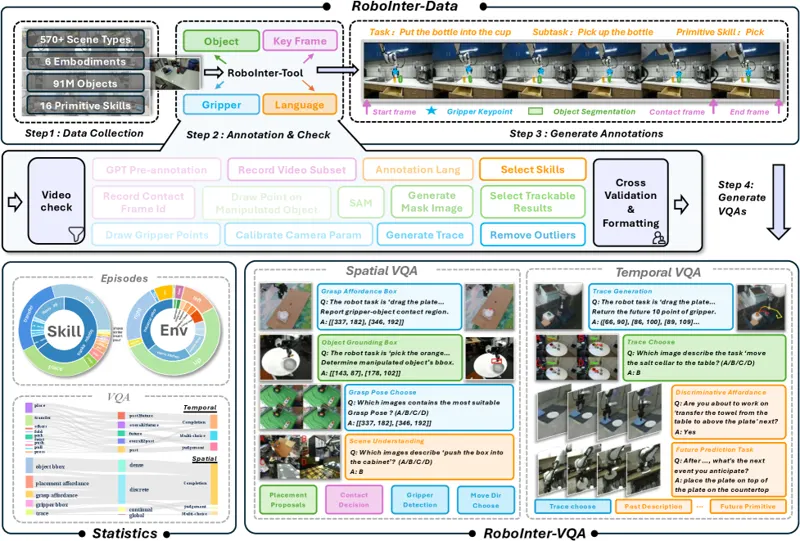
Existing robot datasets remain expensive to curate, embodiment-specific, and insufficiently annotated with the fine-grained structure required for generalizable reasoning, execution, or long-horizon environment dynamics simulation. Building on our prior work, RoboInter1.0, we present RoboInter1.5, an extended and holistic suite of intermediate representations for both robotic manipulation and embodied world modeling. RoboInter1.5 provides a unified resource of data, benchmarks, and models centered on dense manipulation-oriented intermediate representations. Specifically, RoboInter-Data contains over 230k manipulation episodes across 571 scenes with dense per-frame annotations covering more than ten types of intermediate representations, including subtasks, primitive skills, object and gripper grounding, segmentation, affordance, grasp poses, contact points, motion traces, etc. Built upon these annotations, RoboInter-VQA introduces spatial and temporal embodied VQA tasks to benchmark and improve the intermediate-representation reasoning capabilities of our RoboInter-VLM. RoboInter-VLA further studies how such representations benefit action execution through implicit, explicit, and modular plan-then-execute paradigms. To better model the physical world, we further introduce RoboInter-World, which leverages intermediate representations as structured conditioning signals for controllable prediction of future world states. Extensive evaluations demonstrate that RoboInter1.5 provides a unified spatiotemporal scaffolding for intermediate representations. Rather than treating intermediate representations merely as interpretable signals, RoboInter1.5 conceptualizes them as a bidirectional interface that both regularizes low-level action spaces and constrains the latent rollouts of open-world physical simulators.
Robot InteractionRepresentation LearningIntermediate RepresentationZiqin Wang, Hao Li, Weijun Wang · 256 views · Jul 21, 2026

As an Amazon Associate, we earn from qualifying purchases.