Skip to content
When to Plan: Learning to Select Between Reactive Control and Deliberative Planning

When to Plan: Learning to Select Between Reactive Control and Deliberative Planning

It has long been recognized that humans have the ability to switch between fast, reactive decision-making and slower, deliberative planning. In this paper, we study the question of how to learn this ability, known as meta-reasoning, in artificial agents. We model reactive decision-making as a policy that directly maps state observations to actions. Such policies can be trained with reinforcement learning (RL) or imitation learning, but may generalize poorly outside of their training distribution. Alternatively, model-based decision-time planning is more likely to produce good actions across a broader set of states but requires additional computation time, which delays acting. In this work, we introduce an RL method for training a meta-reasoning policy that allocates computation by conditioning on a reactive-policy uncertainty score. This score enables it to predict when the reactive policy is likely to perform poorly and when planning is needed. We conduct an empirical study on motion planning and navigation environments, showing that this design enables the meta-reasoning policy to learn when the reactive policy provides a good-enough action versus when decision-time planning is needed. Additionally, we show that our design enables the meta-agent to shift toward fully reactive control as the reactive policy improves.

PlanningReaction ControlPolicy SelectionAdam Labiosa, Josiah P. Hanna · 378 views · Jul 17, 2026
Scalable Causal Imitation Learning

Scalable Causal Imitation Learning

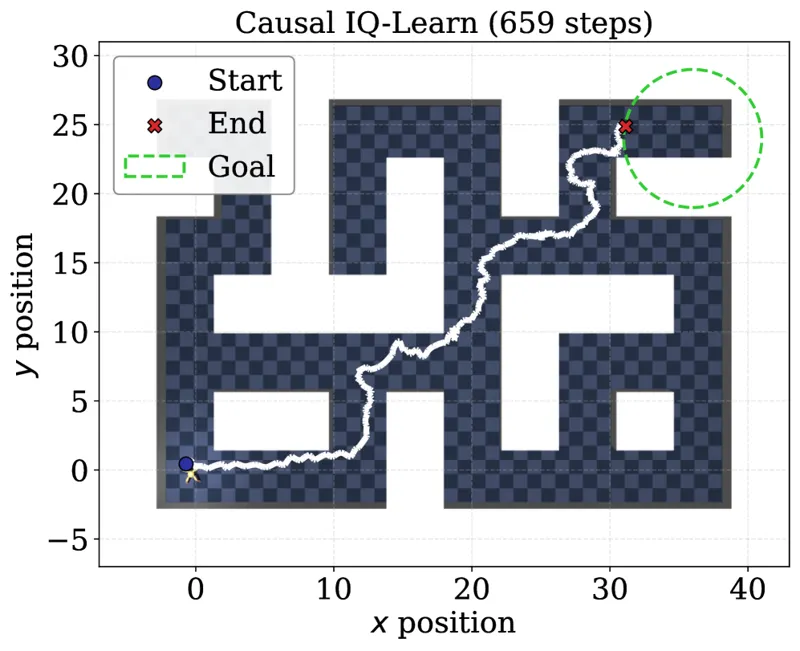
Imitation learning enables learning a policy in an unknown environment with a latent reward signal using expert demonstrations, but it struggles when the imitator's and expert's observations are mismatched and unobserved confounders are present in expert demonstrations. By identifying appropriate adjustment sets via the sequential π-backdoor criterion, causal imitation learning (CIL) provides a framework for approximating the expert's policy from confounded data. However, existing CIL methods, Causal Behavioral Cloning (Causal BC) and Causal Generative Adversarial Imitation Learning (Causal GAIL), are designed for short-horizon, low-dimensional settings. When applied to continuous control tasks with long horizons and high-dimensional state-action spaces, these methods exhibit poor performance: Causal BC suffers from compounding errors, Causal GAIL is unstable and sample-inefficient, and sequential π-backdoor adjustment becomes impractical. We introduce Causal Soft Q Imitation Learning (SQIL) and Causal Inverse soft-Q Learning (IQ-Learn), two off-policy causal imitation learning algorithms that combine the causal adjustment framework with state-of-the-art inverse reinforcement learning objectives. Both algorithms operate on causally-adjusted state representations produced by an efficient approximation of the sequential π-backdoor criterion, exploiting the causal structure of continuous control environments to reduce the full-horizon adjustment to a fixed-size sliding window. We evaluate all methods in a suite of confounded environments and find that Causal SQIL and Causal IQ-Learn substantially outperform prior CIL algorithms on long-horizon tasks, sometimes surpassing the expert, whereas all causally unaware imitation methods fail to learn meaningful behavior.

Imitation LearningCausal InferenceDistribution ShiftEylam Tagor, Mingxuan Li, Elias Bareinboim · 310 views · Jul 18, 2026
Asynchronous Multimodal Diffusion Policy Composition via Latency-Aware Guidance Fusion

Asynchronous Multimodal Diffusion Policy Composition via Latency-Aware Guidance Fusion

Diffusion policies have shown strong potential for robotic imitation learning, and recent extensions incorporate additional modalities to improve manipulation performance. However, these modalities often differ not only in information content but also in sensing rates and inference latencies. Existing multimodal diffusion policies typically rely on synchronous fusion or manually designed multi-frequency architectures, which either slow down high-frequency feedback or limit extensibility to new modality combinations. We propose LAG-Fusion, a latency-aware guidance fusion framework for asynchronous multimodal diffusion policy composition. LAG-Fusion allows modality-specific policies to operate at their native inference rates and contribute denoising guidance whenever available. To make asynchronous composition consistent, we derive a reference-frame rebasing rule for diffusion variables under relative action representations, enabling delayed guidance to be aligned before fusion. We instantiate LAG-Fusion in contact-rich manipulation by composing a low-frequency vision policy with a high-frequency force policy. Experiments under heterogeneous modality latencies show that LAG-Fusion improves policy responsiveness and task performance over synchronous fusion and specially designed force-aware baselines.

Diffusion policiesMultimodalLatencyZihao He, Hongjie Fang, Shirun Tang · 321 views · Jul 19, 2026
MEVION: Low-Cost Open-Source Data Collection System for Powerful and High-Speed Dual-Arm Manipulation

MEVION: Low-Cost Open-Source Data Collection System for Powerful and High-Speed Dual-Arm Manipulation

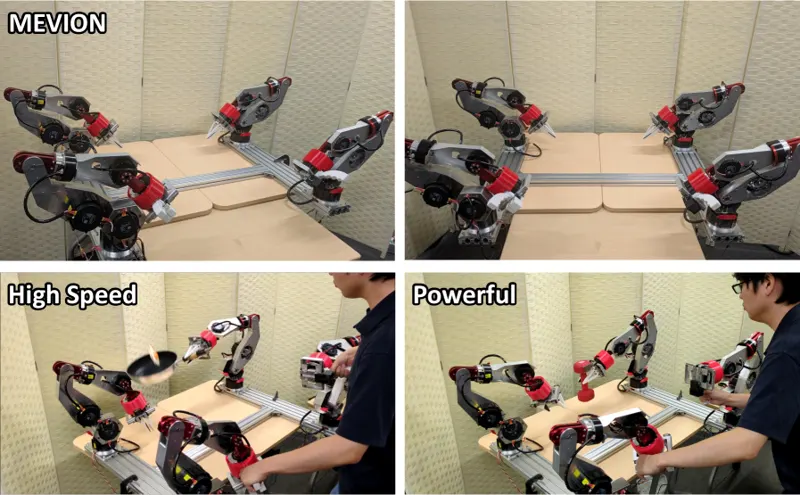
The global competition for developing robotic foundation models is intensifying. Among the data collection systems used for dual-arm robots, ALOHA is representative of being low-cost and open-source, and is widely adopted by researchers as a de facto standard. However, due to its limited ability to generate high forces and speeds, it is difficult to handle heavy objects or perform fast manipulations. To address this, we developed MEVION, a low-cost and open-source dual-arm robot data collection system capable of generating greater force and speed. All parts of this robot can be sourced through e-commerce, and by extensively utilizing sheet metal welding, its large body structure is constructed with a small number of components at low cost, while also simplifying assembly. MEVION is equipped with four 6-DoF arms with parallel grippers. Each arm weighs 7.0 kg and has a maximum torque of 60 Nm, and the entire system can be constructed for about USD 14,000. The elbow joint adopts a closed-link mechanism similar to those used in quadruped robots, which reduces the distal mass and enables higher force and speed output at the end-effector. We demonstrate that MEVION enables data collection for object manipulation tasks not previously possible and supports imitation learning-based motion generation. All hardware and software of this work are included in the Supplementary Materials or https://github.com/haraduka/mevion.

Data CollectionDual-ArmOpen SourceKento Kawaharazuka, Yoshiki Obinata, Hirokazu Ishida · 354 views · Jul 20, 2026
PAVXploreRL: Physical-Action-Visual World Model Reinforcement Learning with Action Exploration

PAVXploreRL: Physical-Action-Visual World Model Reinforcement Learning with Action Exploration

Action-conditioned world models are a key component of embodied AI, serving as scalable policy evaluators that reduce reliance on expensive real-world rollouts. To accurately capture diverse action-induced dynamics, such models should satisfy three key objectives-Physical Plausibility (P), Action Adherence (A), and Visual Fidelity (V), collectively referred to as PAV-while remaining robust to both in-distribution (ID) expert demonstrations and out-of-distribution (OOD) actions. However, existing methods primarily rely on ID action-video pairs and pixel-level reconstruction losses, which do not explicitly optimize PAV objectives and generalize poorly beyond expert data. To address this, we propose PAVXploreRL, a reinforcement learning framework built on a pretrained latent world model that explicitly optimizes PAV objectives through reward-driven training. To improve action generalization, our method jointly leverages ID trajectories and noise-driven OOD action exploration, without paired video supervision. Experiments show that PAVXploreRL consistently outperforms pretrained baselines, achieving a 5.6% average gain across benchmarks and producing higher-quality PAV properties. As a policy evaluator, it also yields more reliable performance estimates and reduces the overestimation bias of prior expert-only world models such as Ctrl-World. Code: https://github.com/Social-AI-Studio/PAVXploreRL

World ModelsReinforcement LearningAction ExplorationHan Wang, Zijun Wang, Shuoshuo Xue · 218 views · Jul 18, 2026
Athena-Brain Technical Report: An Efficient Robot Brain for General Intelligence and Embodied Interaction

Athena-Brain Technical Report: An Efficient Robot Brain for General Intelligence and Embodied Interaction

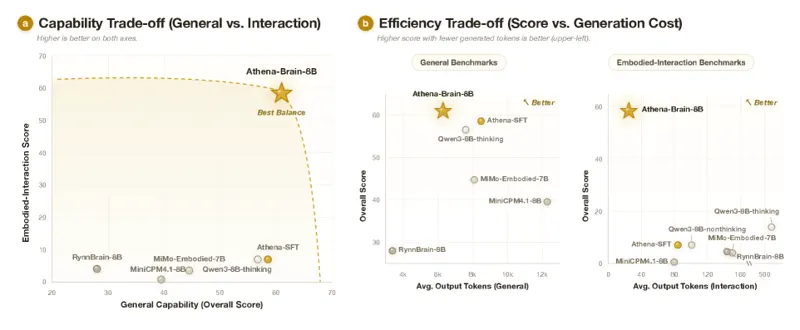
Large language models (LLMs) have demonstrated remarkable capabilities in language understanding, reasoning, and world knowledge. As embodied agents become increasingly capable, there is a growing demand for compact models that can serve as an on-device brain, preserving the broad general intelligence of LLMs while enabling effective high-level interaction with embodied environments. Existing approaches, however, often prioritize either general-purpose intelligence or specialized embodied capabilities, making it challenging to satisfy both requirements within a single model. We present Athena-Brain-8B, an 8B LLM designed to serve as an on-device brain for embodied intelligence for embodied intelligence. Through a multi-stage post-training pipeline consisting of General Supervised Fine-Tuning, General Reinforcement Learning, Embodied Expert training, and Model Merge, Athena-Brain-8B maintains strong general capabilities while acquiring strong high-level embodied interaction capabilities and generating concise responses for efficient embodied interaction. Experimental results demonstrate the effectiveness of Athena across both general and embodied evaluations. Compared with the corresponding Qwen3-8B thinking model, Athena-Brain-8B achieves comparable performance on general language and reasoning benchmarks while generating substantially shorter responses. On in-domain embodied benchmarks, Athena-Brain-8B consistently outperforms models of similar scale and surpasses several substantially larger frontier models evaluated zero-shot, demonstrating that compact language models can effectively integrate strong general intelligence with embodied capabilities.

Embodied AIRobot BrainGeneral Purpose IntelligenceJialian Li, Junhong Liu, Yuchen Cao · 226 views · Jul 21, 2026
EA-Nav: Learning Safe Visual Navigation Policies with Embodiment Awareness

EA-Nav: Learning Safe Visual Navigation Policies with Embodiment Awareness

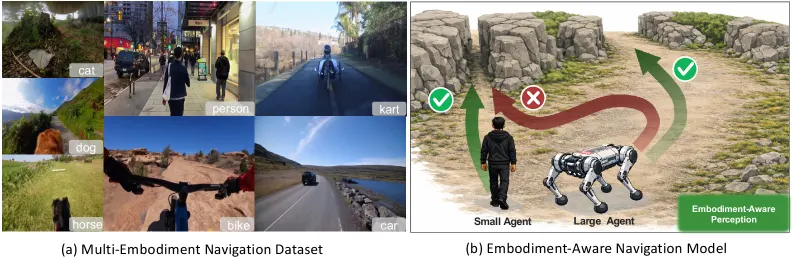
Cross-embodiment navigation is a key challenge in embodied intelligence. Due to differences in embodiment, the same visual observation may imply different actions for different agents, making prediction ambiguous when relying solely on vision. Existing studies mainly rely on reinforcement learning, which requires large-scale interaction and careful reward design, making it difficult to support scalable pretraining and real-world adaptation. In contrast, imitation-learning-based approaches remain limited. To address these challenges, we propose an imitation-learning-based embodiment-aware navigation framework with a modular multi-stage design. In pretraining, we construct a cross-embodiment navigation dataset from Internet videos and introduce embodiment geometry as conditional tokens to reduce action ambiguity under the same observation. In fine-tuning, we design a multimodal information injection mechanism based on a decoupled architecture. Specifically, we design a trajectory augmentation strategy to generate high-risk samples, which are used to train spatial perception and risk-aware correction separately, thereby explicitly incorporating embodiment geometry for safe navigation. Experimental results show that the proposed method effectively improves navigation performance across different embodiment settings, demonstrating the effectiveness of incorporating embodiment geometry into embodied navigation.

Visual navigationBody-AwarenessSafetyJialu Zhang, Yong Du, Xianda Guo · 297 views · Jul 22, 2026
Look Before You Edit: Attention-Guided Camera Placement and Multi-View Alignment for 3D Gaussian Splatting Editing

Look Before You Edit: Attention-Guided Camera Placement and Multi-View Alignment for 3D Gaussian Splatting Editing

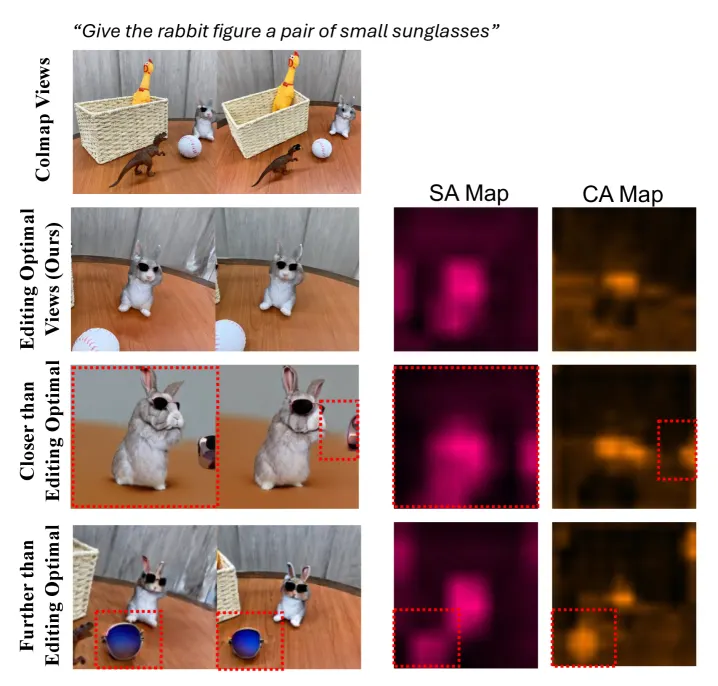
Text-driven 3D scene editing with 3D Gaussian Splatting (3DGS) typically applies a 2D diffusion editor to views rendered from fixed training cameras, limiting both the spatial coverage of edits and the user's freedom to target specific objects in complex scenes. We present LB-Edit, a framework that addresses two coupled problems: where to place editing cameras for localized edits, and how to make per-view edits agree with one another so that the 3D scene remains consistent after fine-tuning. First, Attention-Guided Editing Camera Placement (ACP) probes the diffusion model's self- and cross-attention at multiple candidate camera distances to find where attention is well-contained in the region of interest, then places a compact, geometrically diverse editing camera set at that attention-optimal distance. Second, Multi-view Attention Alignment (MAA) steers the editor toward the same edit across views along two axes: it aligns appearance by sharing self-attention features via token-level correspondence, and aligns spatial location by lifting cross-attention maps onto the 3D Gaussians as a shared 3D attention field, suppressing both appearance and spatial drift. Experiments on multi-object and single-object scenes show that our method achieves the highest user preference in instruction fidelity, multi-view consistency, and editing locality, using as few as 5 editing views and reducing latency by up to 7x over existing methods.

3D Gaussian SplattingScene EditingCamera PlacementJaeyeon Park, Taeho Kang, Youngki Lee · 287 views · Jul 22, 2026
ATSplat: Compact Feed-forward 3D Gaussian Splatting with Adaptive Token Expansion

ATSplat: Compact Feed-forward 3D Gaussian Splatting with Adaptive Token Expansion

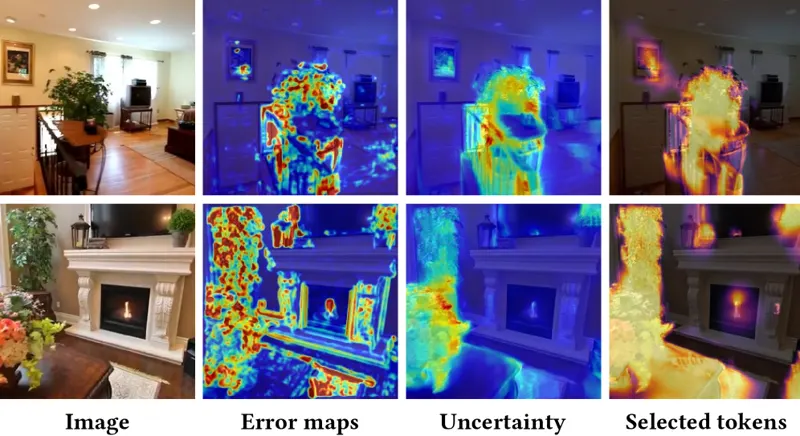
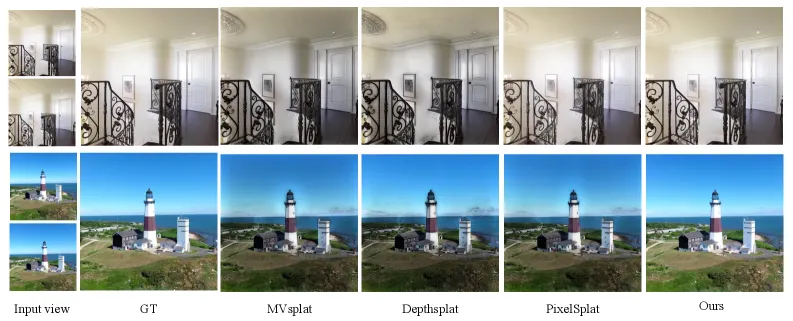
3D Gaussian Splatting (3DGS) achieves high-quality novel-view synthesis by optimizing freely placed primitives in 3D and adaptively densifying them in under-reconstructed regions. However, this scene-adaptive capacity allocation is largely lost in existing feed-forward 3DGS methods, which commonly regress Gaussians at input pixels and lift them along camera rays. Such pixel-aligned formulations make the number and placement of primitives depend on image resolution and input viewpoints rather than scene complexity, resulting in dense and often redundant Gaussian sets. We present ATSplat, a feed-forward 3DGS framework that restores the adaptive allocation capability of 3DGS optimization through Adaptive 3D Tokens. ATSplat first lifts coarse patch-level depth and camera cues into sparse 3D anchor tokens, forming a compact scaffold of the scene. Each token is then regressed into local Gaussians with learnable 3D offsets, decoupling primitive placement from input image grids. An Adaptive Token Expansion module predicts a token-level uncertainty score, supervised by rendering error maps, and selectively expands high-uncertainty tokens through learnable expansion layers. This sparse-to-adaptive formulation enables ATSplat to concentrate primitives in challenging regions while maintaining a compact representation. Experiments on two representative datasets, RealEstate10K and DL3DV, show that ATSplat achieves state-of-the-art rendering quality while reducing the number of Gaussians by more than 5.7× compared with dense feed-forward 3DGS methods. From 12 input images at 512 × 960 resolution, ATSplat completes reconstruction in less than a second using a single commercial GPU, and renders high-quality novel views at 1136 FPS (512 × 960) with only 311K Gaussians.

3D Gaussian SplattingtokenFeedforwardCho In, Jeonghwan Cho, Mijin Yoo · 350 views · Jul 22, 2026
GLAM-SLAM: Real-time Gaussian Large-scale Mapping via Flow Densification and Spatial Decomposition

GLAM-SLAM: Real-time Gaussian Large-scale Mapping via Flow Densification and Spatial Decomposition

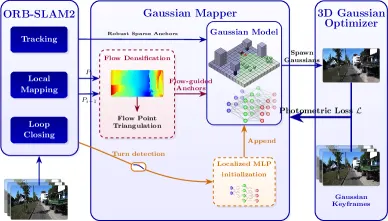
Existing Gaussian-splatting-based monocular Simultaneous Localization and Mapping (SLAM) systems are either tailored to short sequences, are not real-time, or suffer from prohibitive GPU memory requirements, limiting their applicability in realistic, long-horizon scenarios. To address this, we present GLAM-SLAM, a real-time, decoupled Gaussian-splatting SLAM system designed for large-scale outdoor scenes. We ensure lightweight tracking using a robust, feature-based SLAM frontend, while for mapping, we adopt a structured, sparse anchor grid representation that ensures scalable operation and maintains scene coherence across long-term sequences. To satisfy the dense initialization requirements of 3D Gaussian Splatting (3DGS), we introduce a geometry-based flow-densification anchoring strategy using epipolar constraints. Furthermore, by treating mapping as a multi-scene problem, we propose a scene-partitioning strategy that introduces a strong spatial inductive bias via MLP initializations to generate localized Gaussians. We evaluate our system on the challenging, long-sequence KITTI Odometry, Oxford RobotCar, and M'alaga datasets. Extensive ablations and comparisons demonstrate a 15% improvement in reconstruction quality over the second-best performer, while maintaining real-time performance and the ability to scale to longer sequences. Code is publicly available for the benefit of the community.
3D Gaussian SplattingSLAMReal-TimePanagiotis Mermigkas, Argyris Manetas, Petros Maragos · 364 views · Jul 23, 2026

As an Amazon Associate, we earn from qualifying purchases.