PAPER DEEP DIVE
ChairNav: Cross-Embodiment Pre-training and Personalization for Long-Horizon Wheelchair Navigation
ChairNav adapts a visual navigation foundation model to an RGB-D electric wheelchair through cross-embodiment pre-training, wheelchair mid-training, and preference-based post-training from interventions. On a 1.61 km route it drove autonomously for 93.4% of driving time, while the all-drive aggregate reached 84.9%.
Authors: Junhua Huang, Zhizheng Liu, Honglin He, Xiang Zhang, and Bolei Zhou.
Affiliations: University of California, Los Angeles; Louisiana State University.
Paper: arXiv:2610.24012. Project page: vail.cs.ucla.edu/ChairNav.
Code status: The authors provide a public GitHub repository, but at commit 6ac142d it contains only the static project website, media, citation data, and a research-demo design note. No training code, inference code, model weights, dataset-processing pipeline, or wheelchair-control implementation is released. The paper-to-code claims below therefore stop at the published method and system description.
One-sentence summary
ChairNav adapts large-scale delivery-robot navigation data to a wheelchair by jointly transforming camera visibility and vehicle dynamics, then uses small in-domain demonstrations and delayed rider takeovers to produce a personalized, long-horizon sidewalk policy.
Why outdoor wheelchair autonomy is a distinct problem
A wheelchair is not merely a slow car or a small mobile robot. It shares sidewalks with pedestrians, bicycles, strollers, dogs, construction signs, delivery carts, and parked scooters. The traversable region can narrow abruptly from several meters to roughly the width of the chair. A harmless-looking patch of brick may hide a tree pit or a drainage cover. Shadows can erase the visual boundary between pavement and grass. The destination may be a neighborhood route rather than a mapped building corridor. These conditions make local visual judgment central, while the cost of a lateral mistake is immediate and personal.
Much prior work keeps the rider continuously in control through shared autonomy. The system filters joystick commands or intervenes before a collision, but the person still has to monitor the route and provide intent. This can improve safety without reducing attention burden. Another line of work builds full autonomous wheelchairs from modular localization, mapping, planning, and control. Some systems achieve kilometer-scale operation, but often require landmark maps, prior 3D models, RTK waypoints, commercial route data, or a sensor stack that is difficult to transfer to an everyday chair. The paper notes that a survey of 132 robotic wheelchairs found only five intended for both indoor and outdoor use.
Visual navigation foundation models offer a different tradeoff. They learn local traversability and trajectory priors from heterogeneous robot demonstrations and can run with a camera plus onboard compute. Systems such as GNM, ViNT, NoMaD, and FlowPilot show that this paradigm transfers across environments. It does not automatically transfer across embodiments. A delivery robot may have a camera only 0.44 m above the ground, a narrow chassis, and a smooth differential-drive response. The ChairNav platform carries its camera at 1.47 m with a 27.7 degree downward pitch, is 0.72 m wide, and has different inertia, turning behavior, and slope response. Both what the policy sees and which actions it considers feasible are shifted.
The paper also treats personalization as a data problem rather than a generic style layer. Riders differ in how far they stay from a curb, how quickly they approach turns, and how much clearance they want around obstacles. The same rider can make different choices in rain, at night, or in a crowded corridor. A deployed wheelchair must start from useful general behavior and then improve from feedback produced by the actual person using it. Collecting hundreds of hours of demonstrations for every rider is unrealistic, so ChairNav asks how a large source corpus can be reused without pretending that source and target are identical.
The proposed answer is a three-level data pyramid. Large cross-embodiment data creates broad visual and trajectory priors. A much smaller wheelchair corpus corrects the remaining embodiment gap. A yet smaller set of online takeovers aligns local decisions with one user. Each layer has a different transformation or objective, and each layer is evaluated separately. This structure is the main conceptual contribution: it assigns data to the problem it can actually solve.
Background: anchored flow matching and preference optimization
The policy builds on FlowPilot's anchored flow-matching design. Instead of treating the future as one unimodal sequence, the model classifies the observation over 64 trajectory anchors and learns a continuous trajectory distribution within the selected anchor. The anchor classification preserves discrete choices such as passing an obstacle on the left or right, while flow matching models the detailed path. At deployment the best-scoring anchor provides the future plan. This detail matters for post-training because rider preferences can be learned partly as changes in anchor ranking without replacing the entire trajectory generator.
Direct Preference Optimization compares preferred and dispreferred responses under a policy and a reference model. ChairNav adopts the same contrastive idea, but it cannot treat the joystick motion at takeover time as a direct future label. Human reaction delay, controller latency, and vehicle momentum mean that the physical correction occurs after the decision that caused concern. The method therefore creates positive and negative trajectory pairs for earlier observations and keeps the mid-trained policy as a conservative reference. The result is preference learning over anchor choices with an explicit bound on how far the new behavior can drift from the validated wheelchair policy.
Method: the data pyramid end to end
The first layer contains 170 hours of demonstrations from four-wheeled delivery robots. ChairNav transforms the source observations to match the wheelchair camera's visible field and transforms the source trajectories to match an approximate wheelchair dynamics model. The second layer contains 3.19 hours of human wheelchair driving, with another 0.61 hours held out. It adapts the model to the actual camera, chassis, and maneuvers. The third layer contains 0.48 hours of rider-controlled takeover time extracted from 1,117 interventions. It aligns the policy with one user while preserving the second-layer behavior through a reference constraint.
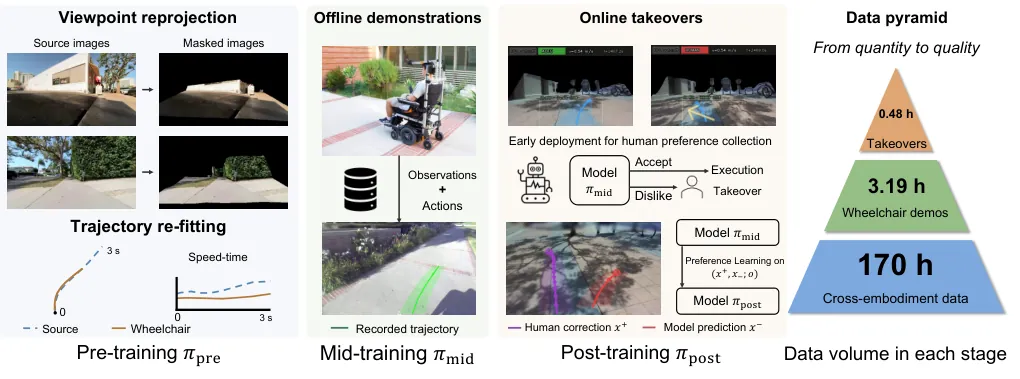
Figure 2: Delivery-robot data, wheelchair demonstrations, and online takeovers feed three adaptation stages. The pyramid indicates decreasing data volume from pre-training to personalization.
flowchart TB
    A[170 h delivery robot data] --> B[Calibrate source-to-wheelchair transform]
    B --> C[Project source depth
build visibility mask]
    C --> D[Re-fit trajectories
with wheelchair dynamics]
    D --> E[Train pi_pre
flow matching with 64 anchors]
    W[3.19 h wheelchair demonstrations] --> F[Train pi_mid
behavior cloning plus KL]
    E --> F
    F --> G[Deploy and log joystick takeovers]
    G --> H[Recover path after each takeover]
    H --> I[Retrospective positive targets
over previous four seconds]
    I --> J[Train pi_post
reference constrained DPO]
    F --> J
    J --> K[Predict a three second plan at 10 Hz]
    K --> L[Apply bounded execution compensation]
    L --> M[Pure pursuit at 50 Hz
send virtual joystick commands]
Two ordering choices are essential. Observation transformation and trajectory re-fitting use the same source batch, so the policy cannot learn a wheelchair-looking image paired with delivery-robot motion limits. The compensator is also placed after the learned planner and before the joystick interface. It corrects systematic execution error without disguising it as a change in user preference. Later, when a takeover is used for personalization, it has a better chance of reflecting choice rather than a predictable tracking fault.
Pre-training: transform what the robot sees and how it moves
Viewpoint alignment through visibility, not hallucinated pixels
ChairNav calibrates a rigid transform $T$ from the delivery camera to the wheelchair camera. Each source pixel $u$ has an estimated metric depth $d(u)$. It is unprojected with source intrinsics $K_s$, transformed into the wheelchair frame, and projected with wheelchair intrinsics $K_w$:
$$ \mathbf{u}_{w}=\Pi\left(\mathbf{K}_{w},\mathbf{T}\cdot\Pi^{-1}\left(\mathbf{K}_{s},\mathbf{u},d(\mathbf{u})\right)\right) $$
Here $\Pi$ and $\Pi^{-1}$ denote perspective projection and unprojection. A source pixel receives mask value $\mathbf{M}(\mathbf{u})=1$ when its projected coordinate lies inside the wheelchair image and has positive depth; otherwise it is rejected. The training image keeps source pixels unchanged and blacks out regions that the target camera would not see. This avoids warping artifacts and prevents interpolation from inventing texture where the source camera had no evidence. The design also gives deployment a simple interface: wheelchair depth can be warped back into the source viewpoint to construct the same mask without a generative image model.
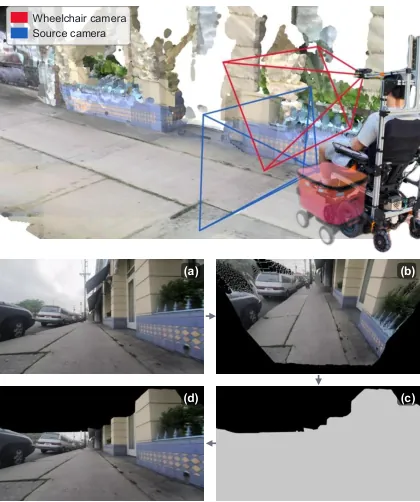
Figure 3: The source and wheelchair cameras have different heights and pitches. ChairNav retains only source pixels visible from the wheelchair camera's perspective.
Trajectory adaptation is a separate constraint
Changing the image does not make a delivery-robot path physically appropriate for a wheelchair. The authors fit an approximate nonlinear dynamics model from calibration runs, covering velocity and acceleration limits, steering response, inertia, and slope effects. They use each source trajectory as a reference and simulate a new rollout under the wheelchair model. The resulting trajectory and speed profile replace the original source target. This is a pragmatic re-fitting operation, not a full optimal-control solution, and it does not inspect the source scene geometry for collisions.
The transformed observation and trajectory are used to fine-tune the anchored flow-matching policy with the behavior-cloning objective
$$ \mathcal{L}_{\mathrm{BC}}=\mathcal{L}_{\mathrm{FM}}+\mathcal{L}_{\mathrm{CE}}+\mathcal{L}_{\mathrm{speed}} $$
where $\mathcal{L}_{\mathrm{FM}}$ trains the continuous flow inside an anchor, $\mathcal{L}_{\mathrm{CE}}$ classifies among 64 anchors, and $\mathcal{L}_{\mathrm{speed}}$ matches the speed profile. No actual wheelchair example is used in this stage. Its purpose is to move visual and behavioral priors closer to the target domain before scarce target data is introduced. The paper is careful to call the result pre-trained rather than deployable: the remaining gap is exactly why mid-training exists.
Why masking is a conservative engineering choice
A visually smoother synthetic image would not necessarily be a better training sample. If a neural renderer fills an occluded region with plausible sidewalk texture, the policy learns from content the original camera never observed. Masking gives the model a different but evidence-grounded representation. It also creates a clear distinction between source regions retained from the delivery camera and regions that become black because they leave the target field of view. For a safety-relevant navigation system, this kind of conservative data transformation is easier to audit than a photo-realistic projection whose missing areas are generated.
Mid-training: spend target data on the remaining embodiment gap
The human wheelchair corpus covers campus paths, residential blocks, and commercial streets. The paper uses 3.19 hours for training and 0.61 hours for validation. These demonstrations include motions the source fleet rarely exhibits, especially turning in place and tighter maneuvers enabled by the wheelchair's drive system. They also expose the exact camera mount, chassis width, and real visual-inertial tracking behavior.
Fine-tuning only on this small set would collapse toward the most frequent demonstrations and could discard useful multimodal anchors learned from the large source corpus. The mid-training loss therefore adds a KL regularizer:
$$ \mathcal{L}_{\mathrm{mid}}=\mathcal{L}_{\mathrm{BC}}+\lambda_{\mathrm{KL}}D_{\mathrm{KL}}\left(p_{\pi_{\mathrm{pre}}}(\cdot\mid\mathbf{o})\,\middle\|\,p_{\pi_{\theta}}(\cdot\mid\mathbf{o})\right) $$
The probabilities are defined over discrete trajectory anchors rather than the intractable full trajectory density. With $\lambda_{\mathrm{KL}}=10$, the policy is penalized for assigning very little probability to anchors that the pre-trained model supports. All parameters are trained for four epochs, and the checkpoint after epoch two is retained as $\pi_{\mathrm{mid}}$. The exact epoch choice is empirical; the point of the objective is to combine new wheelchair behavior with a memory of source-domain mode diversity.
The resulting policy is deployable only as part of ChairNav's complete stack. It produces future waypoints, not wheel torques. A separate controller converts the plan into commands at a different frequency, and a CAN interposer maps those commands into the factory wheelchair bus. This division makes failures easier to localize, but it also means the learned model's quality cannot be judged in isolation from tracking, timing, and hardware behavior.
Platform and low-level execution
The physical system uses a Permobil M3 power wheelchair. A dual-channel USB-CAN interposer sits between the R-net joystick and motor controller. One channel observes the rider's joystick, and the other sends virtual joystick commands to the drive bus. When the rider moves the physical joystick, control is overridden immediately. The researchers do not replace or reprogram the factory electronics. This non-invasive path is significant because certified assistive hardware is difficult to modify and because a research prototype should preserve the original manual control chain.
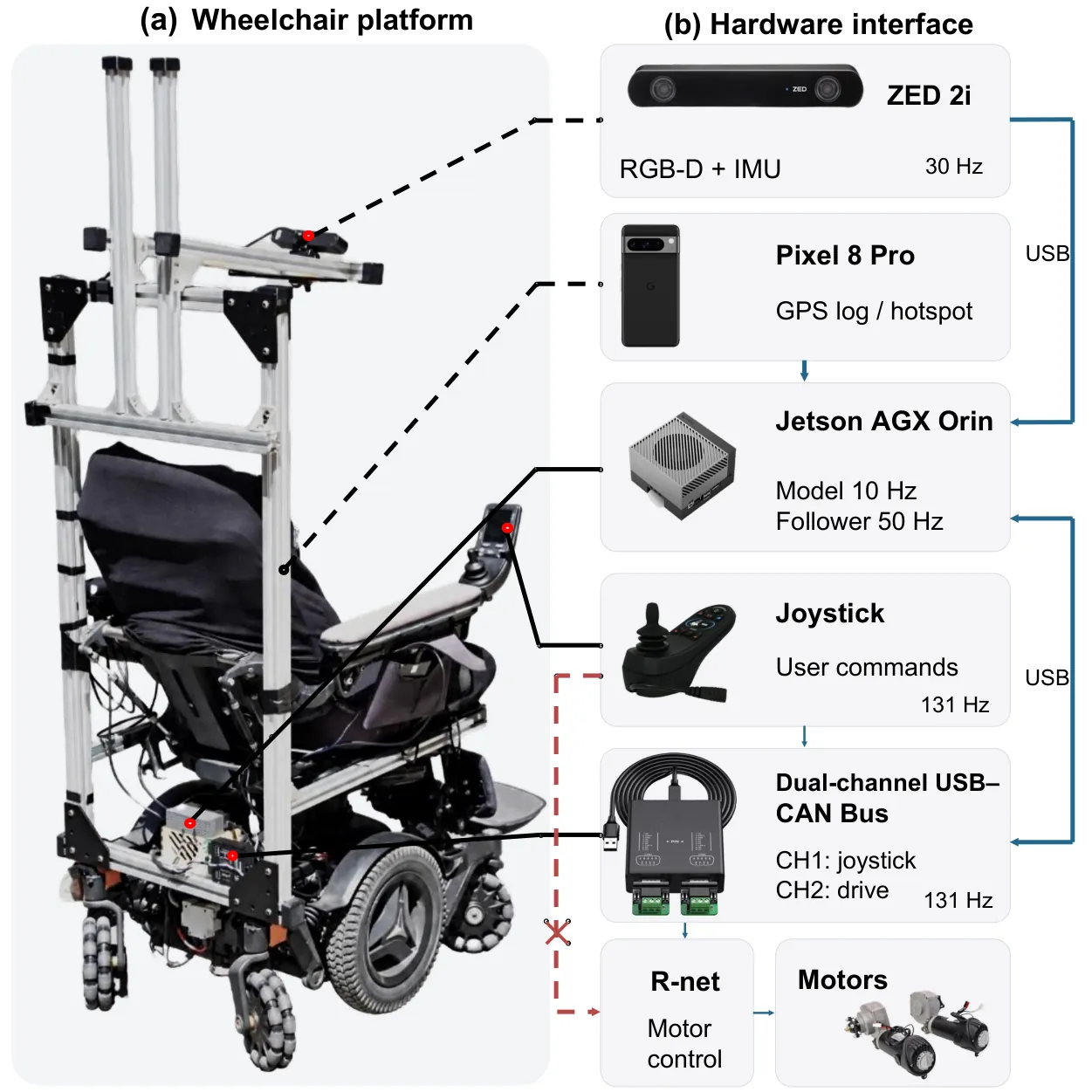
Figure 5: A ZED 2i RGB-D camera, Jetson AGX Orin, and dual-channel CAN interposer are added to the commercial wheelchair without replacing the R-net drive modules.
A ZED 2i supplies color, depth, and visual-inertial odometry. The camera is mounted 1.47 m above the floor and pitched down by 27.7 degrees. The wheelchair has no wheel encoders, so visual-inertial tracking is the only local odometry source. A tethered phone records GPS, but GPS is not used for control. The policy runs at 10 Hz, while a pure-pursuit follower runs at 50 Hz with a 1.5 m look-ahead and generates virtual joystick positions. The hardware stack avoids lidar, RTK, and prior maps, keeping the system within a camera-plus-edge-compute profile.
This architecture makes the intervention signal possible. A takeover is not inferred from a software error; it is a physical joystick deflection that overrides the model through the same control bus used by autonomous commands. That gives the data a direct link to user action. It also means takeover timing includes the full chain from perception to CAN execution, which is exactly why naive time alignment would be misleading.
Compensation: remove repeatable execution error before learning preference
Even a reasonable predicted path can be driven imperfectly because of chassis asymmetry, trajectory-to-joystick mapping noise, camera-to-body calibration, and slope-dependent drift. ChairNav estimates a longitudinal under-execution ratio $k$, an effective crab angle $\theta$, a zero-command yaw rate $\omega$, and a linear residual $r_i(z)$ from speed and IMU features. For waypoint $i$ with cumulative arc length $S_i$ and timestamp $t_i$, the longitudinal correction is
$$ \Delta x_{i}=g_{x}kv t_{i} $$
and the lateral correction is
$$ \Delta y_{i}=g_{y}\left(\sin\theta\,S_{i}+\frac{1}{2}\omega S_{i}^{2}/v\right)+g_{r}r_{i}(\mathbf{z}) $$
Each waypoint $(x_i,y_i)$ is shifted to $(x_i-\Delta x_i,y_i-\Delta y_i)$. The paper deliberately does not apply the full fitted correction. It uses $g_y=0.6$ and $g_r=0.5$, caps lateral correction at 0.4 m over the three-second plan, and sets $g_x=0$. Lengthening the commanded path would increase speed, and an unexpected acceleration is harder for a seated rider to recover from than a modest lateral error. Compensation activates only above 0.3 m/s when at least 1.5 m of plan remains, is low-pass filtered over 0.3 s, and fades over 0.5 s.
The intervention data became more informative after this step. Lateral drift on straight segments over three seconds fell from about 18 cm to 2 cm. The share of takeovers attributed to execution errors fell from 34% to 10%. The remaining events still mix preference, perception, calibration, and control, but the mixture is less dominated by repeatable mechanical error. The bounded gains are a safety choice: an aggressive compensator might improve nominal tracking while creating a larger failure near a curb or on a slope.
Post-training: turn delayed interventions into earlier preferences
Reference recovery from a takeover
Post-training uses five drives totaling 4.96 hours, with 1,117 takeovers and 0.48 hours of rider-controlled driving. The authors hold out 121 takeover events. They exclude events at intersections and crosswalks, detours, and stops longer than five seconds. For each retained takeover, they recover a reference path from the rider's post-intervention recovery behavior. The preference horizon extends four seconds before the takeover.
For an eligible observation, a quintic spline joins the recorded pose to a landing point on the reference path while matching position, heading, and curvature at both ends. Among candidate landing points, the method selects the nearest spline with curvature no greater than 0.25 per meter, then follows the reference path after that point. This produces a positive trajectory $x^{+}$ for every historical observation. The model's own prediction at that observation supplies the negative trajectory $x^{-}$. One takeover can therefore create several temporally aligned training pairs.
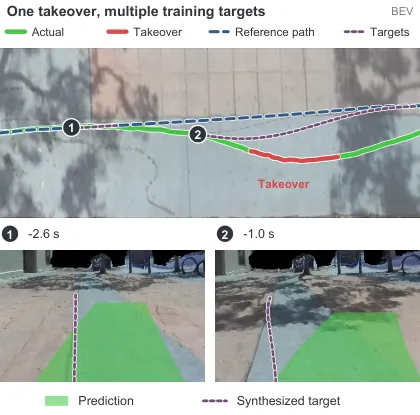
Figure 4: The rider's takeover and recovery path yield a reference. Observations 2.6 s and 1.0 s before the takeover receive different synthesized positive targets.
Reference-constrained DPO over trajectory anchors
The implicit reward of the current policy relative to the reference policy is
$$ r_{\theta}(\mathbf{x},\mathbf{o})\triangleq\log\frac{p_{\pi_{\theta}}(A(\mathbf{x})\mid\mathbf{o})}{p_{\pi_{\mathrm{ref}}}(A(\mathbf{x})\mid\mathbf{o})} $$
where $A(\mathbf{x})$ maps a trajectory to its nearest anchor and $\pi_{\mathrm{ref}}$ is set to $\pi_{\mathrm{mid}}$. The post-training objective combines behavior cloning with a contrastive preference term:
$$ \mathcal{L}_{\mathrm{post}}=\mathcal{L}_{\mathrm{BC}}-\lambda_{p}\log\sigma\left(\beta\left[r_{\theta}(\mathbf{x}^{+},\mathbf{o})-r_{\theta}(\mathbf{x}^{-},\mathbf{o})\right]\right) $$
The sigmoid increases the reward difference between the synthesized preferred path and the original prediction. Because both policies are evaluated through discrete anchors, the preference loss changes relative mode probabilities while the KL-like reference structure limits movement away from the mid-trained behavior. This is a better fit for a small dataset than unconstrained trajectory regression: 121 held-out events can support a ranking correction, but they cannot justify a wholesale relearning of visual navigation.
Open-loop results: lateral error tells a different story from total displacement
The general wheelchair validation split contains 641 left-turn windows, 836 straight windows, and 708 right-turn windows. A window is labeled by its measured lateral displacement over three seconds. The evaluation reports average displacement error, final displacement error, and lateral average displacement error. LADE is essential for sidewalk safety because a trajectory can be excellent in overall progress yet place the chair too close to a curb or obstacle.
| Model | ADE / m | FDE / m | Left LADE | Straight LADE | Right LADE | All LADE |
|---|---|---|---|---|---|---|
| $\pi_{\mathrm{base}}$ | 0.599 | 1.678 | 0.183 | 0.086 | 0.178 | 0.144 |
| $\pi_{\mathrm{pre}}$ | 0.386 | 0.936 | 0.100 | 0.045 | 0.117 | 0.084 |
| Mid-only | 0.152 | 0.470 | 0.100 | 0.042 | 0.113 | 0.082 |
| $\pi_{\mathrm{mid}}$ | 0.213 | 0.546 | 0.083 | 0.030 | 0.097 | 0.067 |
| $\pi_{\mathrm{post}}$ | 0.237 | 0.577 | 0.078 | 0.030 | 0.098 | 0.066 |
Table I: General wheelchair validation results, reproduced from the paper's Table I.
Pre-training lowers all LADE from 0.144 m to 0.084 m without any wheelchair demonstration. Mid-training then reaches 0.067 m. Post-training gives 0.066 m, essentially preserving the general capability while aligning to the user. The ablation that trains only on wheelchair demonstrations is the most informative row. It obtains the best ADE and FDE, 0.152 m and 0.470 m, but its left and right LADE values are 0.100 m and 0.113 m, worse than the full mid-trained model's 0.083 m and 0.097 m.
This is a concrete warning against selecting a navigation policy from one aggregate metric. A model can predict how far the chair moves with lower average distance error while cutting turns too close to the inside or outside of a walkway. ChairNav uses the large source corpus not merely to lower a scalar score but to preserve turning behavior that is less represented in the small wheelchair set. The paper states an 18% reduction in lateral error from pre-training, but the ablation explains why that reduction matters beyond the headline percentage.
Validation on held-out takeovers
| Model | ADE / m | FDE / m | LADE / m |
|---|---|---|---|
| $\pi_{\mathrm{mid}}$ | 0.173 | 0.526 | 0.074 |
| Post without preference synthesis | 0.208 | 0.514 | 0.072 |
| $\pi_{\mathrm{post}}$ | 0.161 | 0.484 | 0.069 |
Table II: Held-out takeover results, reproduced from the paper's Table II.
The complete post-trained model improves ADE from 0.173 m to 0.161 m and FDE from 0.526 m to 0.484 m relative to mid-training. The more important comparison is against post-training on raw takeovers without preference synthesis. There, ADE is 0.208 m; recovering a reference and assigning targets to earlier observations reduces it to 0.161 m. The gain therefore depends on temporal relabeling, not just additional gradient steps on user data. LADE changes are smaller, from 0.074 to 0.069 m, but on a narrow sidewalk a five-centimeter lateral improvement can still alter curb clearance.
Closed-loop deployment: the headline result needs its scope
The authors alternate mid-trained and post-trained policies on the same 1.61 km urban route, with three trials per policy. The six trials occur within one day to limit changes in battery, illumination, and pedestrian activity. Hardware is fully restarted and warmed up for five minutes before every run. Table III reports one complete recorded trial per policy, not an average over all three.
| Model | Autonomy | Auto / total time | Takeovers (L/R/B) | Distance per takeover |
|---|---|---|---|---|
| $\pi_{\mathrm{mid}}$ | 91.8% | 24.5 / 26.7 min | 55 (38 / 12 / 5) | 29.2 m |
| $\pi_{\mathrm{post}}$ | 93.4% | 25.0 / 26.8 min | 28 (15 / 12 / 1) | 57.4 m |
Table III: One full recorded trial per policy on the same 1.61 km route, reproduced from the paper's Table III.
The intervention count falls from 55 to 28, and distance per takeover nearly doubles. The reduction is concentrated in left corrections, from 38 to 15; right corrections remain at 12 and braking events fall from five to one. Figure 7 shows why this may happen at the planning level. On the same recorded inputs, the mid-trained policy plans toward a tree pit, veers near a signal pole, or enters a brick strip beside a drain, while the post-trained policy stays closer to the walkway. The latter's plan endpoint is within 0.45 m of the eventual driven path in four examples, compared with 1.0 to 1.5 m for the mid-trained model.
Autonomy is the fraction of driving time under model control. A takeover is one continuous user-control episode; bursts separated by less than two seconds of model control are merged, and the entire span is counted as user control. On the 1.61 km route, a pedestrian-signal crossing and a designated U-turn require manual operation. These sections remain in the denominator even though they are not realistic targets for the learned policy. The reported 93.4% therefore means autonomy over a complete mixed route, not that the chair independently handled every traffic signal or made every U-turn.
The appendix is even more important for interpretation. Across all drives, the mid-trained policy covers 4.4 km with 77.9% autonomy, while the post-trained policy covers 7.8 km with 84.9% autonomy. Scenario C, a 2.8 km route, reaches only 70.6% for mid-training and 73.5% for post-training. The paper's abstract emphasizes 93.4%, which is a recorded trial on one route; the aggregate 84.9% is a more conservative description of overall performance, and the 2.9-point improvement on Scenario C shows that personalization does not remove hard environmental failures.
| Scenario | Model | Distance | Autonomy | Takeovers / km | Distance / takeover |
|---|---|---|---|---|---|
| A | $\pi_{\mathrm{mid}}$ | 1.6 km | 91.8% | 34.2 | 29.2 m |
| A | $\pi_{\mathrm{post}}$ | 1.6 km | 93.4% | 17.4 | 57.4 m |
| A | $\pi_{\mathrm{post}}$ run 2 | 1.6 km | 95.1% | 18.3 | 54.5 m |
| B | $\pi_{\mathrm{post}}$ | 1.9 km | 86.8% | 42.7 | 23.4 m |
| C | $\pi_{\mathrm{mid}}$ | 2.8 km | 70.6% | 47.9 | 20.9 m |
| C | $\pi_{\mathrm{post}}$ | 2.8 km | 73.5% | 46.1 | 21.7 m |
| All | $\pi_{\mathrm{mid}}$ | 4.4 km | 77.9% | 43.0 | 23.3 m |
| All | $\pi_{\mathrm{post}}$ | 7.8 km | 84.9% | 33.8 | 29.6 m |
Table IV: Closed-loop drive records from the appendix, reproduced from the paper's Table IV.
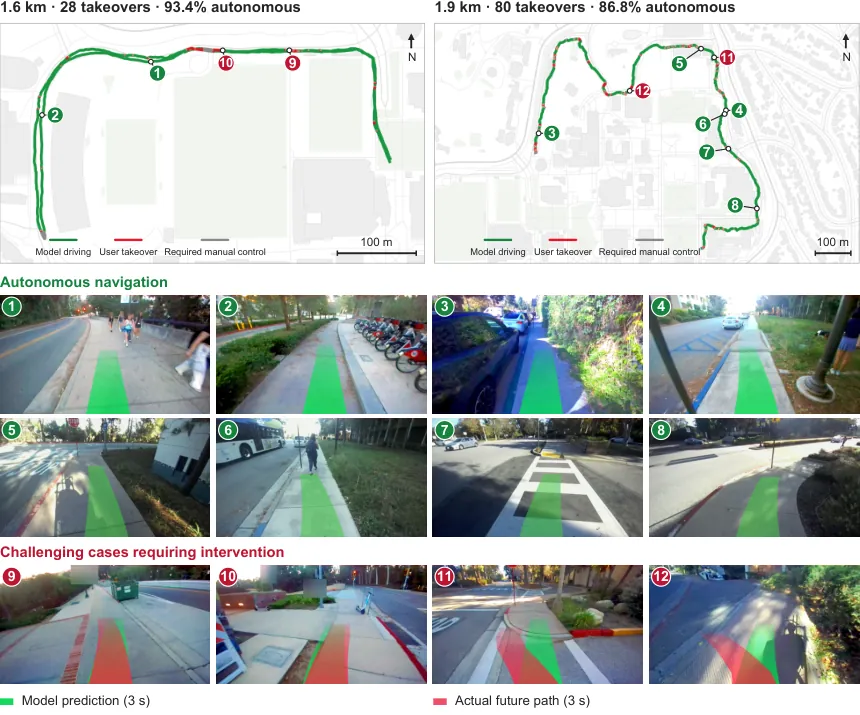
Figure 6: GPS tracks and camera examples from the 1.6 km and 1.9 km routes. Green denotes model driving, red rider takeovers, and grey required manual control.
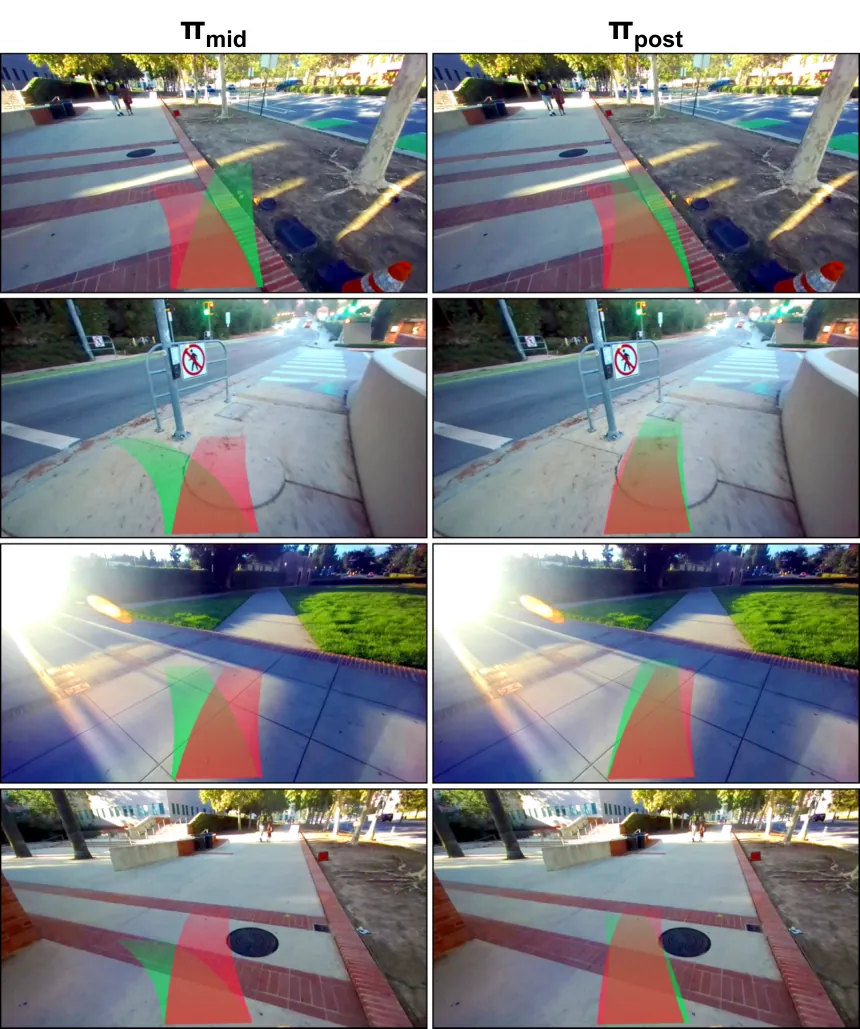
Figure 7: The same recorded observations evaluated by both policies. Green bands are top-ranked three-second plans, while red marks the path actually followed.
What the work actually advances
The strongest contribution is not a claim that one vision model can control any robot. It is the decomposition of transfer into camera visibility, vehicle dynamics, real sensor adaptation, and low-level execution. Each layer has a measurable responsibility. Masking addresses the observation geometry. Re-fitting addresses feasible motion in source labels. Wheelchair demonstrations expose the true sensor and chassis. Compensation reduces systematic tracking error. This modularity gives future work a way to diagnose regressions instead of treating the entire system as one opaque policy.
The post-training method is also useful beyond wheelchairs. A delayed human correction can be interpreted as evidence that a prior observation was already unsatisfactory. Recovering a stable reference path and generating temporally aligned positive samples is a practical alternative to assigning the final joystick action to the wrong frame. The reference policy then preserves competence while anchor-level DPO changes preference. The main assumption is that the recovered reference path is correct; an automatic path generator can inherit its own curb-distance bias or choose an unsafe landing point.
For deployment, the architecture keeps the learned policy separate from the safety and execution path. Yet the paper does not present a full fault-tolerance design. If visual-inertial tracking degrades, CAN frames are delayed, or the camera becomes occluded, the policy may still produce a confident trajectory. The compensator limits lateral correction and fades changes over time, but it is not a complete safety monitor. A production system would need independent fault detection, speed limiting, obstacle checks, and a deterministic stop mode before handing control to a commercial wheelchair.
Limitations
The first author-stated limitation concerns physical feasibility. Trajectory re-fitting uses an approximate dynamics model and re-simulates source motion, but it does not verify whether the resulting path remains traversable in the geometry of the original scene. A trajectory can satisfy velocity and steering bounds while crossing a wall, a curb, or a narrow region. The transformed 170-hour corpus is therefore a useful prior, not a verified source of collision-free wheelchair plans.
The second author-stated limitation is feedback ambiguity. Takeovers mix personal preference with perception noise, camera miscalibration, and execution errors. The compensator reduces execution-related interventions from 34% to 10%, but the remaining events are still treated uniformly by the preference objective. A more nuanced system would classify whether the rider is correcting the world model, the controller, or the desired style. Without that distinction, post-training can reinforce a preference that is actually compensating for a sensor failure.
The third author-stated limitation is single-user evaluation. Closed-loop personalization comes from one rider. The method has not been tested for adaptation across users, weather, regions, or long-term changes in preference. A reference-constrained optimizer is likely to be safer than unrestricted fine-tuning, but the paper cannot claim that the same four-second horizon or curvature bound works equally well for every person or disability.
An independent limitation is the mismatch between headline and aggregate evidence. The 93.4% result is vivid and legible, but the all-drive appendix reports 84.9% for the post-trained system and only a modest gain on Scenario C. The 1.61 km recorded trial also includes required manual sections. Reporting the aggregate alongside the best recorded route is necessary for a realistic assessment of long-horizon autonomy.
Finally, the public repository does not contain the implementation. The paper describes the system in enough detail to understand the research, and the project page supplies impressive media, but reproducibility is limited. There is no released model, no data transformation code, no spline target generator, no controller or CAN interface, and no evaluation script. Independent teams cannot verify the pipeline end to end or test whether the safety bounds behave as described.
Conclusion
ChairNav makes a convincing case for data reuse only when the reuse is structurally honest. Source images are masked to the target camera's visibility, source trajectories are re-fitted to target dynamics, and the actual wheelchair is then used to close the remaining gap. The resulting policy is not an unmodified foundation model with a wheelchair prompt; it is a layered adaptation process backed by a real CAN-controlled platform and kilometer-scale field trials.
The personalization stage adds a second useful idea: the rider's takeover is not a clean future label. It is a delayed indication that an earlier plan was unacceptable. By recovering a reference path and synthesizing historical positive targets, ChairNav turns a sparse intervention into a constrained preference comparison. The right conclusion is therefore neither that automatic wheelchair navigation is solved nor that the headline autonomy rate applies everywhere. It is that cross-embodiment data and delayed human feedback can be made more useful when their geometry, timing, and execution assumptions are handled explicitly.
Golden line: Personalization begins when a late takeover is translated back to the earlier moment at which the rider already knew the plan was wrong.