
Coding AgentsPython
TokenEconomizer
A black-box plugin that learns across coding-agent sessions to reduce repeated repository discovery, unused tools, and failure loops.
A reviewed field guide to robotics, embodied AI and agent software, arranged by what each repository actually does.
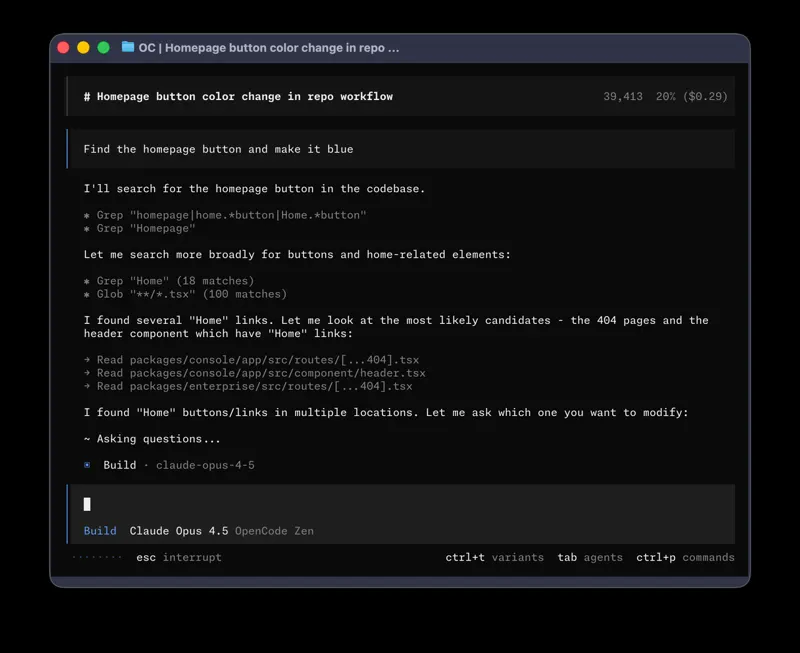
anomalyco/opencode (formerly sst/opencode, 210k stars, MIT) splits the coding agent into a client layer and a server layer: the server exposes OpenAPI 3.1 plus an SDK generated from the spec, and the TUI is just one remote frontend of it, so a single session can be driven from a terminal, an IDE, GitHub Actions and ACP clients such as Zed. More than 75 providers plug in through the AI SDK and Models.dev, OpenCode Zen offers a curated gateway of models tested before listing, the 35+ built-in LSPs ship disabled with docs stating they are not always a net win, skills resolve from .opencode, .claude and .agents roots, and permissions are a three-state allow/ask/deny. It is the most engineering-first branch of open-source coding agents: interface before UI.
Four collections and twelve task-based domains cover the full catalog. Domains, tags and search compose.
Start with the work a repository performs, then search by repository, technology, lab or topic.
Write and understand code, operate computers and carry long-running work to completion.
Agents that write code, reusable skills, parallel workspaces and engineering pipelines from planning through delivery.
Code graphs, repository understanding, review, migration, security testing, binary analysis and reverse engineering.
Train, serve and run models faster, smaller and cheaper.
Inference serving, quantization, fine-tuning, caching, speculative decoding, model routing and local/edge execution.

A training-free behavior editor combining ARA/abliteration, Optuna, pluggable scorers, and reproducible manifests; it changes refusal boundaries rather than proving broad capability preservation.
Strata is an open-source local inference engine built on llama.cpp/ggml that runs the 125-billion-parameter Qwen3.8-Flash-Next MoE model on consumer gaming PCs with as little as 12GB VRAM, using tiered expert caching (GPU→RAM→SSD) and guess-and-check speculative decoding to achieve 53-94 tokens/second.
Generate media, produce designs and documents, organize knowledge and apply it to real work.
Knowledge bases, retrieval, research workspaces, education, CRM and applications built for specific industries.
As an Amazon Associate, we earn from qualifying purchases.