Skip to content

Open-sourceproject atlas

A reviewed field guide to robotics, embodied AI and agent software, arranged by what each repository actually does.

opencode: the open-source coding agent split into client and server
Lead repositoryanomalyco/opencode

opencode: the open-source coding agent split into client and server

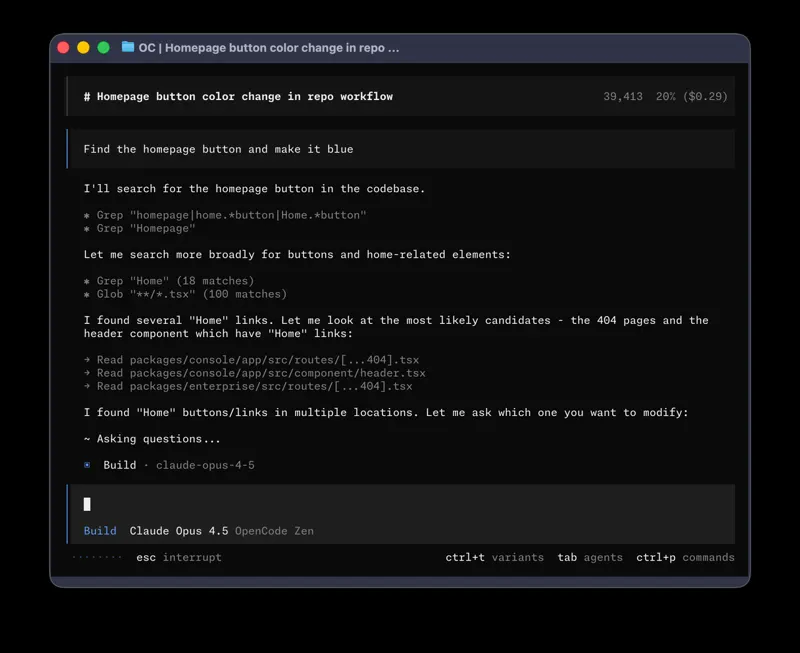
anomalyco/opencode (formerly sst/opencode, 210k stars, MIT) splits the coding agent into a client layer and a server layer: the server exposes OpenAPI 3.1 plus an SDK generated from the spec, and the TUI is just one remote frontend of it, so a single session can be driven from a terminal, an IDE, GitHub Actions and ACP clients such as Zed. More than 75 providers plug in through the AI SDK and Models.dev, OpenCode Zen offers a curated gateway of models tested before listing, the 35+ built-in LSPs ship disabled with docs stating they are not always a net win, skills resolve from .opencode, .claude and .agents roots, and permissions are a three-state allow/ask/deny. It is the most engineering-first branch of open-source coding agents: interface before UI.

136reviewed projects
125builders
12languages
12domains

Find a project by domain

Four collections and twelve task-based domains cover the full catalog. Domains, tags and search compose.

Project index

Start with the work a repository performs, then search by repository, technology, lab or topic.

Agent Workflows

Write and understand code, operate computers and carry long-running work to completion.

5 projects

Coding Agents, Skills & Delivery

Agents that write code, reusable skills, parallel workspaces and engineering pipelines from planning through delivery.

5 projects
opencode: the open-source coding agent split into client and server
Coding AgentsTypeScript

opencode

anomalyco/opencode (formerly sst/opencode, 210k stars, MIT) splits the coding agent into a client layer and a server layer: the server exposes OpenAPI 3.1 plus an SDK generated from the spec, and the TUI is just one remote frontend of it, so a single session can be driven from a terminal, an IDE, GitHub Actions and ACP clients such as Zed. More than 75 providers plug in through the AI SDK and Models.dev, OpenCode Zen offers a curated gateway of models tested before listing, the 35+ built-in LSPs ship disabled with docs stating they are not always a net win, skills resolve from .opencode, .claude and .agents roots, and permissions are a three-state allow/ask/deny. It is the most engineering-first branch of open-source coding agents: interface before UI.

anomalyco/opencode211k stars28k forks
Coding AgentsTypeScript

Orca

Orca calls itself an ADE (Agentic Development Environment), the AI orchestrator for 100x builders (75k+ stars, MIT/TypeScript, YC-backed). Central mechanism: fan one prompt across Codex, Claude Code, OpenCode and Pi, each isolated in its own git worktree, then compare results and merge the winner. Also WebGL terminals, Design Mode (click a UI element to send its HTML/CSS/screenshot into the prompt), native GitHub and Linear integration, diff annotations routed back to the agent, SSH worktrees and mobile notifications. Not independently benchmarked; graded needs-reproduction.

stablyai/orca76k stars5.0k forks
Coding AgentsTypeScript

MiMo Code

Xiaomi open-sourced terminal-native AI coding assistant, TypeScript built with bun. The source is MIT but usage is additionally bound by USE_RESTRICTIONS.md, the MiMo terms of service and the trademark policy - read those before treating it as plain MIT. The README states it is a fork of OpenCode: it keeps the multi-provider, TUI, LSP, MCP and plugin core and adds persistent memory (SQLite FTS5 full-text search across four kinds - project MEMORY.md, session checkpoints, scratch notes and task progress - injected automatically on session resume), intelligent context management (near the limit it rebuilds from the latest checkpoint plus project memory plus task progress plus retained recent messages, ranked by importance against a token budget), goals and stop conditions (/goal sets the condition, and when the agent wants to stop a separate judge model assesses whether it was truly met, which targets optimistic early quitting), and deterministic JS workflows in a sandbox (compose splits independent tasks into isolated git worktrees with per-task TDD; also deep-research, fact-check with three-reviewer adversarial voting, and research-experiment with an anti-metric-gaming audit). Twenty built-in skills (arxiv, claude-code, codex, docx, pdf, pptx, xlsx, html-to-video, product-design and more), compatible with four skill roots - .agents/skills, .claude/skills, .codex/skills, .opencode/skills - where a user skill of the same name overrides the built-in. /dream and /distill are its signature: the first distils recent session trajectories into project memory and prunes stale entries, the second finds your repeated manual routines and packages high-confidence candidates into reusable skills. Model agnostic - the Xiaomi platform, Codex/ChatGPT OAuth, or any OpenAI-compatible endpoint. 13.4k stars. Not installed or run yet; memory-restore accuracy, judge-model effectiveness and the vendor-stated cache hit rates are unverified, so this is graded as pending reproduction.

XiaomiMiMo/MiMo-Code13k stars1.4k forks

As an Amazon Associate, we earn from qualifying purchases.