The Wheeled Humanoid Supply Chain Deep Dive: Omnidirectional Chassis, Lifting Columns and Ball Screws — Who Builds In-House, Who Buys
Wheeled-base (half-body) humanoids are the fastest-moving form factor of the humanoid race: over 40% of humanoid products launched globally in 2025 use wheeled chassis, with travel speed 3-5x that of bipeds, 60%+ energy savings, and system cost one order of magnitude lower. Based on public sources and vendor research, this article dissects the chassis and lift designs of leading players (Galbot, AgiBot, UBTECH, Pudu, Astribot, Yifei, Zhipingfang, Topstar) across mecanum, omni-wheel, four-steer-four-drive and dual-differential chassis and screw / rigid-chain / belt lifting mechanisms; maps the supplier landscape (SEER, WIMAI, SLAMTEC, JIECANG and more); and answers the core question — in-house or outsourced? The answer: chassis and lift mechanisms are overwhelmingly developed in-house; outsourcing concentrates on commodity parts like wheels, motors and screws.
Introduction: Why "half-body" wheeled humanoids are winning
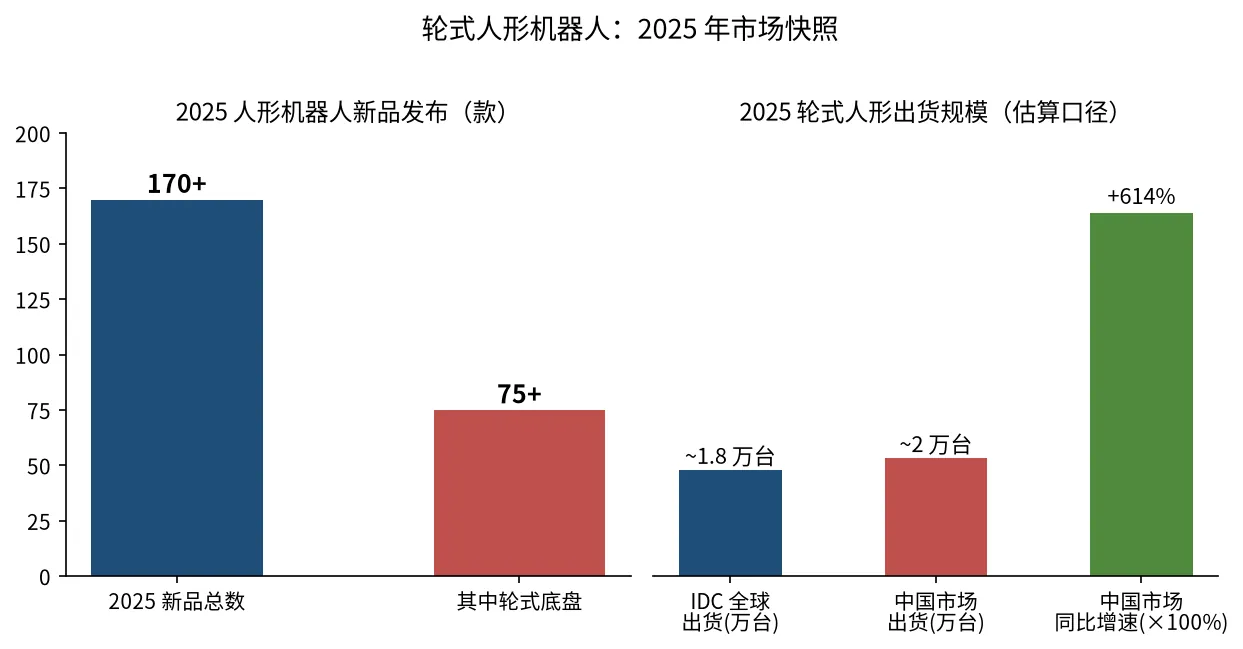
In 2025, over 170 new humanoid robot models were unveiled worldwide, and roughly half of them were wheeled "half-body" designs — a robot torso mounted on an omnidirectional mobile chassis instead of two legs. According to CMR Industry Alliance data, 75 wheeled humanoid models were released in 2025, and wheeled chassis accounted for over 80% of the 55 new models in the first three quarters. IDC's January 2026 report puts global humanoid shipments at roughly 18,000 units, up 508% year on year.
The commercial logic is blunt: speed (wheeled robots move 3-5x faster than bipeds), energy (60%+ power savings — no need to spend electricity balancing), reliability (no falling over), and price (sub-$50,000 machines instead of hundreds of thousands). The bipedal route is a battle for ultimate generality; the wheeled route is where deployments are actually happening today — catering, hotels, warehousing, factories, eldercare.
But strip the marketing away and the engineering question remains: how exactly are these robots built? Which omnidirectional chassis approach (mecanum wheels, multi-roller omni wheels, steering-drive wheels, or dual differential)? Which lift mechanism (ball/roller screw, rigid chain, timing belt, or scissor)? And the supply-chain question this article focuses on: which components are bought from suppliers, and which are developed in-house?
This article is based on RobotWorld's public-data research (2025-2026 industry reports, CMR Industry Alliance, GGII, IDC, company announcements, WAIC exhibition coverage, patent filings and supply-chain teardowns), covering more than a dozen representative robots — Galbot, AgiBot, UBTECH, Keenon, Astribot, Yifei, Zhipingfang, Topstar, Xinghai Tu, ROKAE — plus the full supplier landscape: SEER/Seer-Robotics, WIMAI (Lanxin), Slamtec, Zhide, Phoenix Power, Dexinming/Omniwheel/Hanlu, JIECANG, LINAK, Timotion, Ewellix, Loctek, and more.
2025 market snapshot: wheeled chassis take >80% of new launches
| Metric | Value | Source / scope |
|---|---|---|
| Global new humanoid models (2025) | 170+ | CMR Industry Alliance, incl. 75 wheeled models |
| Wheeled share of new models (first 3 quarters) | >80% (55 models) | CMR Industry Alliance / Xinzhan Mobile Robot Research Institute |
| Global humanoid shipments (2025) | ~18,000 units, +508% YoY | IDC "Global Humanoid Robot Market Analysis", Jan 2026 |
| Top global vendor by shipments | AgiBot ~5,200 units | IDC report |
| China humanoid market size (2025) | ~5-6.5 billion yuan (estimates vary by scope) | Various research reports; some cite >9 billion yuan under broader definitions |
| Typical wheeled-humanoid price | $50,000 / 100k-300k yuan range | vs hundreds of thousands of yuan for many bipeds |
| Speed vs bipedal | 3-5x faster | Industry-wide comparison |
| Energy vs bipedal | 60%+ savings | Industry-wide comparison |
The deployment scenarios are clearly stratified too: catering / hotels (Keenon, Pudu-style busboys, Keenon XMAN-R1), manufacturing / logistics (Galbot G1 deployed at CATL, AgiBot Expedition A2-W in factories), commercial services (UBTECH Cruzr S2 reception), elderly care / rehabilitation. The common denominator is flat indoor floors — exactly the operating condition where wheels dominate and legs are pure overhead.
Chassis: four omnidirectional routes, each with trade-offs
The chassis is what makes these robots "omnidirectional". Four mainstream wheel architectures exist, and each represents a different engineering trade-off:
| Chassis type | Principle | Strengths | Weaknesses | Typical use |
|---|---|---|---|---|
| Mecanum wheel | Hub + 45°-angled rollers around the rim; four-wheel differential vectoring yields lateral / diagonal / spin motion | Cheapest, mature supply chain, easy to control | Roller wear is fast, mediocre obstacle handling and load capacity, noisy, needs flat floors | Low-cost service robots, education platforms |
| Omni wheel (multi-roller) | Large hub with barrel rollers; e.g. ROTACASTER | Smoother omnidirectionality, quieter | Complex roller structure, expensive, limited load | High-end service robots, precision positioning |
| Steering-drive (4 steer + 4 drive) | Each wheel has independent steering + drive motors; true omnidirectionality like a car with 4 steerable wheels | Best omnidirectional agility, highest load and positioning precision, handles slopes and thresholds | Most expensive, most complex control, tallest stack height | Mainstream high-end wheeled humanoids (AgiBot Spirit G2, Yifei Hongjun) |
| Dual differential | Two independently driven wheel groups + casters, skid-steer or pivot turn | Simple, reliable, cheap, high payload | Not truly omnidirectional, scrubbing during turns | Heavy-duty transport (Galbot S1, logistics bases) |
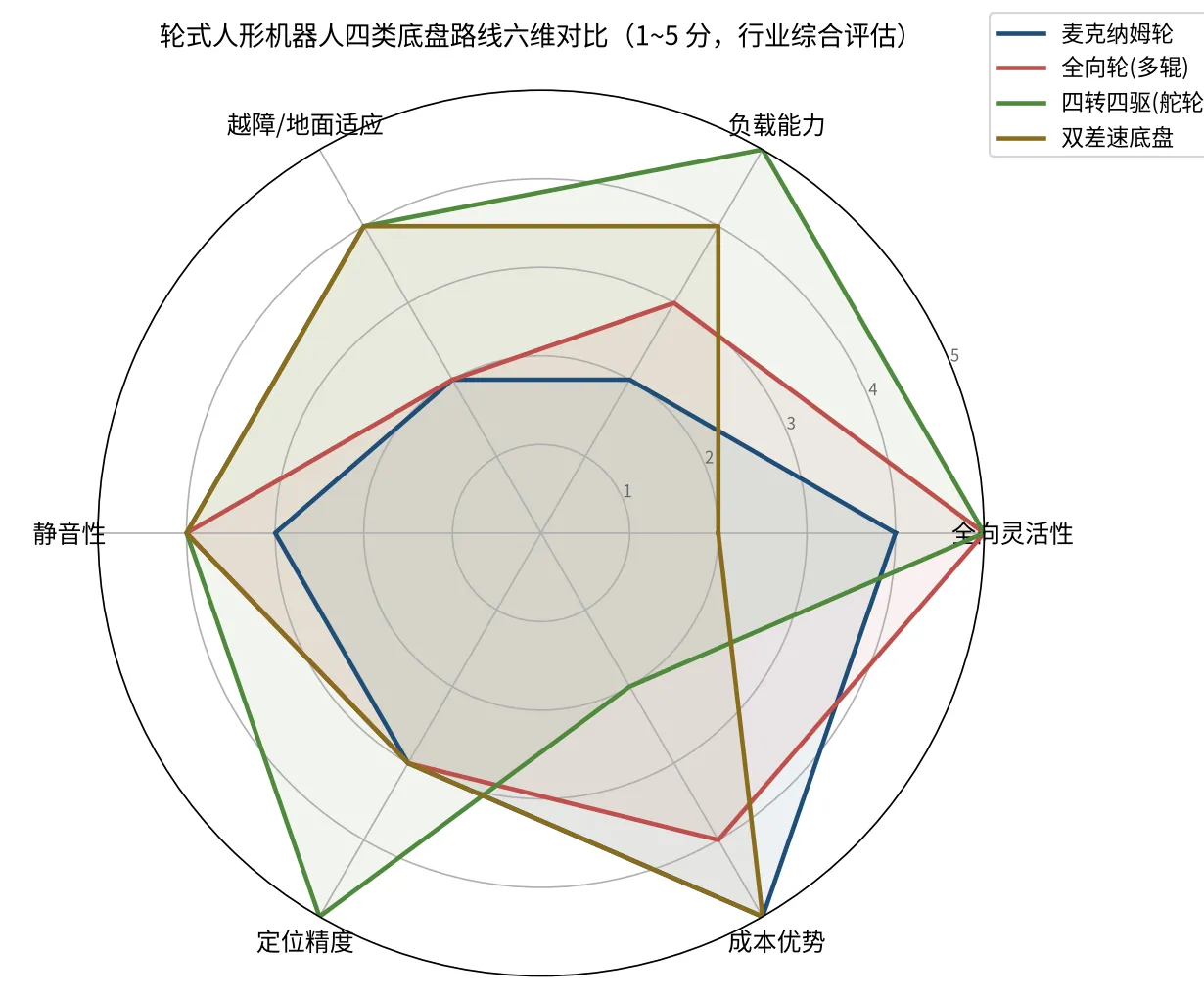
The industry trend is clear: high-end wheeled humanoids are converging on 4-steer-4-drive. It is the only route that simultaneously satisfies "rotate in place inside a narrow aisle" (some models achieve 62 cm aisle passage), "carry a 100 kg+ torso and arms", and "position repeatedly to ±5 mm in front of a workstation". The price is complexity: eight motors per chassis, plus steering encoders, force control, and suspension — this is precisely why chassis self-development is a genuine moat.
Lift mechanism: the "second axis" that doubles the workspace
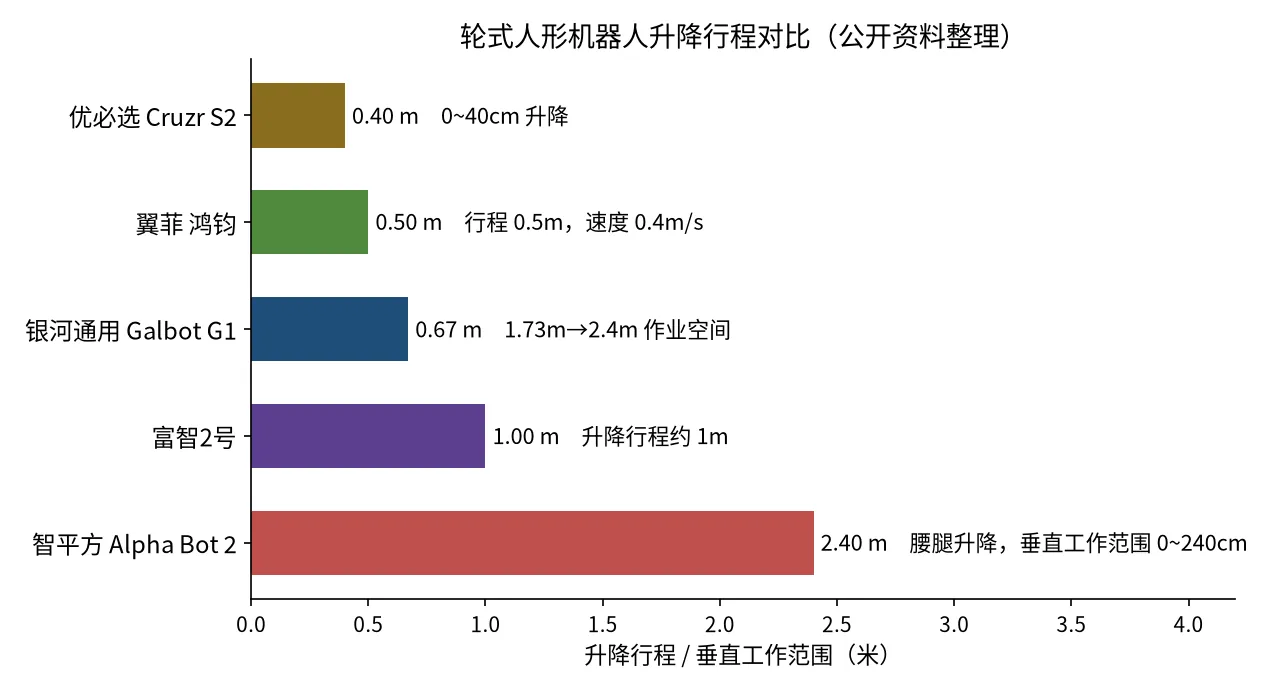
On a wheeled humanoid, the lift column is not a nice-to-have — it is a structural necessity. A 1.7 m-tall robot that cannot reach above 2 m or below 0.4 m is nearly useless in a warehouse or kitchen. The lift axis gives the robot a vertical workspace of 0.4 m to 2.4 m+ — effectively replacing the "crouch down / stretch up" motions of a human's legs and lower back.
Four transmission routes exist, mirroring the industrial linear-motion world:
| Route | Principle | Strengths | Weaknesses | Representatives |
|---|---|---|---|---|
| Ball / roller screw | Motor drives a nut along a screw shaft | High precision, high load, mature supply chain, self-locking | Speed limited by screw critical rpm, long strokes need long screws | Mainstream choice; JIECANG JCLC series, LINAK, Timotion |
| Rigid chain | Interlocking rigid links fold flat into a magazine, extend vertically like a telescoping mast | Very compact when retracted, high load, strong self-locking | Custom design, less off-the-shelf supply | Galbot G1 (patent-filed rigid-chain lift) |
| Timing belt | Motor drives a carriage via closed belt loop | Fast, light, cheap | Low load, no inherent self-locking (needs brake), belt wear | Light-duty service lifts |
| Scissor lift | Pantograph linkage extends vertically | Highest load, stable platform | Large retracted footprint, slow, mechanically complex | Heavy-duty industrial platforms |
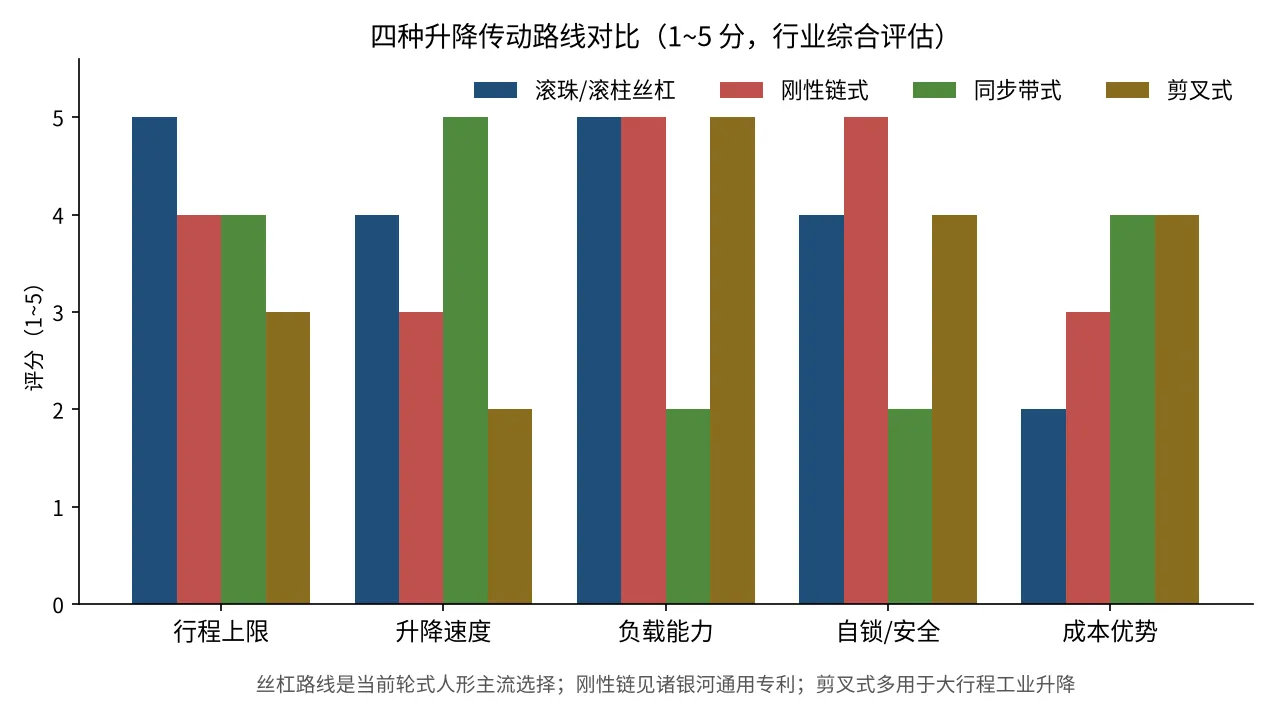
Key engineering numbers for a wheeled-humanoid lift column (from supplier specs): load 300-1000 N (30-100 kg), stroke 300-800 mm typical, speed 40-80 mm/s, life 500,000+ cycles maintenance-free, comms via RS485 / CAN / EtherCAT. JIECANG's JCLC-TN3 is a representative off-the-shelf unit: 800 N load, 60 mm/s, 500 mm stroke, multi-stage options, 485/CAN/EtherCAT. The domestic robot-lift-column market is already sizable and growing ~35% annually; domestic brand share reached 62.7% in 2025, up over 18 points from 2022, with domestic parts priced 20-30% below imports and sample delivery in weeks rather than months.
Model-by-model teardown: who uses what
The table below summarizes the publicly known chassis + lift configurations of representative robots (sources: company announcements, WAIC 2025/2026 coverage, industry reports; where undisclosed, we mark it as such):
| Robot | Chassis | Lift mechanism | Key specs | Chassis source | Lift source |
|---|---|---|---|---|---|
| Galbot G1 (Galbot) | Omni chassis + single-leg hybrid | Rigid-chain lift (patent), 1.73→2.4 m | 92.5 kg; heavy-duty S1 variant: 320 kg chassis, 50 kg payload, deployed at CATL | Self-developed | Self-developed (rigid-chain patent) |
| AgiBot Expedition A2-W (AgiBot) | Omni wheeled base | Torso lift, ~1.73 m working height | ~65 kg, hot-swappable battery | Self-developed | Self-developed |
| AgiBot Spirit G2 | Omni chassis (steering-drive) | Torso lift + 3-DOF waist | 185 kg, launched 2025-10-16; manufactured with Junpu; RMB 100-million-level orders from Longcheer/Joyson | Self-developed (contract-mfd with Junpu) | Self-developed |
| UBTECH Cruzr S2 | Omni-wheel chassis | 0-40 cm lift, ±170° waist | 2 m/s travel speed | Self-developed | Self-developed |
| Keenon XMAN-R1 (Keenon) | Omni chassis | Full-height torso lift | 175 cm, 110 kg, 36 DOF | Self-developed (service-robot chassis heritage) | Self-developed / partner-supplied |
| Astribot S1 (Astribot) | Wheeled base | Rope-driven lift, 170 cm / 80 kg | Focus on upper-body dexterity | Self-developed | Rope-driven (self-developed) |
| Yifei Hongjun (Yifei) | 4-steer-4-drive omni chassis | 0.5 m stroke @ 0.4 m/s | 62 cm narrow-aisle passage; chassis also sold as ODM to other robot makers | Self-developed (also sells it) | Self-developed |
| Zhipingfang Alpha Bot 2 (AI2 Robotics) | Omni chassis | Waist-leg lift, 0-240 cm vertical range | Largest stroke in the segment | Self-developed | Self-developed |
| Xinghai Tu R1 Pro / Xingdong Q5 / ROKAE Helios / Topstar TWH020 | Omni / steering-drive chassis | Various lifts | Q5 has 44 DOF; TWH020 is industrial wheeled humanoid | Mixed self-dev / supplier | Mixed |
| 1X EVE | Wheeled base | Fixed-height torso | Security / patrol use case | Self-developed | — |
Two patterns stand out. First, the leading players (Galbot, AgiBot, UBTECH, Keenon, Yifei) all self-develop their chassis — because for a wheeled humanoid, the chassis IS the platform; buying it off the shelf surrenders the core differentiator. Second, lift mechanisms split by ambition: teams that need compact long-stroke lifts invent their own (Galbot's rigid chain, Astribot's rope drive), while teams with conventional 300-800 mm needs can buy excellent off-the-shelf columns from JIECANG, LINAK or Timotion.
Supplier landscape: who you can actually buy from
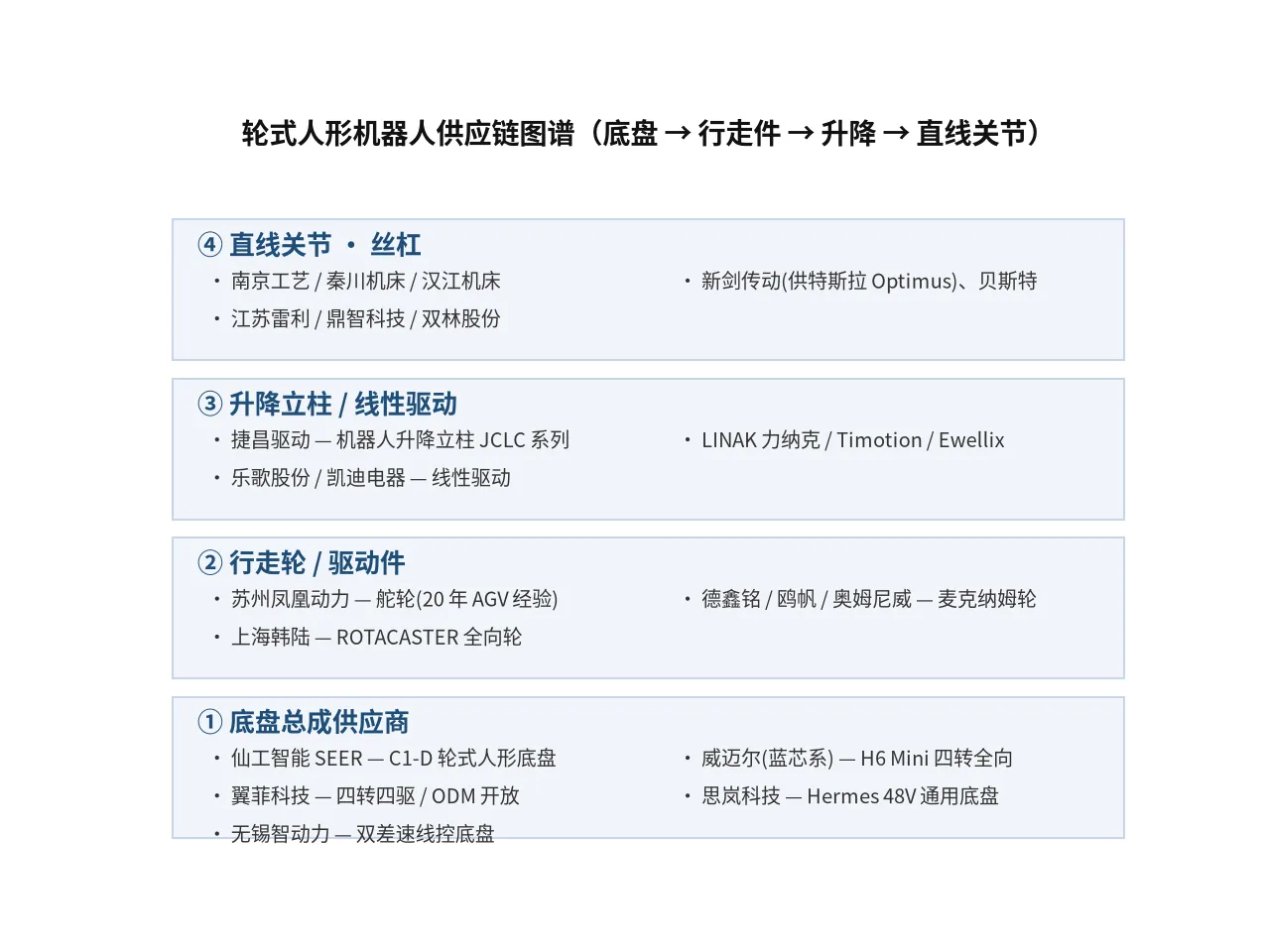
Chassis integrators
| Supplier | Product | Key specs | Notes |
|---|---|---|---|
| SEER SEER | C1-D wheeled-humanoid chassis | 650×650×225 mm, ±5 mm repeat positioning, dual LiDAR, 48V/40Ah | Largest mobile-robot controller ecosystem in China; the C1-D is purpose-built for wheeled humanoids |
| WIMAI WIMAI (a Lanxin Robotics subsidiary) | H6 Mini omni chassis | 550×530×335 mm, 150 kg payload, 20° climb | 4-steer-4-drive omni; targets humanoid integrators |
| Yifei Yifei | 4-steer-4-drive ODM chassis | 0.5 m lift option, 62 cm aisle capability | Robot maker that also sells its chassis as ODM — rare "competitor as supplier" model |
| Slamtec Slamtec | Hermes 48V universal chassis | Lidar + SLAM stack included | Strong in navigation autonomy, lighter payloads |
| Wuxi Zhidongli | Dual-differential chassis | Heavy payload, skid-steer | For logistics-style bases |
Wheels and drive components
- Suzhou Phoenix Power — steering-drive wheel modules, 20+ years of AGV drivetrain experience; the go-to for 4-steer-4-drive wheel sets.
- Dexinming / Oufan / Omniwe — mecanum wheel specialists covering 4-8 inch ranges for low-cost omnidirectional bases.
- Shanghai Hanlu ROTACASTER — omni wheels for smooth, quiet omnidirectional motion.
Lift columns and linear drives
| Supplier | Positioning | Representative product / specs |
|---|---|---|
| Jiecang JIECANG (603583) | Domestic leader; "single-champion" manufacturer; robot-executor business unit | JCLC series robot lift columns; JCLC-TN3: 800 N / 60 mm/s / 500 mm / 485+CAN+EtherCAT; 500k-cycle life; also frameless torque motors; 7-day spec response, 25-day sample delivery; shown at WAIC 2026 |
| LINAK LINAK | Premium Danish brand (est. 1907) | Industrial lift columns, global service network; highest reliability tier, highest price |
| Thomson | US motion-control major | Precision linear actuators for high-end builds |
| Loctek Loctek | Domestic listed linear-drive maker | Cost-effective columns, strong scale; moving from desk-lifts into robotics |
| Timotion Timotion | Taiwan linear-drive brand | Broad series coverage; export-oriented projects |
| Ewellix (ex-SKF) | Precision linear motion | High-precision columns for arm-wheeled hybrid robots |
| Kaidi Electric / Suspa / Geming Transmission / Yishan Technology | Second tier + niche | Various cost/performance tiers |
Market context: domestic brand share of robot lift columns hit 62.7% in 2025 (vs ~44% in 2022), domestic prices run 20-30% below imports, and lead times dropped from months to weeks. The column market is projected to grow at ~35% CAGR as wheeled humanoids scale. Caution: several widely circulated "Top 10 lift-column brand" ranking articles are JIECANG-centric promotional content — use the landscape above, not the rankings, for sourcing decisions.
The precision-screw layer (feeds lift columns and linear joints)
- Nanjing Process Equipment / Qinchuan Machine Tool / Hanjiang Machine Tool — state-owned backbone ball-screw makers.
- Xinjian Transmission — planetary roller screw supplier linked to the Tesla Optimus supply chain.
- Best Precision / Wuzhou Xinchun / Beite Technology / Hengli Hydraulic — roller-screw and linear-component capacity buildout.
- Jiangsu Leili / Dingzhi Technology / Shuanglin — motor + gearbox + screw integrated linear actuators.
Self-developed vs supplier: the real divide
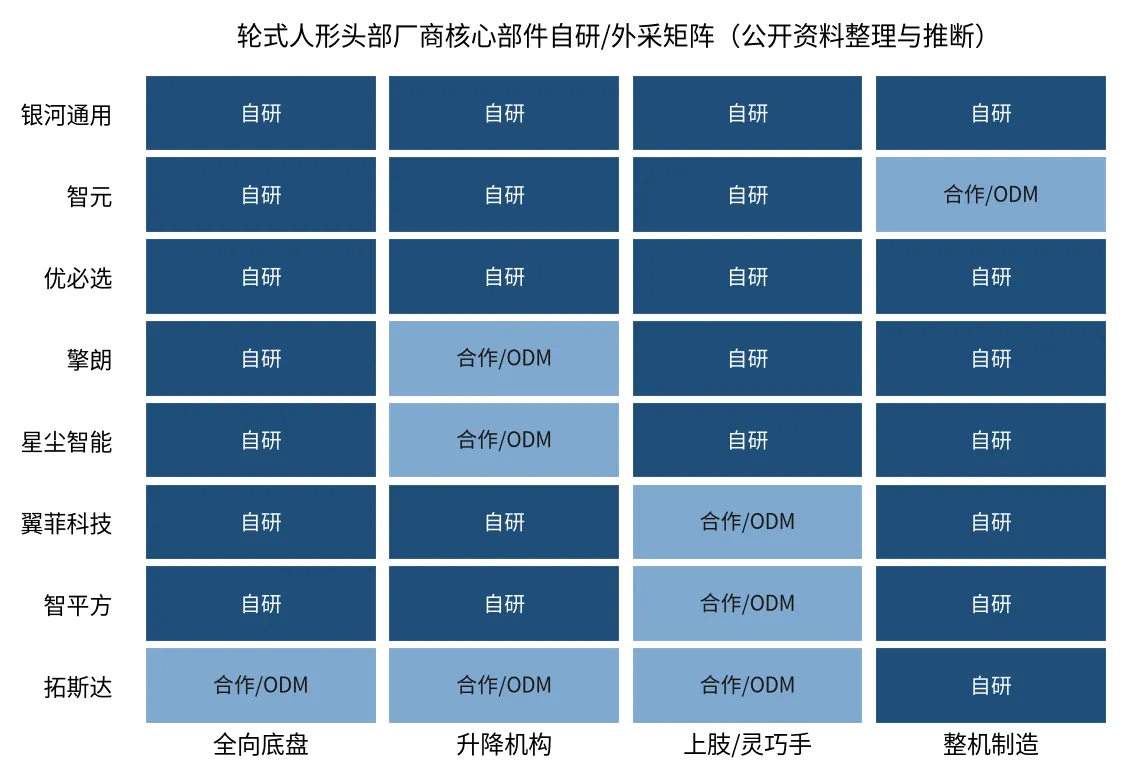
The pattern across the segment is remarkably consistent:
- Chassis: almost universally self-developed. It is the robot's legs, its positioning system, and its interaction interface with the floor — outsourcing it means outsourcing the platform. The exceptions are startups that launch on SEER C1-D or WIMAI H6 bases to reach a demo faster, then re-architect later.
- Lift: self-developed when novel, sourced when conventional. Galbot's rigid chain and Astribot's rope drive are self-developed because no supplier offered what they needed. A 500 mm / 800 N service lift, by contrast, is a commodity — JIECANG/LINAK/Timotion supply it cheaper and better than any robot team could make in-house.
- Upper limbs / dexterous hands: self-developed as a differentiator. This is where the AI value lives; nobody outsources it.
- Manufacturing: the real outsourcing happens here. AgiBot's Spirit G2 is contract-manufactured with Junpu; many teams rely on EMS partners for assembly while keeping design in-house.
flowchart TD
    A["Building a wheeled humanoid?
Three questions before sourcing"] --> B{"Do you need the chassis as
a core differentiator?"}
    B -->|"Yes"| C["Self-develop chassis
(4-steer-4-drive recommended)"]
    B -->|"No — need a demo fast"| D{"Payload > 100 kg?"}
    D -->|"Yes"| E["WIMAI H6 Mini (150 kg)
or Zhide dual-differential"]
    D -->|"No"| F["SEER C1-D (±5 mm, dual LiDAR)
or Slamtec Hermes"]
    C --> G{"Lift: novel stroke/mechanism?"}
    F --> G
    E --> G
    G -->|"Yes (e.g. >800 mm,
compact retraction)"| H["Self-develop:
rigid chain / rope / custom screw"]
    G -->|"No (300-800 mm,
300-1000 N)"| I{"Budget tier?"}
    I -->|"Premium"| J["LINAK / Thomson / Ewellix"]
    I -->|"Value + speed"| K["JIECANG JCLC / Loctek / Timotion
(20-30% cheaper, weeks lead time)"]
Selection guide: matching chassis + lift to your scenario
| Scenario | Recommended chassis | Recommended lift | Why |
|---|---|---|---|
| Restaurant / hotel delivery | Mecanum or dual differential | 40 cm service lift (or none) | Flat floors, cost-sensitive, trays don't need 2 m reach |
| Warehouse / factory handling | 4-steer-4-drive, 100+ kg payload | Screw column 500-800 mm, 800 N+ | Narrow aisles need omni agility; racking needs reach |
| Commercial reception / retail | Omni wheel (quiet) | 40 cm lift + large waist yaw | Noise matters; workspace needs are modest |
| Eldercare / assisted living | Steering-drive, low-speed safety-tuned | Long-stroke lift (0.4-1.8 m) | Must reach floor level and shelf level; safety self-locking mandatory |
| Heavy logistics (pallets/totes) | Dual differential, 300 kg+ class | Scissor or heavy screw platform | Payload dominates; omnidirectionality not needed |
Three selection pitfalls worth flagging:
- Pitfall 1: buying a chassis without validating the SLAM stack. The hardware is only half the chassis; ±5 mm repeat positioning requires fused LiDAR + odometer + visual localization. Ask suppliers for their navigation stack and mapping workflow, not just motor specs.
- Pitfall 2: treating lift columns as interchangeable. Self-locking behavior, duty cycle (S2 vs S3), and comms protocol differ across vendors. A belt-driven column without a brake holding 80 kg at 2 m is a safety incident waiting to happen.
- Pitfall 3: ignoring battery architecture. Wheeled humanoids live or die on hot-swap capability and charging autonomy — AgiBot's hot-swap battery is a feature, not a detail. Design it in from day one.
Conclusion
The wheeled humanoid segment has settled into a clear architecture: omnidirectional chassis (converging on 4-steer-4-drive at the high end) + screw-based lift column + self-developed upper body + contract manufacturing. The supply chain tells an even clearer story than the spec sheets: chassis is platform territory that nobody outsources; lift columns have already become a commoditized, domestically dominated market (62.7% local share, led by JIECANG); and the scarce engineering talent is concentrated in the novel mechanisms — rigid chains, rope drives, 3-DOF waists — that differentiate one robot from the next.
For buyers and integrators: the 2026 sweet spot is buying your chassis from SEER/WIMAI only if you must ship a demo this quarter, and buying your lift column from a domestic leader unless your stroke requirement is exotic. Everything else — the arms, the hands, the brain — stays in-house, because that is the product.
Uncertainties and information gaps
- Lift-mechanism internals are rarely disclosed. Galbot's rigid-chain claim rests on patent filings and teardown reports; Astribot's rope drive on official demos. Others are inferred from stroke/speed/load specs.
- Market numbers mix scopes: IDC's ~18k global shipments (2025) vs various "China ~20k units / 5-9 billion yuan" estimates use different product definitions (some include industrial mobile robots). Treat all market sizing as order-of-magnitude.
- The "Top 10 robot lift-column brands" content circulating in 2026 is promotional material centered on JIECANG; we cite the competitive landscape and the 62.7% domestic-share statistic, not the rankings.
- Self-develop vs supplier assignments in Figure 6 mix company statements, supply-chain reporting, and inference; contract-manufacturing relationships (e.g. AgiBot × Junpu) are public, but component-level BOMs are not.
- Chassis supplier specs (SEER C1-D, WIMAI H6 Mini, etc.) are from vendor datasheets; real-world payload and positioning behavior under dynamic arm loads will differ.