10 Professional Resin 3D Printers for Commercial and Light Manufacturing
A buyer's guide to ten professional resin printers from $4,500 to ~$42,000: build volumes, LCD/DLP/SLA optics, open-material ecosystems and wash/cure workflows that decide real throughput.
Moving from a side hustle into light manufacturing, or building professional-grade prototypes, is where consumer resin printers run out of road. Professional resin systems earn their keep through support, batch throughput, operating experience and material compatibility. Put simply: consumer machines can print, professional machines can produce.
Professional resin printing today serves tooling, molds, prototypes, end-use parts and production parts. Compared with consumer machines, professional systems usually offer larger build volumes, more durable materials and higher reliability, with better consistency across repeated prints and production batches.
People shopping for a professional resin printer usually already know where their consumer machine falls short: parts too large, too many parts per run, or engineering resins with specific mechanical, heat-resistant, flame-retardant or elastomeric properties. Others care more about repeatability, traceability, automated material handling, post-processing efficiency, or simply a machine that can work every day.
So upgrading to a professional resin printer is not about "higher resolution". It is about removing your bottleneck.
Professional resin printing fits these needs:
- Parts close to injection-molded quality
- Complex geometry and fine features
- Very smooth or very soft surfaces
- Functional and engineering materials
- Biocompatible materials
- Transparent parts
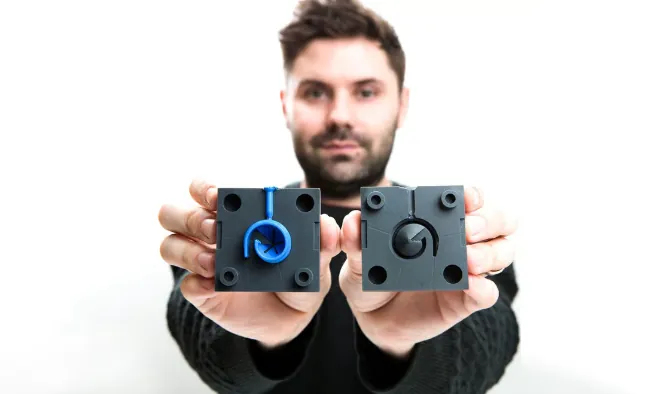
- Repeatable batches or small-series production
There is no single path up from consumer machines. An engineering team may want a compact professional system with a mature material ecosystem; another user wants a large build volume for tooling and prototypes; a service bureau watches throughput and uptime; an R&D department wants an open material platform so it can tune resins in-house.
This guide follows those paths: machines suited to large parts and batches, machines for engineering materials, machines for accuracy and reliability, and machines for automated production. It also spells out the differences between LCD, DLP and SLA, the line between professional and consumer machines, how to choose advanced resins, and when it is simply cheaper to buy printing services.
What Makes a Resin 3D Printer Professional?
The line between consumer and professional is blurry. This guide mainly covers machines in the roughly $4,000-100,000 range (about RMB 28,400-710,000), including wash and cure post-processing equipment. Industrial resin machines get a mention at the end. If your budget is $200-3,000 (about RMB 1,420-21,300), or you are just starting out, a more hobby-oriented guide will serve you better.
Dental and Casting Machines Are Not Covered Here
The resin machine market has changed a lot in recent years. Dental applications make up a large slice of professional resin printing, and many vendors focus on dental exclusively. Jewelry casting and resin printing are also growing, with dedicated machines. Micro- and nano-scale printing uses resin heavily too, but that is another guide.
Remove dental, jewelry and micro-printing, and what remains are machines that manufacture with highly durable and flexible materials. They can certainly print dental and jewelry parts, but their core mission is stiff, accurate, durable components.
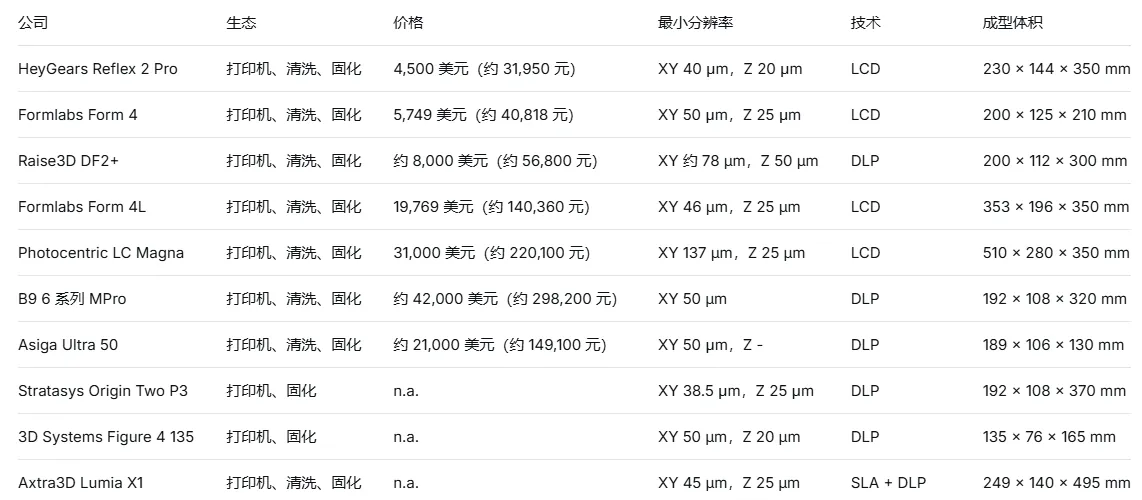
| # | Machine | Technology | Min. resolution (XY / Z) | Build volume (mm) | Price |
|---|---|---|---|---|---|
| 01 | HeyGears Reflex 2 Pro | LCD | 40 / 20 μm | 230 × 144 × 350 | $4,500 |
| 02 | Formlabs Form 4 | LCD | 50 / 25 μm | 200 × 125 × 210 | $5,749 |
| 03 | Raise3D DF2+ | DLP | ~78 / 50 μm | 200 × 112 × 300 | ~$8,000 |
| 04 | Formlabs Form 4L | LCD | 46 / 25 μm | 353 × 196 × 350 | $19,769 |
| 05 | Photocentric LC Magna | LCD | 137 / 25 μm | 510 × 280 × 350 | $31,000 |
| 06 | B9 Series 6 MPro | DLP | 50 / - μm | 192 × 108 × 320 | ~$42,000 |
| 07 | Asiga Ultra 50 | DLP | 50 / - μm | 189 × 106 × 130 | ~$21,000 |
| 08 | Stratasys Origin Two P3 | DLP | 38.5 / 25 μm | 192 × 108 × 370 | Not public, quoted |
| 09 | 3D Systems Figure 4 135 | DLP | 50 / 20 μm | 135 × 76 × 165 | Not public |
| 10 | Axtra3D Lumia X1 | SLA + DLP | 45 / 25 μm | 249 × 140 × 495 | Not public |
01 · HeyGears Reflex 2 Pro and Ecosystem
| Price | $4,500 (about RMB 31,950) |
|---|---|
| Resolution | XY 40 μm, Z 20 μm |
| Technology | LCD |
| Build volume | 230 × 144 × 350 mm |
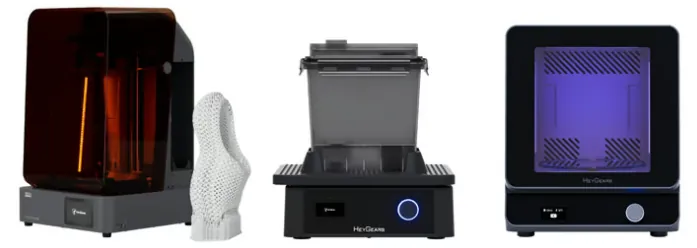
The Reflex 2 Pro is a bridge between high-end consumer machines and pricier professional systems. At this price it delivers 230 × 144 × 350 mm, a genuinely useful volume. More valuable is the automation: a 1,032-zone OptiZone light engine, automatic resin refilling, active temperature control and mixing, debris detection, and automatic compensation for small platform errors.
None of this is chasing resolution for its own sake; it is what makes long jobs and repeated batches steadier. Materials span high-temperature, tough, rigid, clear and elastomer engineering directions. Compared with the cheaper Reflex RS Turbo, the emphasis here is capacity, material capability and production hardware. It pairs with a wash station and a cure unit.
02 · Formlabs Form 4 and Ecosystem
| Price | $5,749 (about RMB 40,818) |
|---|---|
| Resolution | XY 50 μm, Z 25 μm |
| Technology | LCD |
| Build volume | 200 × 125 × 210 mm |
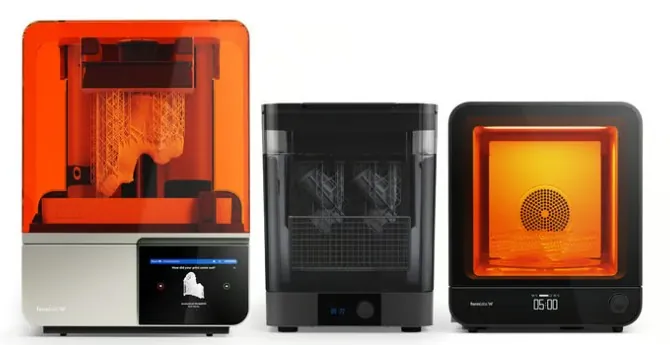
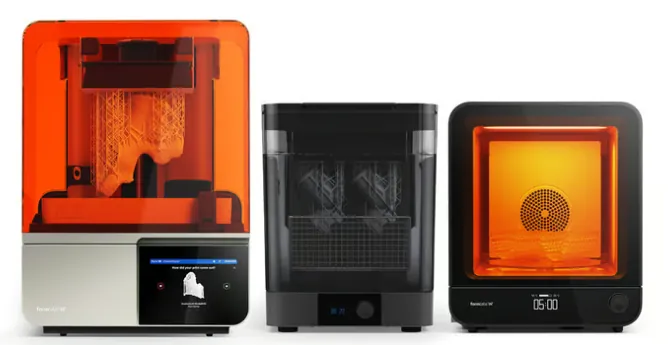
The Form 4 is LCD, i.e. masked SLA. At its core is the Low Force Display: 60 high-power LEDs with collimating lenses curing an entire layer at once. Print time is essentially the same whether the platform holds one part or a full plate. Up to 100 mm/h, with most jobs finishing inside two hours.
Accuracy is specified at ±0.15% XY for 1-30 mm features; 50 μm pixels with pre-tuned anti-aliasing. The company cites a 98.7% print success rate in independent testing. The built-in camera supports remote monitoring, logging and timelapses, and can be switched off, covered or removed, which matters to users under NDAs.
Materials cover 23 Formlabs resins: rigid, tough, general purpose, flame retardant, silicone, elastic, ceramic, casting and more. Open Material Mode costs $875 per machine (about RMB 6,213) and unlocks third-party 405 nm resins. The standard Form 4 does not support biocompatible materials; that requires the Form 4B. PreForm is free.
Post-processing uses Form Wash and Form Cure. Form Wash agitates solvent then automatically lifts and air-dries parts; IPA is recommended, with TPM and Formlabs' own wash fluid also compatible. Form Cure combines 48 LEDs with convection heating, reaching 60 °C in one minute and 100 °C at most, at 14.5 mW/cm² irradiance. General resins cure in 60 seconds, engineering resins within 15 minutes. That is why Formlabs can claim as little as 11 minutes from print to finished part. The Form 4L offers 4.6x the volume.
03 · Raise3D DF2+ and Ecosystem
| Price | ~$8,000 (about RMB 56,800) |
|---|---|
| Resolution | XY ~78 µm, Z 50 µm |
| Technology | DLP |
| Build volume | 200 × 112 × 300 mm |
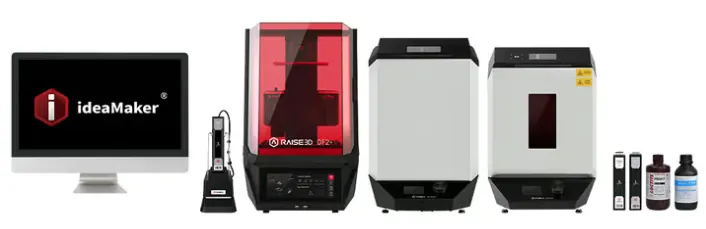
The DF2+ is "real DLP": a projector with industrial optics rather than an LCD mask screen. The light path uses a Texas Instruments industrial-grade DMD and Schott glass, aiming for sharper layers. The headline 100 mm/h comes with very specific conditions: Draft resin, 200 μm layers, 24-26 °C and humidity below 50%. Averaged over its own resins at 100 μm, real-world speed is 50-60 mm/h.
Two details matter for large parts: Air-Peel cuts peel force per layer from 50 kg to 10 kg, and the Z axis is rated for 200 kg. DF Wash and DF Cure are linked by RFID: the resin vat tag confirms the material and pushes print, wash and cure parameters to all three machines. DF Wash holds 14 L of IPA/TPM with automatic draining; DF Cure uses mixed 365/385/405 nm LEDs and handles ø230 × 300 mm.
Materials are the strong suit. The open material platform is free, with no license. Beyond its own 8 resins there are 8 Henkel Loctite and 5 Forward AM Ultracur3D options, including flame-retardant grades. Shops that need ESD or flame-retardant parts can print them in-house instead of outsourcing. A good fit for functional prototypes, fixtures and small-series end-use parts.
04 · Formlabs Form 4L and Ecosystem
| Price | $19,769 (about RMB 140,360) |
|---|---|
| Resolution | XY 46 µm, Z 25 µm |
| Technology | LCD |
| Build volume | 353 × 196 × 350 mm |
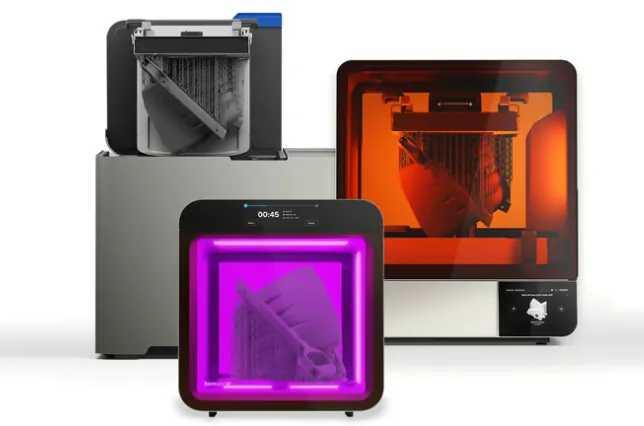
The Form 4L scales up the Form 4's strengths. At 353 × 196 × 350 mm and 24.2 L it is more than four times the Form 4's volume. Engineering teams can print larger prototypes, tools and end-use parts, or many more small parts per run.
It uses Formlabs' Low Force Display masked SLA at up to 80 mm/h depending on material and layer height. Crucially, speed is largely independent of platform fill, so the big platform suits both large parts and batches.
The ecosystem is the familiar Formlabs stack: PreForm, Dashboard remote management, Form Wash L, Form Cure L, and engineering resins spanning tough, rigid, flexible, high-temperature and flame-retardant grades. Open Material Mode supports third-party 405 nm resins, but at a cost.
The US base printer package is $7,125 (about RMB 50,588). It is not the largest machine in this guide, and that is precisely the appeal: clearly more capacity without jumping into a more specialized industrial system. Add Form Wash L V2 and Form Cure L V2 at $4,500 each (about RMB 31,950). Printer plus wash and cure totals $16,125 (about RMB 114,488), excluding resins and accessories.
05 · Photocentric LC Magna and Ecosystem
| Price | $31,000 (about RMB 220,100) |
|---|---|
| Resolution | XY 137 µm, Z 25 µm |
| Technology | LCD |
| Build volume | 510 × 280 × 350 mm |
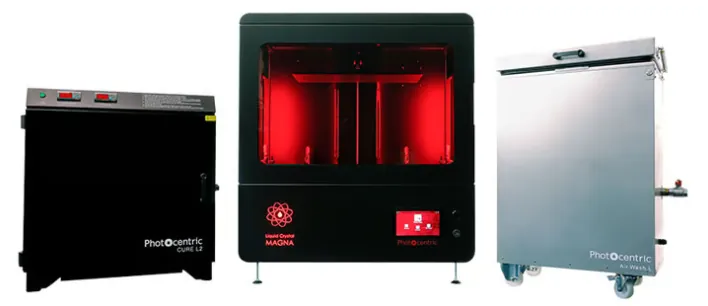
The LC Magna is a large-format LCD with a 50 L volume, one of the biggest machines you can buy without spending six figures. The company claims up to 86 mm/h at 350 μm layers, using its patented Blow-Peel layer separation. A 137 μm pixel pitch is coarse next to 50 μm desktop machines, but it buys a half-meter platform or dense trays of small parts.
Two cost-of-ownership advantages: the screen does not degrade under UV, removing a common UV-LCD consumable cost, and the system is fully open with no license fees on third-party resins. Its own resins cost $40-114 per kg (about RMB 284-809). Designed and assembled in the UK with 97% British components.
Post-processing comes as two dedicated units, both able to hold the entire Magna platform at full height so parts can be washed and cured without leaving the plate, which matters for dimensional accuracy on large parts. Air Wash L is a 90 L wash station with air and bubble agitation at 40 L/min, under 40 dB noise and under 0.5 kW average power, designed for 24/7 operation. Cure L2 uses 405 nm at up to 60 °C in a 550 × 350 × 500 mm chamber with a lid-open power cut. Standard warranty is 12 months.
06 · B9 Series 6 MPro and Ecosystem
| Price | ~$42,000 (about RMB 298,200) |
|---|---|
| Resolution | XY 50 µm |
| Technology | DLP |
| Build volume | 192 × 108 × 320 mm |
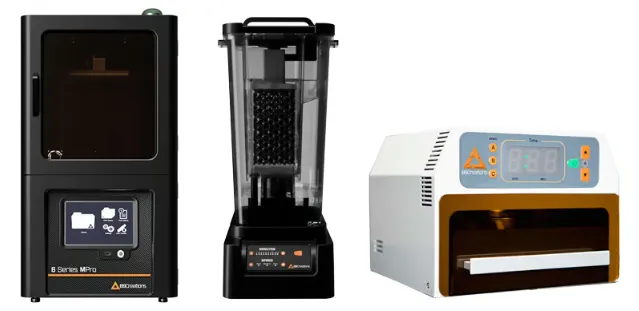
The MPro's highlight is not any single spec but material freedom. Beyond B9's own engineering, elastomer and specialty resins, this 385 nm system is open to third-party materials and custom material settings.
Materials cover Rugged Nylon 6, silicone-like elastomers, ESD, ABS-like and high-detail prototype grades, plus third-party options such as Loctite 3D 3843. R&D teams will like B9Captivate, which lets them develop and optimize print parameters around custom chemistries, with material development support from B9.
Post-processing includes B9Clean for IPA washing and B9 Model Cure plus the larger Model Cure XL for programmable UV curing. The 192 × 108 × 320 mm volume also handles larger functional parts and batches. The real selling point is treating printer and materials as a configurable system rather than a closed ecosystem.
07 · Asiga Ultra 50 and Ecosystem
| Price | ~$21,000 (about RMB 149,100) |
|---|---|
| Resolution | XY 50 μm, Z - |
| Technology | DLP |
| Build volume | 189 × 106 × 130 mm |
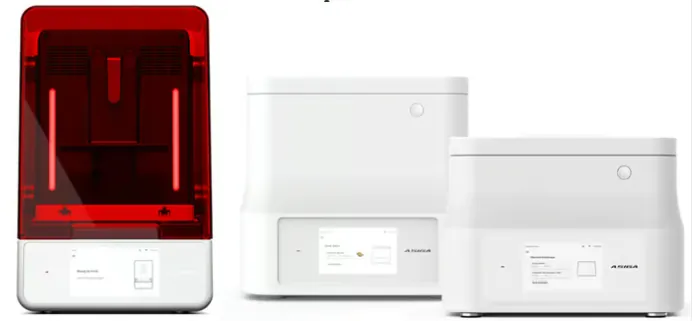
Asiga is known for dental, but its open materials also make it relevant to engineering, R&D and manufacturing. The Ultra 50 is the larger member of the Ultra series, and its biggest draw is the material ecosystem.
It is an open-material DLP machine compatible with more than 650 qualified third-party resins, and users can build their own material parameters. That matters for companies developing applications around specific mechanical, thermal, elastomeric or casting performance.
The Ultra 50 offers a 189 × 106 × 130 mm build volume at 50 μm pixels. The Ultra 32 is smaller but finer at 32 μm, with a 119 × 67 × 130 mm volume. Both are DLP with auto-calibrating 385 nm UV LEDs, customizable to 365 or 405 nm. Add infrared heating, contactless lid opening, fast material change and a magnetic build platform.
Asiga Composer handles preparation and material parameters, with lifetime software updates. Post-processing includes the Flash cure chamber; the more advanced Asiga Cure adds dose-controlled UV, vacuum curing, infrared heating and third-party material profiles. A dedicated wash station is not yet on the market, so cleaning follows resin vendors' manual or ultrasonic recommendations. The Ultra 50 is not big, but accuracy and material freedom are its reasons to exist.
08 · Stratasys Origin Two P3 and Cure Unit
| Price | Not public, sold on quotation |
|---|---|
| Resolution | XY 38.5 μm, Z 25 μm |
| Technology | DLP |
| Build volume | 192 × 108 × 370 mm |
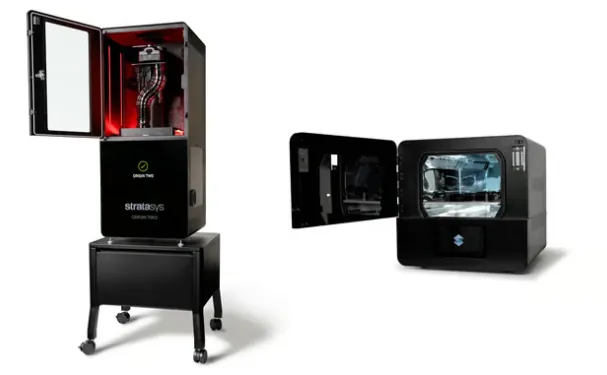
Launched in 2024, the Origin Two is an industrial DLP machine aimed at short runs and on-demand production. Its pitch is high accuracy, repeatability and near-injection-molded surfaces, suitable for end-use parts rather than prototypes alone.
It uses Stratasys' Programmable PhotoPolymerization (P3) with 4K DLP at 38.5 μm pixels in a 192 × 108 × 370 mm volume. A heated chamber supports high-performance and high-viscosity resins, green parts come out strong, and post-processing can be shorter.
Materials include Stratasys-validated tough, elastomeric, high-temperature and medical-grade resins. An optional OpenAM license permits third-party or custom materials with tunable parameters. Post-processing pairs with Origin Cure, offering multi-wavelength LEDs and programmable curing. There is no Origin-branded washer; cleaning follows the resin and validation workflow. Software is GrabCAD Print. Pricing is not public and sold on quotation.
09 · 3D Systems Figure 4 135 and Cure Unit
| Resolution | XY 50 µm, Z 20 µm |
|---|---|
| Technology | DLP |
| Build volume | 135 × 76 × 165 mm |
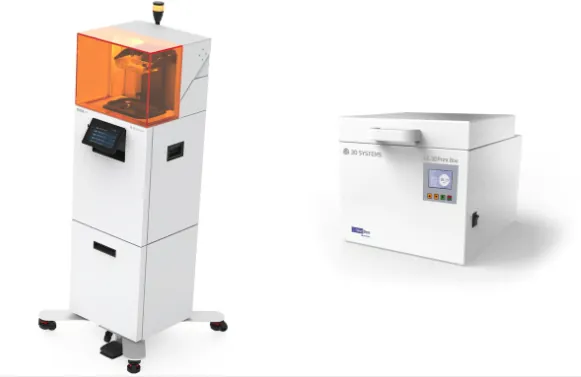
The Figure 4 135 is a 2025 product built for high-mix, low-to-medium volume small plastic parts. Its 135 × 76 × 165 mm volume is not large, deliberately so: the focus is throughput, repeatability and precision batches, such as connectors, housings, sensors and snap fits.
The projection system runs at 50 μm pixels with roughly the same layer speed for a single part or a full platform. Production features include a 9 kg cartridge with automatic feeding, build and material traceability, fleet management, foot-pedal or software-controlled automatic door, and headroom for future robot integration. Materials span tough, rigid, elastomeric, high-temperature and flame-retardant grades.
Post-processing integration is weaker than Formlabs or Raise3D. There is no dedicated automatic wash station today; manual or ultrasonic IPA is typical, with times depending on the resin. Curing is supported by the Figure 4 UV Cure Unit 350 and the smaller LC-3DPrint Box. The Cure Unit 350's 346 mm load height suits the full Figure 4 workflow. This machine fits shops where resin printing already sits inside a repeatable manufacturing process; the small platform is not universal, but automation, traceability and fleet management are the differentiators.
10 · Axtra3D Lumia X1 and Ecosystem
| Resolution | XY 45 µm, Z 25 µm |
|---|---|
| Technology | SLA + DLP |
| Build volume | 249 × 140 × 495 mm |
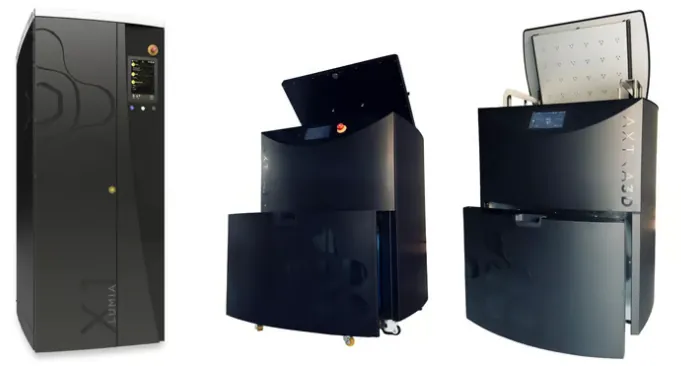
The Lumia X1 targets production, and its core is Hybrid PhotoSynthesis (HPS): DLP and laser combined in one optical system. DLP handles area speed while the laser manages detail and edges, sacrificing as little throughput as possible.
The current X1 offers a 249 × 140 × 495 mm volume at 45 μm resolution with 25-200 μm layers. Dual Z axes, automatic resin handling and the TruLayer separation system keep large cross-sections and high-viscosity materials stable. Applications cover end-use parts, tooling, molds and medical components.
Materials are a strong suit. The system is open and 405 nm compatible, with validated materials from Henkel and other major suppliers. That is attractive to manufacturers who need both production repeatability and specialized third-party formulations.
Post-processing is complete as well: Axtra.Wash automatically washes and dries parts, platform and resin vat with up to three cleaning agents; Axtra.Cure provides 355/385/405 nm multi-wavelength UV plus thermal post-curing; both connect to Axtra.Insight for print, wash and cure traceability. The Lumia X1's pitch is the combination of throughput, fine features, open materials and a production workflow, not any single spec.
Source: 3D Printing Science & Technology (WeChat), "10 Professional Resin 3D Printers for Commercial and Light Manufacturing", adapted from the same-titled long-form post by 3D on X, October 2026 — https://x.com/gewuerleo/status/2112354252089675966. All specifications, prices and images in this article come from that source; prices are the source's USD figures (RMB conversions as given by the source).
Source:3D打印雷哥说 (X) / 3D打印科技 (WeChat)https://x.com/gewuerleo/status/2112354252089675966