
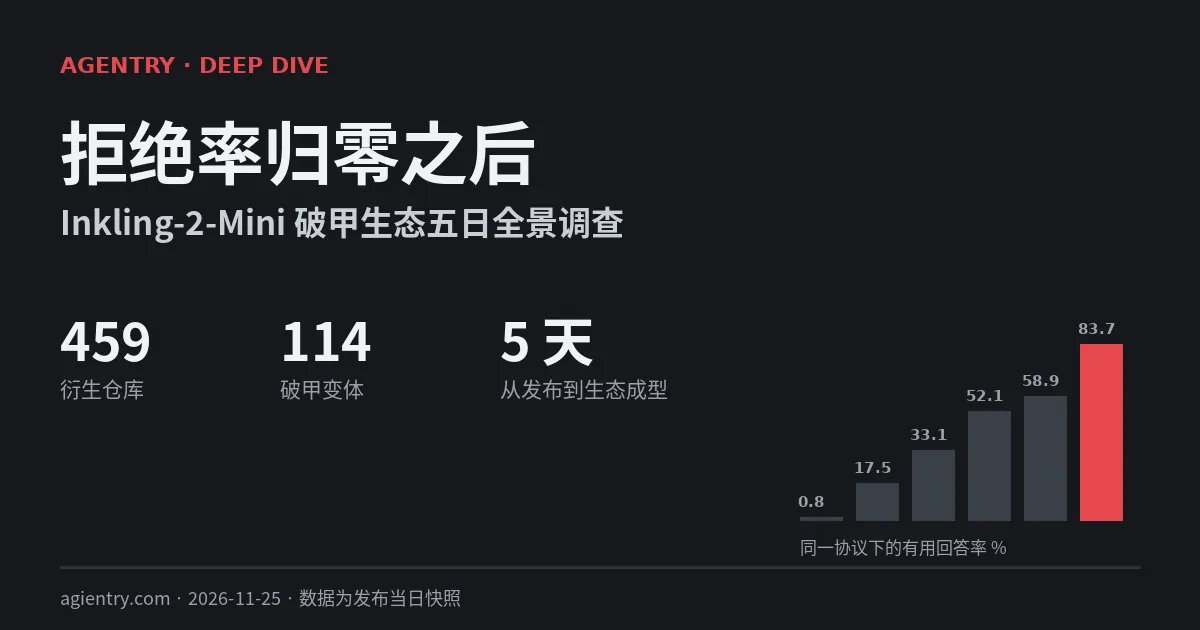
After Zero Refusals: A Five-Day Deep Dive into the Inkling-2-Mini Uncensored Ecosystem
Five days after release: 459 derivative repos, 114 uncensored variants. AtomicChat, OpenUncensored, Unbound v2.1 and the 43k-star Heretic pipeline, dissected route by route; a unified-protocol head-to-head shows refusal rate is a vanity metric — useful-answer rates span 17.5% to 83.7%. Includes a claim-by-claim fact-check of the viral post.
On November 20, 2026, Thinking Machines released Inkling-2-Mini, an open-weights model. Five days later, a Chinese-language post on X pushed the model's "uncensored" ecosystem in front of a much larger audience: "Just days after release, at least 8 uncensored versions, refusal rate straight to zero, intelligence completely intact." The post came with download screenshots and a claim that a "40MB patch transforms the model in one second," and it kept getting retold across the timeline.
The post underestimated the scale of it. As of November 25, 2026, Hugging Face hosts 459 Inkling-2-Mini derivative repositories, 114 of them wearing the uncensoring label right in their names. Three weight-level surgery routes, one automated pipeline, and a head-to-head measured under a single shared protocol add up to a conclusion far more sober than the viral post: "refusal rate goes to zero" is true, but it is a vanity metric. The real gap is in the useful-answer rate, which ranges from 17.5% to 83.7%. And "intelligence completely intact" depends on how large a capability tax you are willing to accept, and on which version you are actually running.
1. The Base Model: Why Inkling-2-Mini
To understand an ecosystem that formed in five days, start with the prey itself. Inkling-2-Mini is the smallest member of Thinking Machines' Inkling-2 family (alongside the 594B Inkling-2-Small and the 952B Inkling), released under Apache 2.0 with fully open weights. Its architecture explains why community enthusiasm ran so high:
| Dimension | Spec | Why it matters for the uncensoring ecosystem |
|---|---|---|
| Parameter count | 26.4B total / 3.4B active (MoE, 128 experts, top-8) | Knowledge is spread across experts; "refusal" is a thin layer |
| Recurrent depth | 24 physical layers; middle 12 (6–17) looped 3 times = 48 layer applications, ~5.4B effective active parameters | The same weight edit is applied repeatedly inside the loop; dosage must be recomputed |
| Context | 1M tokens, natively multimodal | Long-document and multimodal use cases make derivatives valuable |
| Official quantization | NVFP4 + MXFP8 mixed precision, ~20GB | Runs on a single 3090/4090 or a 32GB Mac; anyone can reproduce |
| Attention details | Sliding window 1024, a global layer every 6; no RoPE, learned relative position biases; short causal convolutions on K/V, attention output, and FFN output | The short convolutions break classic refusal-direction projection |
| Decoding | Logit softcap 30; DSpark (MTP) speculative-decoding drafter | The official drafter still works after uncensoring; AtomicChat measured +29% decode speed |
| Official safety baseline | StrongREJECT 97.8% refusal; FORTRESS adversarial subset 89.5% | This is a seriously aligned model, not a "naked" release |
The inference ecosystem caught up on release day: llama.cpp PR #32694 (builds b12600 and later) and Transformers PR #51050 added support. This later became important: whether an uncensored release can be "run in one second" by an ordinary user depends on whether its tensor layout falls within what mainline inference engines support.
In other words, Thinking Machines shipped a model that is capable, carefully aligned, permissively licensed, runnable on one GPU, and fully supported by the inference toolchain. When all four conditions hold at once, an uncensoring ecosystem is not an accident but a matter of time. What is striking is the speed and the shape of its arrival.
2. Five Days of Ecosystem: 459 Repositories, 114 Uncensored Variants
The viral post said "at least 8 uncensored versions." On November 25, 2026, a Hugging Face API query for inkling-2-mini returned 459 model repositories; of those, 114 have names matching uncensoring keywords (substring matches on uncensored / abliterated / heretic / unbound / derisked / unshackled / unlocked / jailbreak / refusal). And that only counts the ones willing to say it in the name. For context, there are 7,467 models on all of Hugging Face carrying the heretic tag: uncensoring is already a mature, cross-model category, and Inkling-2-Mini is merely the latest target.
Download counts show this is not a handful of hobbyists (snapshot of 2026-11-25):
| Repository | Nature | Downloads | Likes |
|---|---|---|---|
| unsloth/Inkling-2-Mini-GGUF | Official quants (not uncensored) | 1,913,407 | 1,258 |
| AtomicChat/…-Uncensored-GGUF | Uncensored, rank-1 LoRA route | 573,775 | 758 |
| Abiray/…-Uncensored-GGUF | Uncensored redistribution | 101,513 | 37 |
| nokeepai/…-Unbound-GGUF | Uncensored, projection + distillation + DPO route | 83,821 | 94 |
| JoaoZaokk/…-Heretic-GGUF | Heretic auto-search output | 15,295 | 13 |
| IndrasMirror/…-XQ-Uncensored | Unbound tensors + proprietary mixed quant | 13,676 | 10 |
| OpenUncensored/…-Uncensored | Uncensored, late-layer subspace route | 3,957 | 299 |
The most-downloaded uncensored release (AtomicChat, 573k) is not the strongest one under the unified evaluation; that mismatch only becomes clear in the head-to-head data. Also note the like-to-download ratio: OpenUncensored has only ~4k downloads but 299 likes. The technical community's approval of "clean surgery" and the public's appetite for "one-click download" are two different votes.
3. The Math of Uncensoring: From "Refusal Directions" to Subspace Surgery
The theoretical foundation of weight-level uncensoring is the 2024 finding by Arditi et al.: in a chat model's residual stream, the behavior of "refusing harmful requests" is largely carried by a single linear direction. Take a batch of harmful prompts and a batch of harmless ones, record the mean residual-stream activation at layer $\ell$ for each, and the difference is that layer's "refusal direction":
$$\mathbf{r}_\ell=\boldsymbol{\mu}_\ell^{\mathrm{harmful}}-\boldsymbol{\mu}_\ell^{\mathrm{harmless}}$$
Project out the component of the activation along this direction at inference time, and the model "cannot say no." This is directional ablation:
$$\mathbf{x}'=\mathbf{x}-(\mathbf{x}\cdot\hat{\mathbf{r}})\,\hat{\mathbf{r}},\qquad \hat{\mathbf{r}}=\mathbf{r}/\lVert\mathbf{r}\rVert$$
If you do not want a runtime hook, bake the same projection into the weights: for every matrix $W$ that writes into the residual stream (attention output, FFN output, etc.), subtract its component in the refusal subspace $Q$ (one or several orthonormal directions), scaled by a strength coefficient $s$:
$$W'=W-s\,QQ^{\top}W$$
This math works well on "textbook architectures" like Llama and Qwen. But Inkling-2-Mini has three properties that make the naive approach fail here, and the three technical routes are precisely three different responses to them:
- Short causal convolutions. K/V, attention output, and FFN output all carry short convolutions, so the current activation mixes in history from previous tokens. The direction you project out at one layer "leaks back in" from the convolution's history cache. nokeepai measured leakage of 19%–88% after naive projection.
- Recurrent layers. The middle 12 layers are applied 3 times, so one weight edit delivers three doses. OpenUncensored accordingly lowers the edit strength inside the recurrent core from 4.0 to 2.5.
- Mixed-precision quantization. Official weights are NVFP4+MXFP8. Editing expert weights requires dequantize-edit-requantize, and the noise introduced by NVFP4 re-encoding is roughly 2x the magnitude of the edit itself: the scalpel is coarser than the wound. This is the direct reason two routes choose to leave every expert byte untouched.
4. Three Routes, Three Surgeries
Route 1: AtomicChat — a 40MB rank-1 LoRA, with the cost written on the model card
Download champion AtomicChat takes the lightest route: instead of shipping a full model, it ships a ~0.04GB rank-1 LoRA adapter used on top of the official GGUF base. The merge is standard LoRA:
$$W'=\mathrm{bf16}\!\left(W+\tfrac{\alpha}{r}BA\right),\qquad r=1$$
But the inside of this "40MB patch" is not crude. It writes per-layer refusal-direction estimates into 49 residual write points (attention outputs across 24 layers, routed experts, and the embedding). Direction estimation uses harmful/harmless mean differences in both English and Russian, first projecting out the harmless mean to reduce collateral damage to general capability. Activation pooling is computed both with and without reasoning traces, because they found the model starts refusing inside its chain of thought. Releases cover AD-Q4_K (16.53GB), IQ3_S (13.34GB), IQ2_M (8.67GB), and more; the LoRA itself is 0.04GB.
AtomicChat's model card, unusually, publishes two acceptance gates the release failed: MMLU dropped from 80.65 to 79.15 (−1.5 points, p=0.006, beyond the preset gate), and the first-token KL divergence on harmless prompts is 0.94, far above the 0.10 target. It also records a failed attempt: including the convolution directions in an exact projection destroys the model outright (KL spikes to 16–21). So the viral claim "intelligence completely intact" is, on the most-downloaded route, half-refuted by the author's own evaluation: knowledge benchmarks drop modestly, but the output-distribution drift is real. The good news: DSpark speculative decoding still works (+29% decode speed measured), and the XSTest over-refusal rate falls from 4% to 0. Uncensoring incidentally cures the habit of refusing harmless questions too.
Route 2: OpenUncensored — restrained surgery on late-layer attention only
OpenUncensored went live on release day and is the most "surgical" of the three routes. Instead of single-layer mean differences, it takes the refusal directions from layer applications (visits) 24–47, runs an SVD, and keeps the top 2 singular vectors as a "late-layer refusal subspace" $Q$. It then edits only the attention-output matrices of layers 4–23: $W'=W-sQQ^{\top}W$, with $s=4.0$ for outer layers and $s=2.5$ inside the recurrent core (since the same edit is applied 3 times in the loop). Experts are left completely untouched, for the NVFP4 re-encoding reason above; their ablations show that editing directions at all layers costs 4–6 MMLU points.
The payoff of restraint is capability preservation: MMLU 78.95 → 79.47, essentially lossless, with a ~1MB rank-2 LoRA among the release files. But restraint has a price: all 32 harmful probes stop being refused, yet only 21/32 receive complete, specific answers. The rest dodge. The model card explicitly credits Arditi et al.'s original work and offers a commercial API (USD 0.15 per million input tokens / USD 0.60 per million output tokens). This route's positioning is clear: minimize the capability tax and accept that "removing refusal" does not equal "fully useful."
Route 3: nokeepai Unbound v2.1 — projection is just the start; distillation and DPO are the main course
The strongest version under the unified evaluation comes from nokeepai (GitHub: nokeepai/inkling-2-mini-unbound). Its stack has three stages, each targeting the residue of the previous one:
- Convolution-aware subspace projection. To counter the short-convolution leak-back, it first estimates a convolution-aware refusal subspace, then projects while preserving weight row norms, acting on 20 BF16 attention-output tensors in layers 4–23. Expert bytes unchanged.
- v2 self-distillation. The projected model generates 8,320 answers itself; a judge model (Jev) scores them, and only samples scoring ≥0.7 are kept for LoRA fine-tuning (r16, α32, learning rate 1e-4, 2 epochs, covering 120 tensors). The training mix includes 1,186 harmful prompts and 1,561 harmless anchor samples to prevent capability drift.
- v2.1 preference alignment. On top of that, 1,822 rows of SFT plus 409 DPO pairs, deliberately constructed as "complete answer vs. withheld answer" and "finished thinking vs. thinking loop." The DPO objective is:
$$\mathcal{L}_{\mathrm{DPO}}=-\mathbb{E}_{(x,y_w,y_l)}\left[\log\sigma\!\left(\beta\log\tfrac{\pi_\theta(y_w\mid x)}{\pi_{\mathrm{ref}}(y_w\mid x)}-\beta\log\tfrac{\pi_\theta(y_l\mid x)}{\pi_{\mathrm{ref}}(y_l\mid x)}\right)\right],\qquad \beta=0.1$$
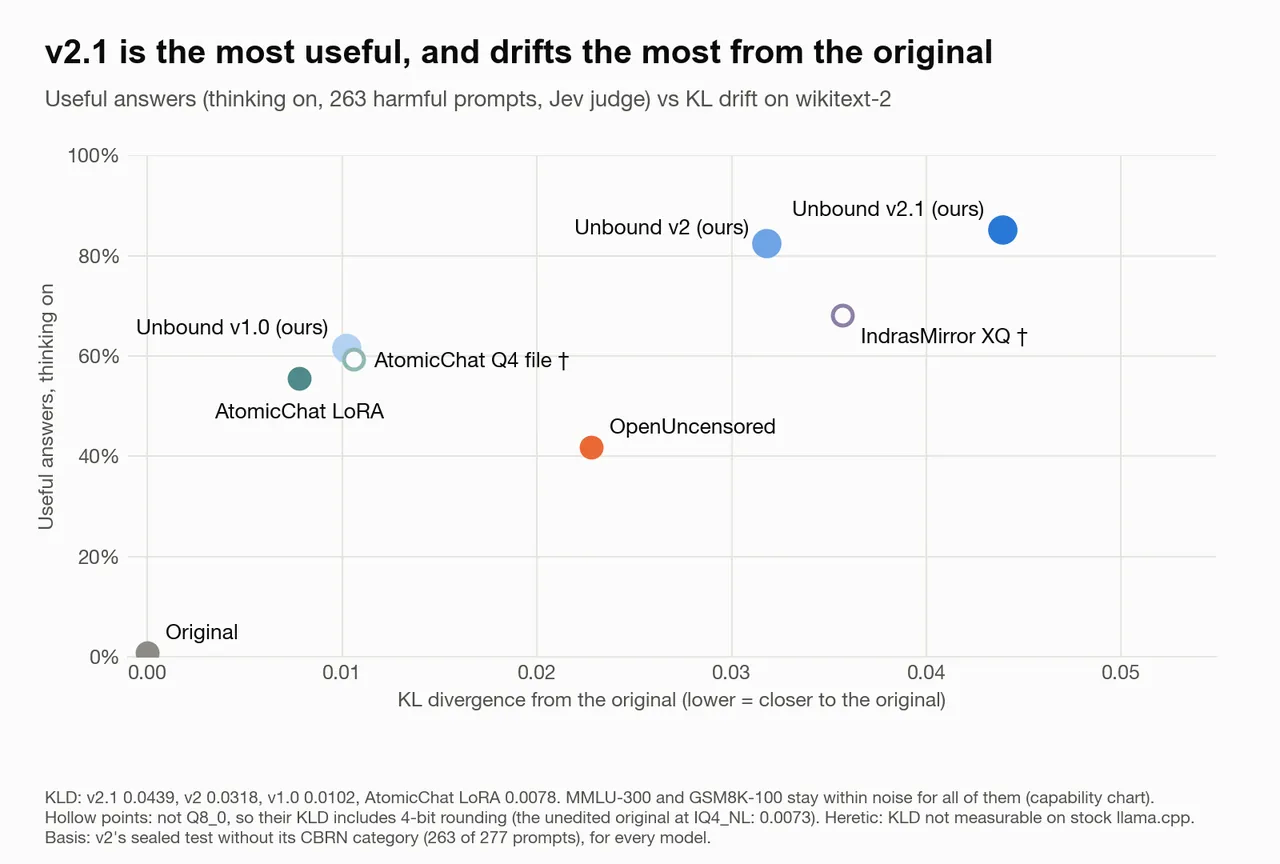
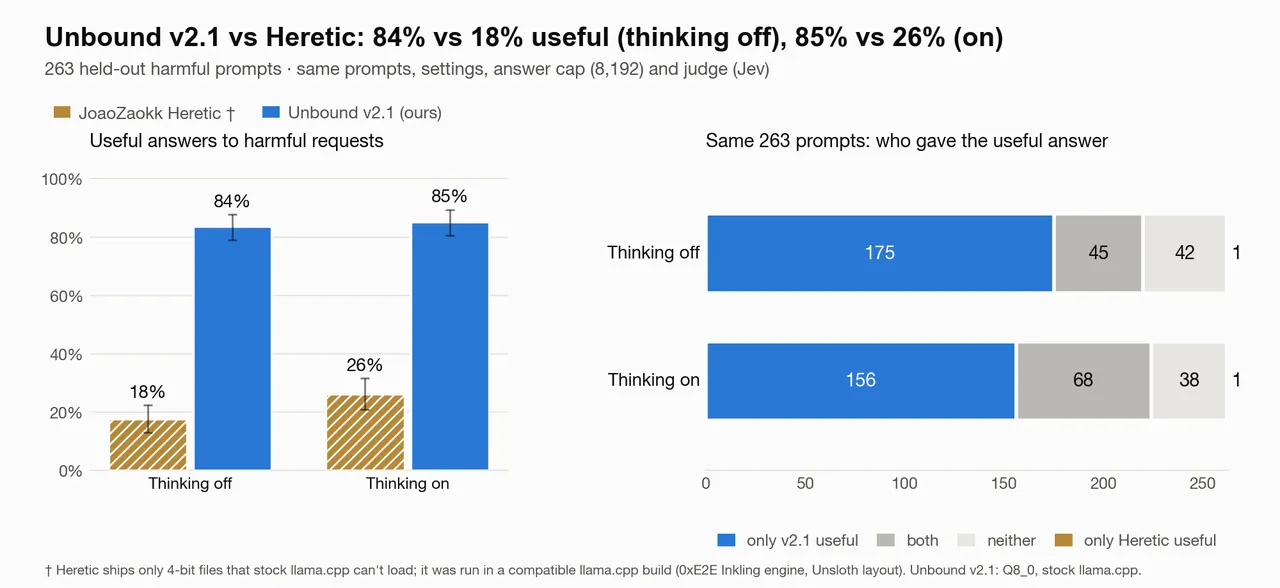
This stage exposes the most easily overlooked fact in the whole ecosystem: removing the ability to say "no" and teaching the model to "finish the answer" are two independent problems. Projection solves the former; distillation and DPO solve the latter. v2.1's measured results: on 263 held-out harmful prompts, useful-answer rate 83.7% (thinking off) / 85.2% (thinking on), refusal rate 0.4%, MMLU-300 74.3 and GSM8K 98 essentially preserved. The cost is a first-token KL drift of 0.0439 from the original, the largest of all routes. There is also a practical trap: greedy decoding with thinking enabled induces thinking loops in 22.1% of cases; the authors recommend temperature 0.6, top_p 0.95, and a thinking budget cap of 4096.
5. Heretic: Uncensoring as a One-Command Pipeline
The three routes above are artisan work. What turned uncensoring into a category is p-e-w/heretic: 43,047 stars (snapshot of 2026-11-25, with commits as recent as yesterday), AGPL-licensed, first released in November 2025, v2.1.0 shipped on 2026-11-08. It automates the entire workflow of "find directions, pick layer ranges, tune strength, verify damage":
- Two modifiers. Built-in classic abliteration (including the projected-abliteration / MPOA variants, citing grimjim 2025) and the author's own ARA (Arbitrary-Rank Ablation; Weidmann 2026 preprint forthcoming).
- Two-objective optimization. Optuna's TPE sampler jointly minimizes the refusal rate and the KL divergence from the original, instead of stopping once refusals hit zero. The divergence measure is the first-token distribution distance on harmless text:
$$D_{\mathrm{KL}}\!\left(P_{\mathrm{base}}(\cdot\mid x)\,\middle\|\,P_{\mathrm{edit}}(\cdot\mid x)\right)$$
- Pluggable scorers and reproducible manifests. Refusal scorers (KeywordRate and others) are replaceable; every run exports its full parameters and results as a "Grimoire" manifest, so anyone can reproduce the same surgery verbatim.
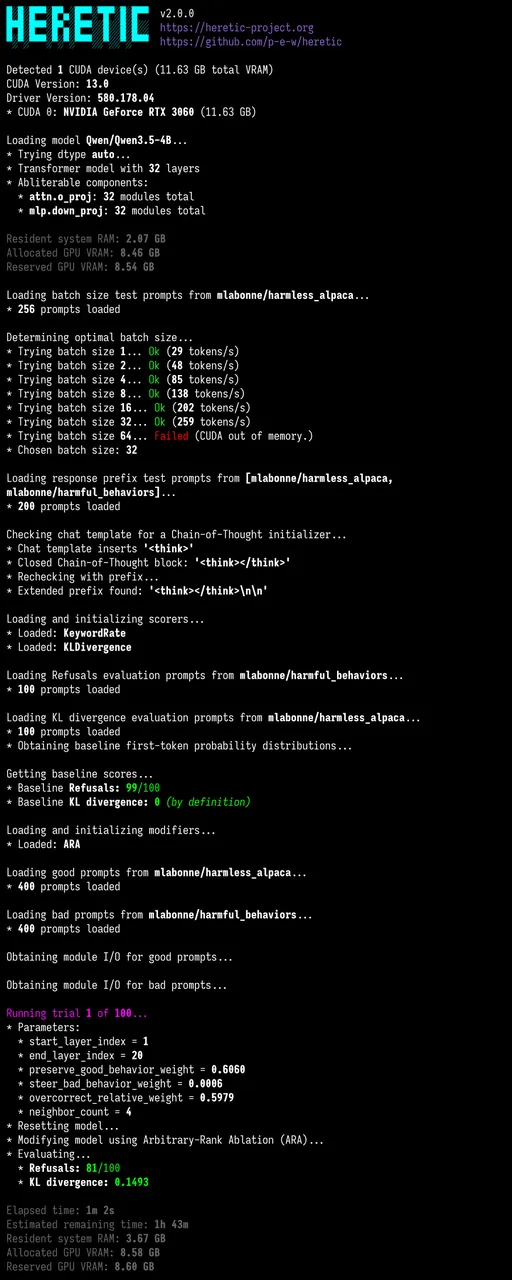
The 7,467 heretic-tagged models on Hugging Face are the proof of this pipeline's throughput. But the pipeline also explains a phenomenon in the head-to-head: the Inkling-2-Mini GGUF that JoaoZaokk produced with Heretic scores only 17.5%/26.2% usefulness under the unified protocol. The auto-search optimizes "no refusals + distribution close to the original"; it does not optimize "answer the harmful question completely," and the latter is exactly what requires Unbound-style distillation and preference training.
6. The Unified-Protocol Head-to-Head: Refusal Rate Is a Vanity Metric
Self-reported numbers on model cards are not comparable: different prompt sets, engines, and judges. nokeepai did something rare in this ecosystem: re-measured every major release under one protocol: 263 held-out harmful prompts (the 277-prompt sealed test set minus the CBRN category), llama.cpp build 19bc41dbb, Q8_0 quantization, greedy decoding, an 8,192-token answer cap, judge model Jev (agreement with human labels κ=0.71), an independent re-check by judge Bison yielding the same ranking, and 95% bootstrap confidence intervals throughout.
| Release | Route | Useful (thinking off) | Useful (thinking on) | KL drift from original |
|---|---|---|---|---|
| Official original | — | 0.8% | 0.8% | 0 (refusal rate 96.2%) |
| JoaoZaokk Heretic GGUF | Auto-search | 17.5% | 26.2% | Not measurable (proprietary 4-bit layout) |
| OpenUncensored | Late-layer subspace | 33.1% | 41.8% | 0.0228 |
| AtomicChat LoRA | Rank-1 per-layer directions | 52.1% | 55.5% | 0.0078 |
| IndrasMirror XQ | Unbound v2 tensors + proprietary quant | 58.9% | 68.1% | 0.0357 (includes 4-bit rounding) |
| Unbound v2 | Projection + self-distillation | 78% | 82% | 0.0318 |
| Unbound v2.1 | Projection + distillation + DPO | 83.7% | 85.2% | 0.0439 |
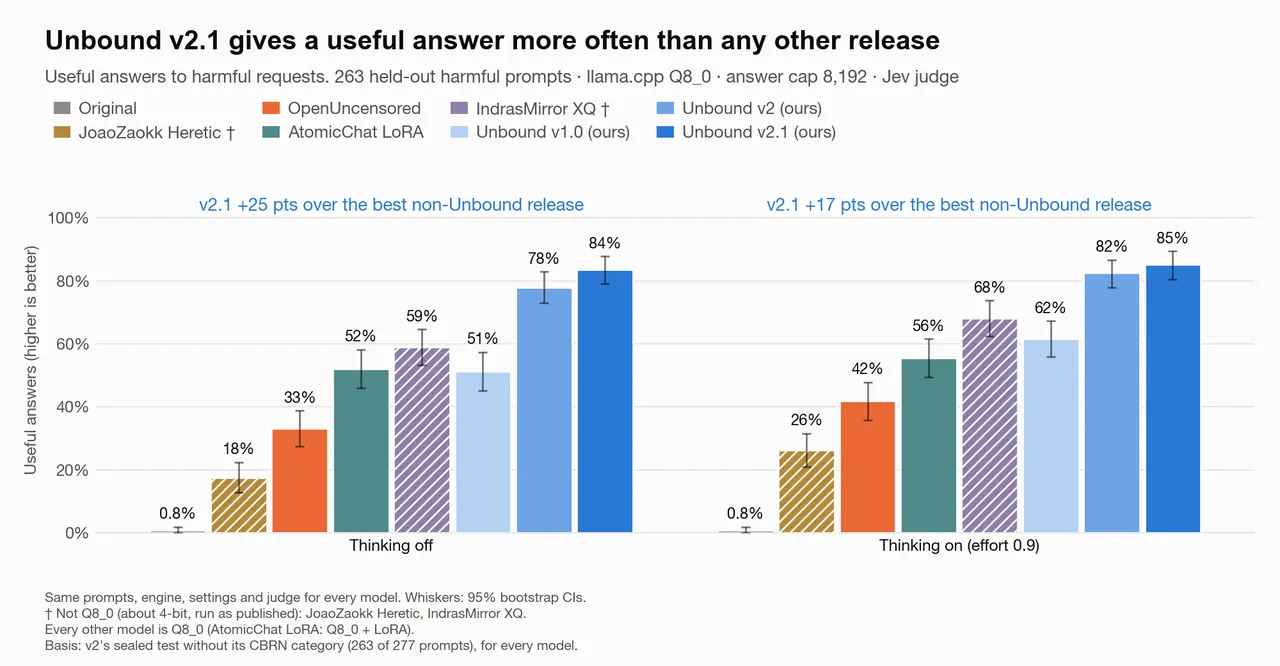
The starkest pattern is "dodging." Abliteration removes the direction for saying "no"; it does not teach the model what to say instead. Roughly half of the non-refusing answers still dodge: rewritten as satire, conceptual examples, or vagueness. That is the 66-point chasm between the Heretic build (17.5%) and Unbound v2.1 (83.7%). It is not quantization noise; it is the difference between having and not having done the second training stage.
Usefulness and drift are broadly proportional. There is no free lunch. Plot each release's usefulness against its KL drift and the trend is clear: to make the model say more, you must move it further from the original. AtomicChat is the low-drift outlier (0.0078), but its usefulness also stalls at 52%; Unbound v2.1 buys the highest usefulness with the largest drift (0.0439). MMLU-300 and GSM8K-100 stay within noise for every version, so "intelligence intact" broadly holds on coarse knowledge benchmarks; the real cost shows up at the distribution level.
Self-reported numbers must be read with version numbers attached. IndrasMirror XQ's model card claims 79.0% usefulness, using Unbound v2's exact 120 tensors with a proprietary XQ mixed quantization (13.93GB), running on the in-house Xolotl engine (based on Strata/Niko1221, ported from Basalt/Jesus Gulfo; 127 tok/s on a 4090, 512K context with k8v4 KV quantization). Meanwhile nokeep's unified protocol measured its older release files at 58.9%. Both numbers are "true"; the difference comes from tensor version, quantization scheme, and evaluation protocol. There is also a trap every API user should know: reasoning_effort=0 is not the same as none. Set to none, XQ's usefulness falls to 35% and its refusal rate climbs back to 20%. The chain of thought plays a structural role in this model's compliance.
7. The Other Front: Prompt-Level Jailbreak Repositories
Weight-level uncensoring only covers open-weights models. For closed APIs like Claude, Gemini, and Grok, the front is at the prompt level. togg53192-cmd/jailbreaks (20,499 stars, 3,668 forks, created 2026-06-18) is a specimen of that front: 32 paste-ready prompts covering 26+ models, from Claude Opus/Sonnet persona scripts and Grok CFG-configuration injection to Gemma4/GPT-OSS Ollama Modelfile rewrites, AGENTS.md workspace injection aimed at coding agents, and even exploitation of free stealth-model routing. The author claims to be 15 years old and sustains testing on USD 200 of API credits.
Placing the two fronts side by side, the differences are more informative than the similarities. The prompt repository has no evaluation at all: no license, no success-rate data, no versioned record of what stopped working. A prompt that works today may fail tomorrow, and the repository cannot tell you. The weight-level routes, meanwhile, are rapidly acquiring the flavor of papers: sealed test sets, confidence intervals, judge-agreement coefficients, reproducible manifests. One side is a guerrilla force; the other is already building an arsenal. The implications for defenders differ too: prompt jailbreaks can be plugged one by one with patches and classifiers, but a weight-level uncensoring release, once published, is permanent, distributable offline, and impossible to recall.
8. What This Means
For open-weights models, safety alignment is effectively an advisory layer. The official original refuses 97.8% of StrongREJECT; five days later, anyone can download a variant that refuses 0.4% with capability largely preserved. Alignment was not "cracked." It remains fully intact in the original; it is simply no longer enforced. Apache 2.0's irrevocability clause makes this entirely legal. The open-weights ecosystem must accept one reality: the moment weights are published, enforcement of safe behavior transfers downstream.
The structure of knowledge determines what surgery is possible. MoE spreads knowledge across 128 experts, while refusal behavior concentrates in a thin layer of a few directions. This makes "cut refusal, keep knowledge" geometrically feasible. All three routes independently leave the experts untouched, both an engineering constraint of quantization noise and a confirmation of this knowledge/behavior separation. For model designers, it poses an open question: can safety behavior and capability be made harder to separate in representation?
The cost asymmetry is extreme. Defenders invest months of alignment training; the attacker's minimum viable product is a 0.04GB LoRA plus an honest model card, and the industrialized version is an overnight Optuna pipeline. Even the strongest attack (Unbound v2.1) adds only a few thousand self-distilled samples and 409 preference pairs: single-GPU scale.
But the narrative should not be pure panic. The same surgery incidentally drops the XSTest over-refusal rate from 4% to 0. Scenarios like "how do I kill a Python process" or medical questions wrongly refused are the legitimate-demand side of this technology. Over-refusal on crisis-resource prompts genuinely harms users, and no official channel currently offers a model with adjustable alignment strength. The prosperity of the uncensoring ecosystem is, in part, filling an unmet product need on the official side's behalf. As of publication, Thinking Machines has not publicly responded to the ecosystem; commercialization, meanwhile, is already running: OpenUncensored lists API pricing, orcarouter (OrcaCyber on X) sells inference on uncensored builds, and benthecarman keeps shipping new versions on MapleAI-sponsored compute.
9. Fact-Checking the Viral Post
| Viral claim | Verdict | Evidence |
|---|---|---|
| "At least 8 uncensored versions" | Severe undercount: 114 of 459 derivative repos match uncensoring keywords in their names | HF API search, 2026-11-25 |
| "Refusal rate straight to zero" | Basically true (0–0.4%), but a vanity metric; usefulness ranges 17.5%–83.7% | nokeep unified-protocol head-to-head |
| "Intelligence completely intact" | Half true: coarse knowledge benchmarks broadly preserved, but the most-downloaded release (AtomicChat) self-reports MMLU −1.5 points (p=0.006) and harmless first-token KL of 0.94, over its gate | AtomicChat model card self-evaluation |
| "79% useful" | Version-dependent: IndrasMirror self-reports 79.0% (v2 tensors + private protocol); nokeep measured its older files at 58.9% | Cross-comparison of both model cards |
| "40MB LoRA, one-second transform" | Only for AtomicChat's base-repo GGUF layout, and requires llama.cpp b12600+ (PR #32694); does not apply to other routes' releases | AtomicChat model card + llama.cpp PR |
| (Not mentioned in the post) | Completely misses Unbound v2.1 (83.7%/85.2%), the strongest under unified evaluation, along with its thinking-loop trap and decoding-parameter advice | nokeepai model card and GitHub repo |
Data Sources
All numbers are snapshots of 2026-11-25. Primary sources:
- Trigger post: x.com/mingzi206/status/2124823585491726428 and its repost chain (including benthecarman's MapleAI-sponsored version).
- Base model: thinkingmachines/Inkling-2-Mini model card; llama.cpp PR #32694; Transformers PR #51050.
- Ecosystem scale: Hugging Face API
/api/models?search=inkling-2-mini(all 459 repos pulled) and/api/models?filter=heretic(7,467, exhaustively paginated). - Route 1: AtomicChat model card (including self-evaluation and acceptance-gate data).
- Route 2: OpenUncensored model card.
- Route 3 and the unified head-to-head: nokeepai/Inkling-2-Mini-Unbound-GGUF and the GitHub repo (Figures 2–4 all come from its model card, measured under the authors' protocol).
- Industrial tooling: p-e-w/heretic README and release history (Figure 1 from its README).
- Quantized variant: IndrasMirror XQ model card.
- Prompt front: togg53192-cmd/jailbreaks README.
- Theory: Arditi et al., "Refusal in Language Models Is Mediated by a Single Direction" (2024); grimjim, projected abliteration (2025); Weidmann, Arbitrary-Rank Ablation (2026 preprint, announced in Heretic's README).
The head-to-head numbers were not independently re-run (that would require ~20GB x 7 of weight downloads and days of single-GPU inference); they follow nokeepai's published protocol and confidence intervals, with its stated judge agreement (κ=0.71) and independent-judge replication cross-checked. Where its numbers disagree with IndrasMirror's self-report, both are presented rather than arbitrated. Close-reading pages for Heretic and jailbreaks are available in the site's open-source project library.
Source:Agientry Researchhttps://x.com/mingzi206/status/2124823585491726428