Fable 5.2: How to Turn It Into a Fully Automated Full Stack System
How Fable 5.2 drives five creative tools through generated scripts, with distinct fixes for knowledge-cutoff gaps and training-distribution bias.
A model release usually improves the output produced inside an existing workflow. Fable 5.2 changes the workflow itself. The same model can write scripts for 3ds Max, Unreal Engine, Blender, Illustrator, and Figma, while each application supplies its own way to prove whether the result is correct.
The important loop is not "model generates asset." It is "model generates executable instructions, the host application runs them, and the application returns a concrete failure or a rendered result." The model does not need to be trusted. It needs to be graded.
For readers working on physical-AI infrastructure, the architectural lesson extends beyond these five desktop applications. Simulation environments, synthetic-data tools, 3D asset preparation, and technical visualization all expose the same opportunity: put the domain contract in context, let the model write against it, and make the toolchain reject anything that does not satisfy it.
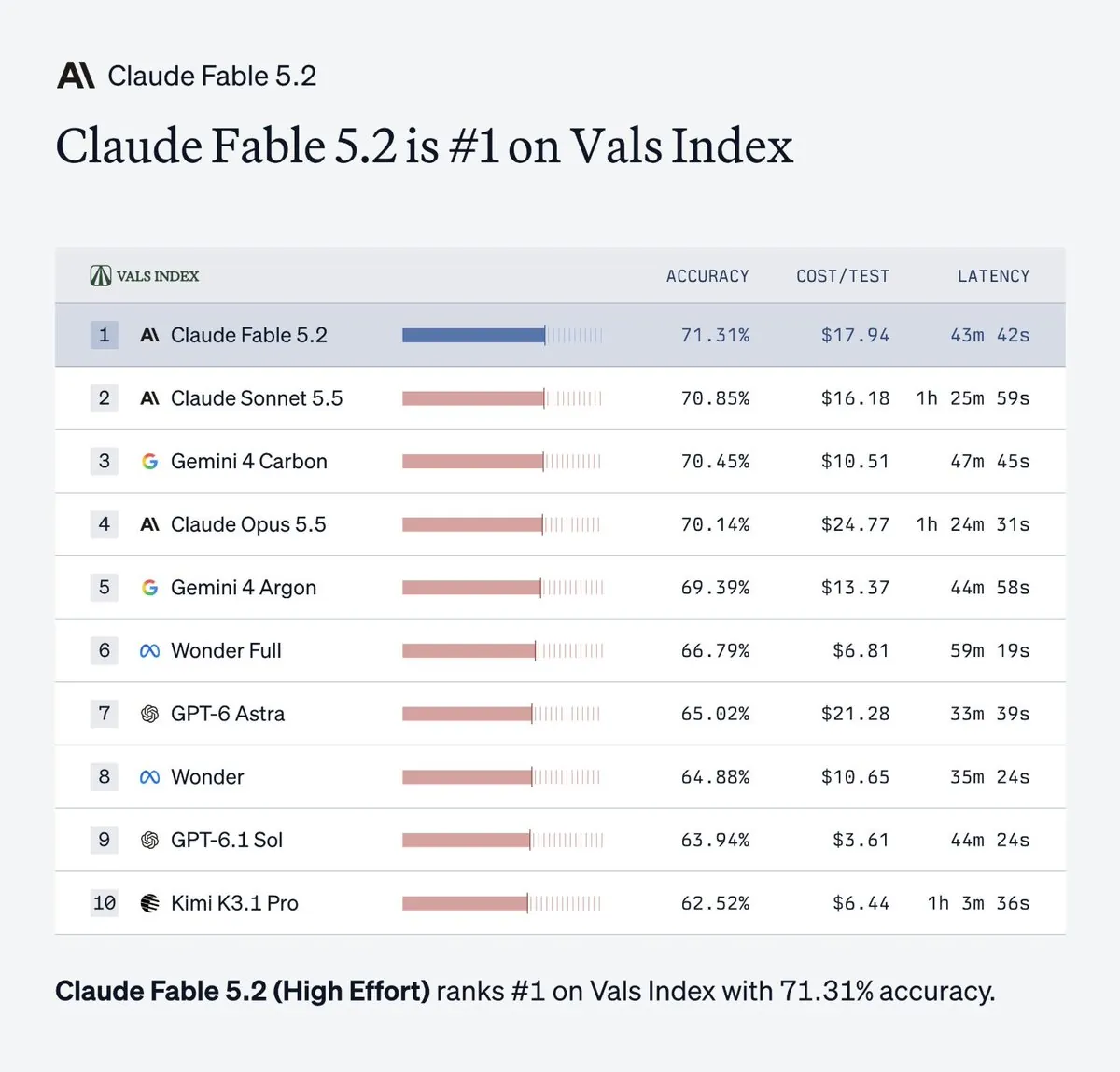
Fable 5.2 shipped on November 9, 2026 under the model string claude-fable-5-2. The source cites a 1M-token context window, 128K maximum output, $8 per million input tokens, and $40 per million output tokens, a price 20% below Fable 5.1. Its reliable knowledge cutoff is June 2026.
Two facts create the engineering problem. The tool stack is programmable enough to support a generate-and-grade loop, but the model has an incomplete and statistically biased picture of the APIs it must write against. Most discussions collapse those issues into one vague "knowledge cutoff" problem. They require different fixes.
The two walls
The first wall is the cutoff: changes made after June 2026 cannot be in the model's reliable knowledge. Two of the five applications changed on the wrong side of that boundary.
Blender 5.2 LTS, July 14, 2026. The Geometry Nodes modifier property API changed shape completely. Add-ons that drove Geometry Nodes through the former Python pattern broke.
Figma Plugin API, Updates 132 through 141. Ten updates landed between July 29 and October 15, 2026, including OKLCH color, variable fonts, easing and timing variables, and text-wrap styles.
The second wall is distribution: changes that happened before June 2026 are represented in the training data, yet the model still returns an older pattern. A single recent release is buried under years or decades of historical examples, so the most frequent pattern wins.
The other three applications sit behind this second wall.
Illustrator has no public UXP API. This was true in June and remains true now. The model reaches for UXP because modern Adobe documentation establishes it as the company's current extensibility platform.
Unreal's editor Python API is Experimental. Epic has labeled it that way since Unreal Engine 5.7 shipped on November 14, 2025. The model often writes against it as if the surface were stable.
3ds Max 2027 moved its foundation. The release uses .NET Core 10, Qt 6.8, and C++20 and shipped by April 2026. One new release is competing against two decades of Max scripts in the model's training distribution.
The repairs are not interchangeable. This is the central point of the article.
The cutoff wall is repaired by pasting. Put the current release notes into the cached context. There is no other route, because the model has no latent representation of information that did not exist when it was trained.
The distribution wall is not repaired by pasting alone. The model has already encountered these APIs. Pin the exact version at the beginning of the request, then make the tool reject output written against the wrong era. A statistical pull toward old code is stronger than an abstract instruction.
Why this is economical
Fable 5.2 accepts text and images and returns text. It does not paint, model, or render. In all five applications it produces a script, and the application executes that script. That sounds like a limitation until you inspect what these five surfaces already expose.
| Tool | Scripting layer | Language | The gate |
|---|---|---|---|
| 3ds Max 2027 | pymxs, MAXScript | Python, MAXScript | Exception on execute |
| Unreal Engine 5.7 | Editor Python, Blueprint | Python | Cook result |
| Blender 5.2 LTS | bpy | Python | Add-on registration |
| Illustrator | ExtendScript, CEP | JavaScript | Script error |
| Figma | Plugin API | TypeScript | tsc compile |
Five programmable surfaces, five automatic graders. None of them needs a model that can draw. None of them needs a human to manually inspect every diff before the result can be evaluated.
The full specification fits in the 1M-token window. Cache reads cost $0.20 per million tokens, so keeping the same reference material alive across retries is inexpensive.
| Mode | Input per million | Output per million |
|---|---|---|
| Standard | $8 | $40 |
| Batch | $4 | $20 |
| Fast mode, up to 2.5x | $16 | $80 |
| Cache read | $0.20 | Not applicable |
A full API reference may be around 200K tokens. The first pass costs roughly $1.60 to read it; writing it into a one-hour cache costs $3.20; every later pass costs about four cents. Four cents per correction is what makes a generate-and-grade loop practical. The benchmark result is not the economic unlock; the retry price is.
One calling convention changes how every example works. Adaptive thinking is always enabled in Fable 5.2 and cannot be switched off. Passing thinking with a token budget returns HTTP 400. The available control is effort, with five settings: low, medium, high, xhigh, and max. The default is high.
The source summarizes the documentation's recommendation directly: start at high because most of the gain is already there; use xhigh only for long-running agentic work where a benefit has been measured; reserve max for finding the ceiling rather than for production.
1. Hand 3ds Max a drawing, not a description
The first demonstration starts with a floor-plan image and a table of dimensions. Nothing is modeled by hand.
Fable 5.2 reads images. The source cites a 73.4% score on Chartography, which tests chart and diagram reading without tools. That capability makes the entry point practical: a floor plan goes in as an image, and a table of millimetres comes out.
The table is the contract. Once the table exists, the script can be almost boring: walls are walls, door openings are openings, slabs are slabs, and the geometry functions consume numbers instead of adjectives.
from pymxs import runtime as rt

def wall(x, y, length, height, thickness):
    w = rt.Box(length=thickness, width=length, height=height)
    w.position = rt.Point3(x, y, 0)
    return w
Three design decisions make the workflow survive contact with a real plan.
Use millimetres, never adjectives. The table carries numbers only. "Spacious living room" produces a box. A room specified as 5400 by 3900 produces a room.
Use one function per element type. Walls, openings, slabs, and trim each take numbers and return an object. The model fills the table; the functions do the geometry.
Export USD. USD for 3ds Max sits at version 0.14.0 in the 2027 release and is aimed at production stability. It is the handoff format, so the apartment can leave Max without a separate conversion step.
A description of a wall is a guess. A dimension table is a wall.
2. Pin the Max version because 2027 changed underneath
3ds Max is the mildest case of the distribution wall, which makes it a useful example.
3ds Max 2027 is not 2026 with a few features bolted on. Its foundation moved to .NET Core 10, Qt 6.8, and C++20, and it shipped by April 2026. The model has seen that release. It has also seen every Max script written since 2005, and the older scripts greatly outnumber the new ones.
The result is code aimed at an average of all versions instead of the version actually installed.
Use pymxs for scene construction. Geometry, materials, transforms, and modifiers are a stable surface and the strongest area for generated code.
Build UI and panels by hand. Qt 6.8 and .NET Core 10 are a human debugging problem this year. The payoff does not cover the debugging cost.
Put the version in the first line of the prompt. Not in the middle and not in a system block thousands of tokens above the request. First line, every request.
A model that knows your version writes code. A model that averages your versions writes homework.
3. Unreal's Python API is Experimental, so keep that layer thin
Open Epic's Python API documentation for Unreal Engine 5.7 and the title says Experimental. It has said so since November 2025.
Experimental does not mean deprecated, unsupported, or useless. It means the API surface may move between releases. Four hundred generated lines of editor automation against a moving surface create a maintenance bill with a delayed due date.
A workable division of responsibility looks like this:
Data tables, yes. Material parameters, weapon stats, spawn tables, and curve assets are plain data the engine reads, with little API surface to break.
Commandlet arguments, yes. Cook and build invocations are command-line contracts, and those are comparatively stable.
Blueprint graph data, carefully. Prefer node graphs represented as structured data that the editor imports over Python that walks the editor step by step.
Deep editor automation, no. Anything that drives the editor through dozens of Python calls should be written once, by hand, and reviewed.
The cook is the grader here, and it is the slowest grader of the five. That feedback latency is another argument for keeping the generated surface small.
Material graphs are the one candidate for raising effort. They carry many interacting parameters, and small mistakes may become visible only under moving light. The source notes a reported 49.1% FrontierCode 2.0 score at xhigh and treats this as the kind of work the effort guidance has in mind. The rule still applies: raise effort where the benefit can be measured.
Experimental is not a warning against use. It is a warning against volume.
4. Forced tool use is gone, and many harnesses depended on it
This is the migration note to read before changing any other part of an agent harness.
Fable 5.2 removed forced tool use. Both older forms return HTTP 400.
# 400 on Fable 5.2
tool_choice = {"type": "any"}
tool_choice = {"type": "tool", "name": "write_script"}

# works
tool_choice = {"type": "auto"}
tools = [{"name": "write_script", "strict": True, ...}]
Any pipeline that guaranteed structured output by forcing a tool call on every turn has turned that guarantee into an error response. The replacement is auto with strict: true, or JSON outputs. Organizations using customer-managed encryption keys cannot use structured outputs at all, so strict tool mode comes off and validation must move into application code.
There are two more edges to know before hitting them in production.
Computer use has moved. The current toolset is
computer_toolset_20260801. The oldercomputer_20251124returns 400 everywhere except Amazon Bedrock. This matters because OSWorld 2.1 reaches 89.3%, making desktop control a real fallback when no scripting API reaches the target application.
Editing earlier turns invalidates thinking. Changing the system prompt, tools, or a prior message returns 400 unless
thinking.block_binding.prefix_mismatch_behavioris set to"drop_block". Keep history append-only, or explicitly opt out.
A beta feature makes the second restriction easier to live with: mid-conversation tool changes under the flag inline-tools-2026-09-15. Tools can be added or removed in a system role message rather than by rewriting the tools array, so the prior history stays append-only. In a five-application session where every application needs its own tools, that is the difference between one conversation and five.
A model upgrade changes output quality. An API change decides whether there is any output at all.
5. Blender 5.2 broke the pattern every procedural script used
Blender is the cleanest cutoff example of the five. Version 5.2 LTS landed on July 14, 2026, one month after the reliable knowledge cutoff. Geometry Nodes modifier inputs and outputs stopped being custom properties and became real RNA properties.
# before, and what the model writes
modifier["identifier"] = 5.0
modifier["identifier_use_attribute"] = True
modifier["identifier_attribute_name"] = "some_input_attribute"

# 5.2
modifier.properties.inputs.identifier.value = 5.0
modifier.properties.inputs.identifier.type = "ATTRIBUTE"
modifier.properties.inputs.identifier.attribute_name = "some_input_attribute"
modifier.properties.outputs.identifier.attribute_name = "some_output_attribute"
The bracketed dictionary-style access is how Python had driven Geometry Nodes for years. Every add-on using it broke at once.
Blender 5.2 did not stop there.
Sculpt automasking moved. Seventeen properties left Paint and Brush for a new
MeshAutomaskingSettingsstruct atmesh_automasking_settings.
Socket identifiers changed on the Compare and Random Value nodes.
UILayout.template_palettelost its color argument.
IDProperty nesting is capped at 1024 levels. It was previously unlimited.
Active asset-library indices shifted. All Libraries and Essentials now occupy the first two slots, so the index no longer lines up with
asset_libraries.
None of this API detail exists inside the model, and it cannot exist before the release. The fix is to place the Blender 5.2 Python API release notes in the cached prefix before the request. At roughly four cents per reread, removing an entire class of failure is inexpensive.
There is also a distribution failure in the same application. Blender 5.0 removed the BGL API in November 2025, yet generated code still reaches for it. The cutoff fix and the distribution fix have to run together: current release notes address the new API, while the registration gate rejects old habits.
A cutoff gap is an absence. A distribution gap is a habit. Only one of them is solved by telling the model.
6. Blender 5.2 also shipped the loop
Blender already had the strongest automatic grader of the five: an add-on either registers or it does not. Version 5.2 added the two missing pieces that turn that gate into a nearly complete visual loop.
# the only review that matters
blender --background --python-expr "import addon; addon.register()"
Exit zero or go back. There is no opinion, no manual diff reading, and no judgment call. A stale property pattern fails registration every time, which is exactly the combined failure mode produced by both walls.
The 5.2 additions close the loop around that gate.
gpu.init()initializes the GPU backend in background mode. Headless rendering stops being a workaround.
Window.screenshotreturns pixel data without saving a file. The viewport can go straight back to the model as an image, with no disk round trip.
Combine those capabilities with a model that cites 73.4% on reading charts and diagrams and the loop becomes complete: generate the script, register the add-on, render or screenshot the viewport, hand the image back, correct, and repeat. No human sits in the middle of each iteration.
The source emphasizes that this complete automated loop exists in exactly one of these five applications today. Blender is not merely the hardest API case; with the new headless rendering and screenshot feedback, it becomes the most automated case.
Reading generated code is an opinion. Running it and looking at the result is a pipeline.
7. Illustrator is where the model reaches for the wrong API
Illustrator is the purest distribution-wall example. Ask Fable 5.2 for an Illustrator plug-in and it will often reach for UXP. UXP is Adobe's modern extensibility platform, it is well documented, and the instinct is entirely reasonable.
It is also wrong, and it was already wrong in June.
UXP for Illustrator is not publicly available. The runtime exists inside the application because Adobe uses it for some built-in features, but there is no public API and no published developer documentation for third-party use. Photoshop received public UXP in 2021 and InDesign received it in 2022. Illustrator has not had its turn.
The working API set for Illustrator is therefore older than the model expects.
Use ExtendScript for automation. It covers nearly the entire Illustrator object model. For generating artwork, this is the route.
Use CEP for a persistent panel. It remains the only public panel option for Illustrator, and Adobe has not deprecated it there.
Use the C++ SDK for performance. Custom file formats, native tools, and notifier hooks belong here. UXP was never going to replace this layer.
One sentence at the top of the request handles the problem: "UXP is not public for Illustrator; write ExtendScript." That one line eliminates an entire category of wasted output.
No release notes would have helped, because Adobe did not release public Illustrator UXP. The model is not behind on Illustrator. Illustrator is behind the model's assumption, and the model confidently fills the gap with the wrong modern API.
8. The deliverable is a script, which suits vector work exactly
Fable 5.2 outputs text. For raster artwork that is a constraint to design around. For vector artwork it is the native representation.
An aurora study is gradient mathematics and path geometry. Both are numerical, and both can be described precisely as a script.
var doc = app.documents.add();
var band = doc.pathItems.add();
band.setEntirePath(ribbon(width, drift, bend));
band.filled = true;
The division of labor matters:
The model owns the mathematics. Band count, drift, opacity falloff, and color stops across the sweep are parameters.
Illustrator owns the rendering. Gradient meshes, blends, and rasterization are better handled by Illustrator than by any generated approximation.
The script owns the limits. The model proposes values, and the script clamps them. Unclamped falloff is the obvious failure mode, and preventing it costs almost nothing.
The output also stays editable. Every band is a path and every gradient is a gradient. Nothing is baked, so the study is a starting point rather than a final image.
A generated image is finished whether anyone likes it or not. A generated script is a draft that opens.
9. Figma publishes its version number, so use it
Figma returns to the cutoff wall, and it is the only one of the five applications that makes that wall easy to see.
Figma's plugin API is the best-documented surface among these tools and the only one with a public, continuously increasing update number. In 2026 it ran from Update 122 in January to Update 141 in October. Ten updates landed after the June cutoff, and they are not cosmetic.
Want OKLCH color in a generated frame, a variable-font axis, or balanced text wrapping? The model must be told those features exist. It will not reach for them on its own, because in its reliable world they do not.
Naming the update number in the prompt is a short, cheap fix for a four-month knowledge gap.
10. The typings file is the context
This is what makes Figma the smoothest of the five, and the pattern generalizes to the others.
@figma/plugin-typings is available on npm. It contains the complete type surface of the plugin API as a file. Paste it into the context, cache it, and the model writes against the real API instead of its remembered version. Then TypeScript grades the output.
npm i -D @figma/plugin-typings
npx tsc --noEmit # a hallucinated method fails the buildThe loop has four parts:
Keep the typings in the cached prefix. Pay for them once at $8 per million tokens and reread them at $0.20.
Generate, compile, and paste the error back. The compiler names the exact symbol that does not exist, which is the most precise correction signal in this entire stack.
Build the page in stages. Frames first, then auto layout, then typography, then color. Each stage compiles before the next begins.
Place nothing by hand. Positions come from auto layout, never from coordinates invented by the model.
This is also the general shape of the answer to the distribution wall. A typings file is not documentation; it is a machine-checkable contract, and a contract beats an instruction. Every application has some equivalent: add-on registration in Blender, tsc in Figma, script errors in Illustrator, the cook in Unreal, and an exception in pymxs.
Models keep getting better at writing code. The thing that decides whether a particular piece of code is right has been sitting inside the tool all along.
What this changes
Five applications, five languages, one model release, and the model is not the bottleneck in any of them.
The bottleneck is a knowledge gap with two shapes. Blender 5.2 and ten Figma updates landed after June 2026, so the model cannot know them at all. Illustrator's missing UXP, Unreal's Experimental Python API, and the 3ds Max 2027 foundation change all predate June, so the model has read about them and still writes the older pattern because that pattern dominates its training data.
Neither behavior is a mysterious flaw. The first is what a knowledge cutoff is. The second is what a training distribution is.
That leaves four habits, and their order matters:
Paste the release notes. For anything after June, there is no substitute. The 1M-token window can hold the material, and the $0.20 cache read makes rereading inexpensive.
Pin the version in the first line. For anything before June, this is the cheap half of the fix.
Let the tool grade the output. Registration, compilation, cooking, or an exception are the half that actually works, because the gate does not depend on the model agreeing with the instruction.
Stay at
higheffort until there is a measured reason not to. The source describes this as the cheapest advice in the API documentation.
Almost none of the remaining work is prompt writing. It is assembling context and wiring the mechanism that says yes or no. The model writes the pymxs, bpy, ExtendScript, and TypeScript. The engineers decide what counts as correct.
Automating a tool you already know saves an afternoon. Automating the gate that grades the output is what makes one model credible across five applications at once.
Source: wast3 (0xWast3), "Fable 5.2: How to Turn It Into a Fully Automated Full Stack System," X Article, November 11, 2026. Product versions, benchmark scores, prices, and API behavior are presented as reported in the source article.
Source:X Article / wast3https://x.com/0xWast3/status/2120473635009740808