PAPER DEEP DIVE
A Framework for Deploying Learning-based Quadruped Loco-Manipulation
Quadruped mobile manipulators offer strong potential for agile loco-manipulation but remain difficult to control and transfer reliably from simulation to reality. Reinforcement learning (RL) shows promise for whole-body control, yet most frameworks are proprietary and hard to reproduce on real hardware. We present an open pipeline for training, benchmarking, and deploying RL-based controllers on the Unitree B1 quadruped with a Z1 arm. The framework unifies sim-to-sim and sim-to-real transfer through ROS, re-implementing a policy trained in Isaac Gym, extending it to MuJoCo via a hardware abstraction layer, and deploying the same controller on physical hardware. Sim-to-sim experiments expose discrepancies between Isaac Gym and MuJoCo contact models that influence policy behavior, while real-world teleoperated object-picking trials show that coordinated whole-body control extends reach and improves manipulation over floating-base baselines. The pipeline provides a transparent, reproducible foundation for developing and analyzing RL-based loco-manipulation controllers and will be released open source to support future research.
A Framework for Deploying Learning-based Quadruped Loco-Manipulation
Paper: A Framework for Deploying Learning-based Quadruped Loco-Manipulation
Authors: Yadong Liu, Jianwei Liu, He Liang, Dimitrios Kanoulas
Affiliations: University College London (UCL), University of Oxford
Links: arXiv:2512.18938
Code: Coming soon (open source)
One-Sentence Summary
This paper presents an open RL whole-body control training, benchmarking, and deployment pipeline for the Unitree B1+Z1 quadruped-manipulator platform, unifying sim-to-sim and sim-to-real transfer through ROS, revealing how Isaac Gym vs MuJoCo contact model discrepancies influence policy behavior, and demonstrating that coordinated whole-body control extends manipulation reach in real-world teleoperated picking experiments.
Background and Motivation
Legged mobile manipulators combine the terrain adaptability of quadrupeds with the dexterity of robotic arms, enabling tasks such as stair climbing, rough terrain traversal, and disaster response. However, these platforms are inherently high-dimensional (e.g., Unitree B1+Z1 has 19 DoF), making effective coordination between locomotion and manipulation a longstanding challenge. Most existing systems decouple locomotion and manipulation, simplifying control but limiting coordination and generalization—the arm cannot leverage leg motion to extend the workspace, and legs cannot use the arm to adjust the center of mass for balance.
Whole-body control (WBC) aims to unify all degrees of freedom, allowing legs to extend the arm's workspace and arms to contribute to balance. Low-level WBC strategies can be categorized into three classes. Optimization-based approaches (e.g., MPC, NMPC) produce interpretable multi-contact behaviors but require accurate models and significant computation, difficult to meet in real-time scenarios. Sampling-based methods (e.g., RRT, contact planning) address hybrid contacts but are task-specific and computationally heavy. Reinforcement learning (RL) has emerged as a compelling alternative, producing unified policies that achieve smoother coordination, extended reach, and robust recovery from disturbances, gaining increasing attention in recent years.
RL-based WBC methods span multiple directions. Monolithic policies (e.g., Deep WBC, Unified Force Position, Efficient Unified Policy) integrate locomotion and manipulation within a single controller, exploiting inter-limb coupling for seamless coordination using advantage mixing, proprioceptive force inference, and structural priors, though scaling to high-DoF platforms makes training challenging. Hierarchical frameworks decompose control into high-level planning and low-level execution (e.g., ANYmal Parkour's terrain-conditioned skill library, ReLIC's adaptive limb allocation, UMI-on-Legs' bi-level diffusion-RL system), improving modularity and transfer but depending on carefully designed task interfaces and rewards. Adaptive and recurrent architectures enhance robustness by estimating latent extrinsics (e.g., RMA, ROA) or introducing GRU/LSTM temporal reasoning, but may suffer instability in high-DoF settings.
Despite architectural diversity, most pipelines converge on a common substrate—compact proprioceptive observations, PD-stabilized joint-target actions, and PPO optimization—differentiated primarily by how perception, adaptation, and planning modules are composed. Notably, while some codebases are partially open-sourced, most omit real-hardware deployment stacks, hindering rigorous replication and benchmarking. Despite rapid RL progress, RL-based loco-manipulation frameworks remain largely proprietary and hardware-specific, limiting reproducibility and systematic evaluation. In particular, no open end-to-end RL pipeline currently supports whole-body control or sim-to-real deployment on the Unitree B1+Z1, a widely used quadruped-manipulator platform.
This work addresses this gap by developing a transparent and extensible whole-body RL research pipeline supporting reproducible training, sim-to-sim benchmarking, and real hardware deployment. The core value lies not in algorithmic novelty but in engineering reproducibility and systematic analysis—it is the first to compare the impact of different simulator contact models on policy behavior within a unified framework.
Method Details
The framework is built on the Unitree B1 quadruped with a Unitree Z1 arm, totaling 19 DoF: B1 contributes 12 actuated joints (hip, thigh, knee for each leg), Z1 adds 6 arm DoFs and 1 gripper DoF. The method comprises low-level policy training and a unified deployment pipeline, extending the partially open-source framework of Liu et al.
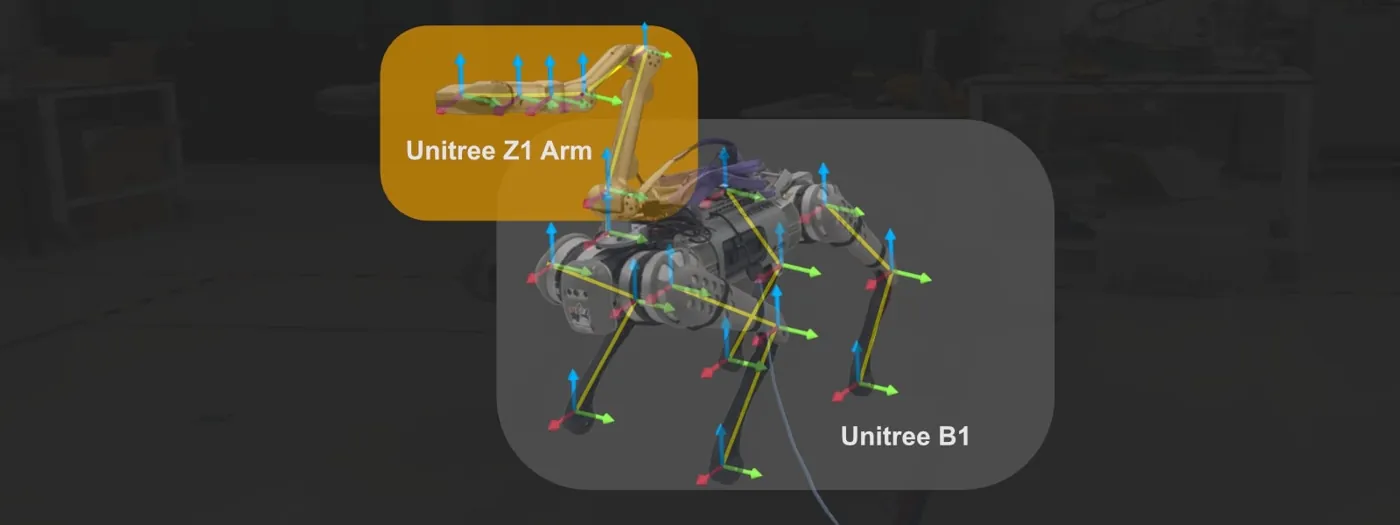
Figure 1: Unitree B1 and Z1 platform setup. B1 quadruped (12 DoF) + Z1 arm (6 DoF + 1 DoF gripper) = 19 DoF.
RL Formulation. The controller is trained as an RL policy in an MDP $\mathcal{M}=\langle\mathcal{S},\mathcal{A},\mathcal{P},r,\gamma,\rho_{0}\rangle$ with state space $\mathcal{S}$ (proprioception, joint states, contacts), actions $\mathcal{A}$ (joint targets), transition dynamics $\mathcal{P}$, reward $r$, discount $\gamma$, and initial distribution $\rho_0$. At each step, policy $\pi_\theta$ produces $a_t \sim \pi_\theta(\cdot|s_t)$, maximizing expected return:
$$J(\pi_{\theta})=\mathbb{E}\left[\sum_{t=0}^{\infty}\gamma^{t}r(s_{t},a_{t})\right]$$
Partial observability is addressed through observation histories, recurrent encoders, and domain randomization. Observation histories let the policy see past frames, recurrent encoders extract temporal features, and domain randomization exposes the policy to various dynamics parameter variations during training.
Policy Architecture. The low-level policy $\pi_\theta$ is a 3-layer MLP (128 units, ELU) with a $\tanh$ output head for 12 leg joint targets. Inputs concatenate proprioception (joint angles, velocities, IMU data), previous action, gait phase cues, high-level command $c_t$, and a latent extrinsic vector $z_t$. The latter is supervised with privileged parameters (friction, mass distribution, latency) during training and inferred online at deployment via an ROA-style adaptation module from historical observations—this design enables the policy to adapt to unmodeled dynamics at runtime. The command $c_t=(v^{\mathrm{cmd}}, \omega^{\mathrm{cmd}}, \mathbf{p}^{\mathrm{ee,cmd}}, \mathbf{R}^{\mathrm{ee,cmd}})$ specifies both base velocity and end-effector pose goals, unifying locomotion and manipulation at the command level. Arm control is analytically handled by damped least-squares IK, leaving RL to focus on coordinated body behaviors—this hybrid design reduces learning difficulty since arm IK has analytical solutions while leg coordination requires learning.
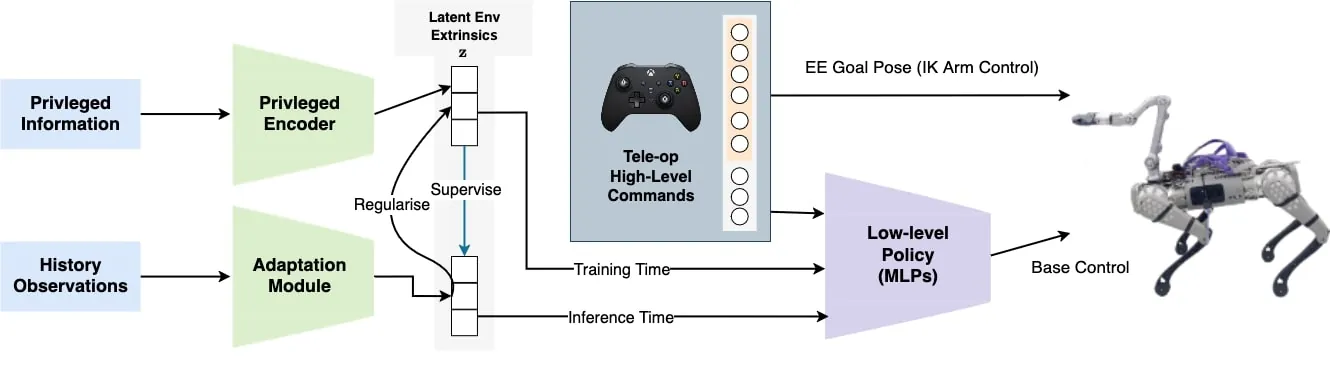
Figure 2: Policy inputs (proprioception, previous action, phase cues, command, extrinsics) pass through a 3-layer MLP to produce 12 leg joint targets. A privileged encoder (training) and adaptation module (deployment) provide $z_t$.
Optimization. Policies are trained with PPO, whose clipped surrogate objective is:
$$L_{\mathrm{CLIP}}(\theta)=\mathbb{E}_{t}\left[\min\big(\rho_{t}(\theta)\hat{A}_{t},\ \mathrm{clip}(\rho_{t}(\theta),1-\epsilon,1+\epsilon)\hat{A}_{t}\big)\right]$$
where $\rho_t(\theta)=\frac{\pi_\theta(a_t|s_t)}{\pi_{\theta_{\mathrm{old}}}(a_t|s_t)}$ is the probability ratio, $\hat{A}_t$ is the estimated advantage, and $\epsilon$ is the clipping range (typically 0.2). The clipping mechanism limits policy update magnitude to prevent instability. Combined with value loss and entropy regularization for exploration, advantages are estimated using GAE. Training runs in Isaac Gym with thousands of parallel environments for large-batch on-policy updates.
Training Setup. Rewards combine base-velocity tracking, energy efficiency, alive stability, and gait regularization with exponential kernels for velocity tracking stabilization. Commands $c_t$ are sampled across wide ranges of end-effector velocities and poses. Domain randomization covers terrain friction and geometry, robot parameters (mass, CoM, damping, latency), and sensor noise. Curriculum learning gradually increases randomization difficulty. The extrinsics latent $z_t$ enables online adaptation to unmodeled dynamics.
Unified Deployment Pipeline. The core contribution—a unified pipeline supporting both sim-to-sim verification and real-world deployment, implemented in ROS with ros_control for thread safety and real-time control. The only difference between simulation and hardware execution lies in the interface layer. The framework has five layers: consistency layer (identical nodes, parameters, variants across environments); external interfaces (teleoperation, RViz, Foxglove, RQT); shared software stack (policy inference, finite state machine, goal management, unified PD controllers—invariant across environments); execution branching into simulation (MuJoCo physics, MujocoHW emulation) or real hardware (HW interface to B1, Z1, safety systems).
graph TB
  A[Consistency Layer
Nodes/Params/Variants] --> B[External Interfaces
Teleop/RViz/Foxglove]
  B --> C[Shared Software Stack
Policy + FSM + PD Controllers]
  C --> D{Execution Branch}
  D --> E[Simulation
MuJoCo + MujocoHW]
  D --> F[Real Hardware
B1+Z1 HW Interface]
  style C fill:#e3f2fd,stroke:#1565c0,stroke-width:2px
  style D fill:#fff3cd,stroke:#856404,stroke-width:2px
Figure 3: Five-layer deployment architecture. Policy and control stack are invariant across simulation and hardware; only the interface layer differs (blue=shared stack, yellow=branch point).
Sim-to-sim Transfer. Since no public sim-to-sim pipeline exists for B1+Z1, the authors reconstructed robot assets from URDF and generated MuJoCo scenes. The hardware abstraction layer (MujocoHW) emulates the ros_control hardware interface for seamless controller execution across Isaac Gym and MuJoCo. Foot contact estimation uses foot force torque thresholds to detect contact events, replacing precise simulation contact information at deployment—real hardware cannot directly provide accurate contact states, only indirect estimates via torque sensors.
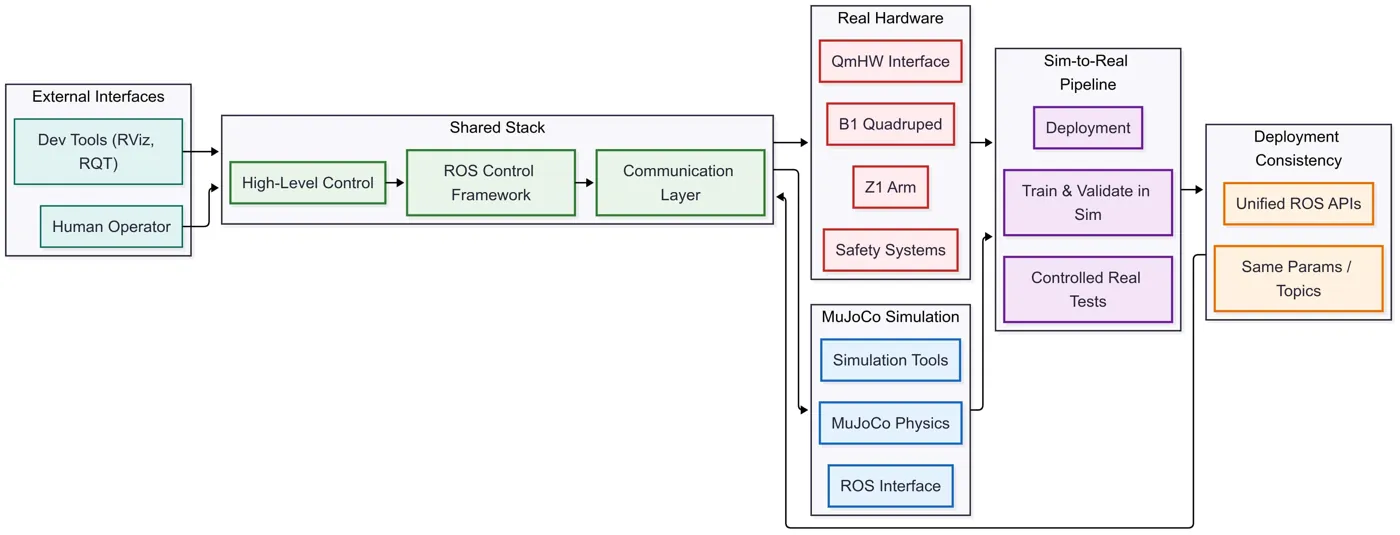
Figure 4: Deployment architecture. The same policy and controller stack runs across simulation and real environments, with only the hardware interface replaced.
Teleoperation and Visualization. Dual-mode joystick control: left stick/triggers for base locomotion, right stick/buttons for arm manipulation. Arm mode incrementally updates end-effector pose in the trunk frame, with persistent goals constrained within workspace bounds. Inputs pass through deadzones, scaling curves, and rate limits. Foxglove Studio integration provides real-time visualization of joint states, IMU data, contact events, and end-effector goals at 500 Hz control loop without impact.
Experimental Results
Experiments evaluate in three settings: (1) sim-to-sim tracking across Isaac Gym and MuJoCo; (2) sim-to-real tracking on Unitree B1+Z1; (3) teleoperated object picking. All use the same ROS stack and policy; only the hardware interface differs. Fixed end-effector poses and predefined base-velocity commands are used, reporting RMSE between commanded and measured velocities.
Sim-to-sim Tracking. Three end-effector poses (low, mid/neutral, high) were tested with a 23s sequence of forward, backward, turning, and combined motions. Tracking accuracy measured as base velocity RMSE:
$$\text{RMSE}(v_{d})=\sqrt{\frac{1}{N}\sum_{t=1}^{N}(v_{d}^{\text{meas}}(t)-v_{d}^{\text{cmd}}(t))^{2}}$$
In Isaac Gym, commanded velocities were broadly tracked but with systematic errors. Backward motions consistently yielded the largest translational errors, and the low EE pose produced elevated yaw noise. In the low configuration, forward tracking was acceptable but $v_x$ showed step-like artifacts and yaw exhibited persistent high-frequency oscillations—because lowering the arm shifted the center of mass and distorted support geometry, producing asymmetric loading and unstable ground reactions under PhysX's rigid impulses. MuJoCo produced smoother dynamics with fewer oscillations but exhibited foot sliding artifacts from its softened constraint solver. Tuning MuJoCo friction (impratio=100) nearly eliminated sliding with near-zero error in neutral/stop phases, but this reflects unrealistic traction tuning rather than intrinsic policy robustness.
| Simulator | Low EE (avg) | Mid EE (avg) | High EE (avg) |
|---|---|---|---|
| Isaac Gym | 0.144 / 0.231 | 0.144 / 0.118 | 0.163 / 0.114 |
| MuJoCo (default) | 0.113 / 0.123 | 0.123 / 0.118 | 0.123 / 0.122 |
| MuJoCo (impratio=100) | 0.118 / 0.120 | 0.109 / 0.110 | 0.112 / 0.118 |
Table 1: Cross-simulator average velocity tracking RMSE ($v_x$ / $v_{\text{yaw}}$, m/s, rad/s). Low pose is most error-prone; Isaac Gym has yaw oscillations, MuJoCo has foot drift.
Cross-simulator comparison reveals two consistent findings: first, the low EE pose is most error-prone while the high pose yields the lowest RMSE, independent of simulator—lowering the arm changes mass distribution affecting support geometry. Second, absolute error levels depend strongly on contact modeling: Isaac Gym introduces yaw oscillations, MuJoCo exhibits foot drift. These findings have important implications for sim-to-real transfer—policy quality cannot be judged from a single simulator's results.
Sim-to-real Tracking. On the physical B1+Z1, the deployed policy successfully executed locomotion across all tested EE poses. Mid-pose configurations produced the most stable behavior with smooth trajectories and minimal oscillation even at maximum teleoperation speeds (0.4 m/s, 0.8 rad/s). High-pose induced base shaking suggesting overcompensation for ground contacts—consistent with Isaac Gym oscillations, indicating partial sim-to-real behavior transfer. Low-pose maintained stability but showed reduced gait fluidity and slower forward speed. Unlike simulation, persistent oscillations were not observed on real hardware, reflecting real-sim dynamics differences—real-world compliance and damping may absorb rigid simulation oscillations.
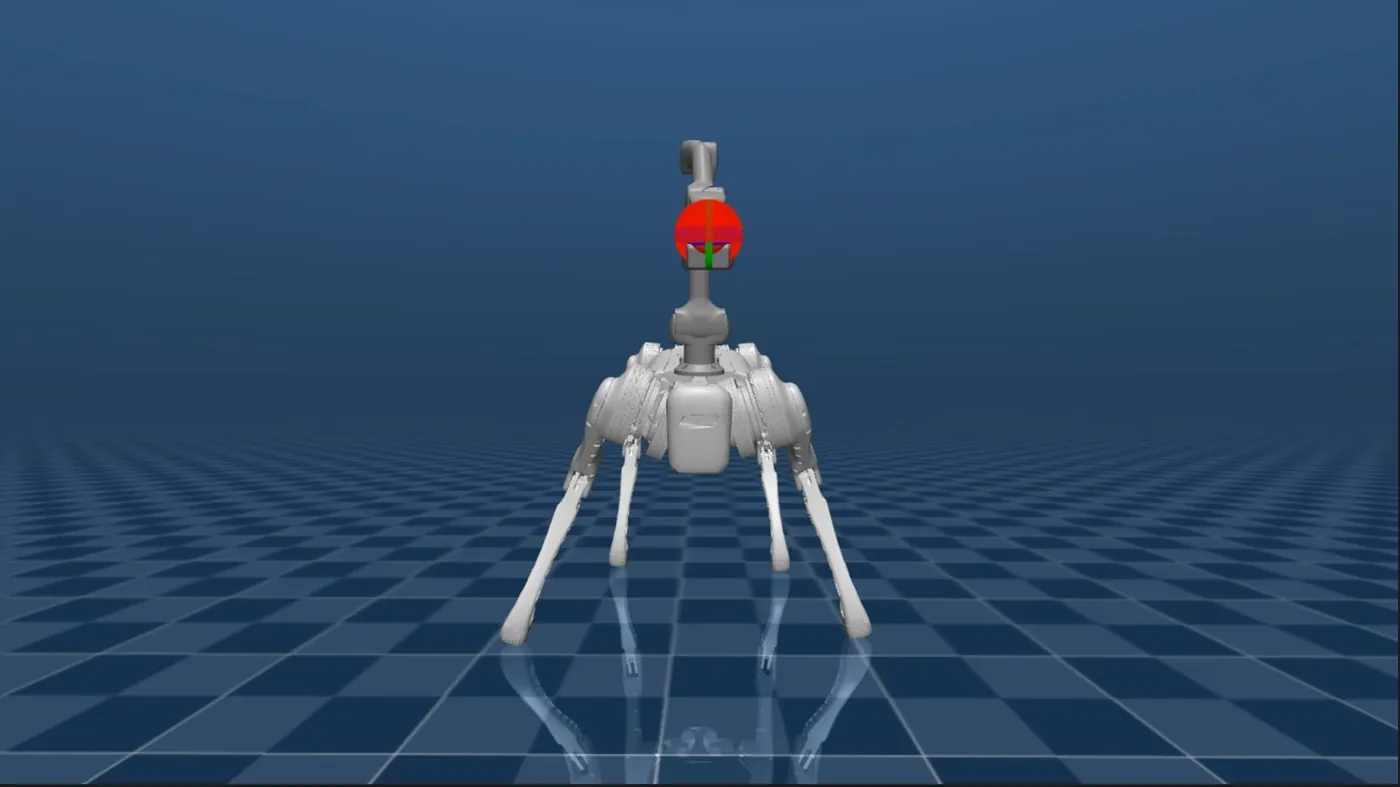
Figure 5: Reaching range test. The controller adapts trunk posture to extend manipulation reach while preserving stability.
Real-world Teleoperation Picking. Three YCB objects were tested: mustard container (tall bottle), potted meat can (compact box), plum (spherical, difficult). Objects placed at 0-0.58 m heights and 0.5-1.5 m distances. Two modes compared: baseline (Unitree default controller, separate arm-base control, fixed trunk height) and WBC (unified whole-body controller). Both performed similarly for high objects (0.58 m), but baseline failed consistently at low heights (0.18 m and ground) due to reach limitations. WBC achieved near-perfect success across all heights by adapting body posture (crouching, leaning forward). Spherical objects (plum) remained challenging due to gripper constraints. Overall, WBC succeeded 21/24 trials vs 11/24 for floating-base.
| Object | Height(m) | Floating Base | WBC |
|---|---|---|---|
| Meat can | 0.58 | 3/3 | 3/3 |
| Meat can | 0.36 | 1/3 (reach limit) | 2/3 |
| Meat can | 0.18 | 0/3 (reach limit) | 3/3 |
| Meat can | 0.00 | 0/1 (unreachable) | 1/1 |
| Mustard bottle | 0.36 | 2/3 | 3/3 |
| Mustard bottle | 0.18 | 0/3 (reach limit) | 3/3 |
| Plum | 0.36 | 0/3 (reach limit) | 2/3 |
| Plum | 0.18 | 0/3 (reach limit) | 2/3 |
Table 2: Teleoperated pick success rate. WBC significantly outperforms floating-base baseline at low heights.
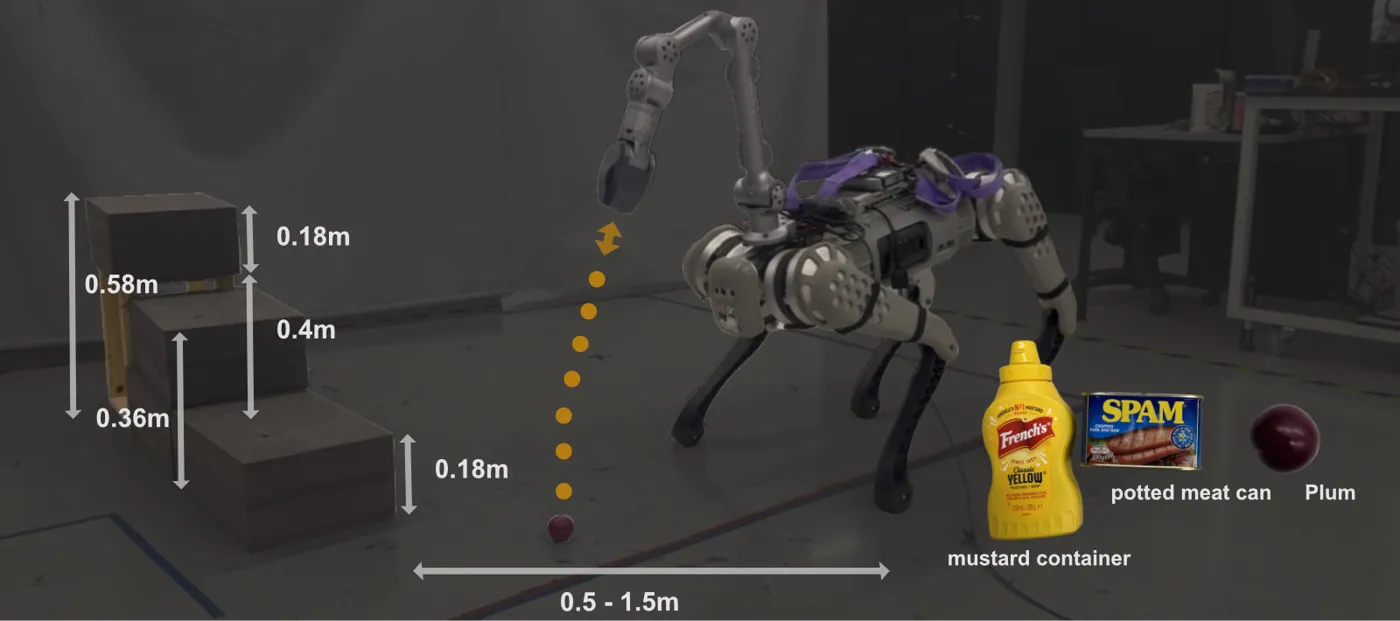
Figure 6: Object picking under two strategies. Left: floating-base arm control at fixed body height. Right: WBC coordinating arm and leg motions for extended reach.
MDP定义
$$ \mathcal{M}=\langle\mathcal{S},\mathcal{A},\mathcal{P},r,\gamma,\rho_{0}\rangle $$
期望回报
$$ J(\pi_{\theta})=\mathbb{E}\!\left[\sum_{t=0}^{\infty}\gamma^{t}r(s_{t},a_{t})\right] $$
LimitationsFirst, sim-to-sim experiments reveal significant simulator discrepancies—Isaac Gym's rigid contact model introduces yaw oscillations, while MuJoCo's softened constraints cause foot sliding. These differences mean policies trained in one simulator may behave differently in another, creating uncertainty for sim-to-real transfer. Tuning MuJoCo friction reduces sliding but reflects unrealistic traction rather than true robustness. This indicates the high sensitivity of current RL policies to contact models is an unresolved problem—choosing different simulators may lead to drastically different policy evaluation conclusions.
Second, the current framework handles arm control analytically via damped least-squares IK, with RL controlling only legs. This means arm-leg coordination is not fully driven by the learned policy, limiting the upper bound of whole-body coordination—the arm cannot proactively adjust based on leg motion to assist balance, and legs cannot adjust support strategy based on arm manipulation needs. Additionally, real-world experiments are limited to teleoperated picking without autonomous task execution or perception integration. The code, while promised open-source, was not yet public at publication time.
Conclusion and Future Work
This work emphasizes reproducibility and transferability over algorithmic novelty, providing a transparent RL whole-body control pipeline supporting sim-to-sim benchmarking and sim-to-real deployment on Unitree B1+Z1. Cross-simulator studies reveal contact modeling sensitivities: Isaac Gym introduces oscillatory artifacts, MuJoCo produces smooth but potentially distorted dynamics. Real-world teleoperated picking demonstrates that whole-body coordinated control extends manipulation reach by adapting body posture, significantly outperforming decoupled control at low heights (21/24 vs 11/24 success).
This pipeline provides a reproducible foundation for future RL loco-manipulation research, with open code supporting systematic evaluation and method comparison. Future work can integrate perception modules for autonomous operation, incorporate arm control into the learned policy for true unified whole-body control, and validate generalization across more tasks and environments.
Golden Quotes
Cross-simulator consistency is not proof of policy robustness, but an artifact of contact model differences between simulators that have not yet been exposed.
The value of whole-body control lies not in grasping higher, but in reaching lower and farther—places that floating-base control simply cannot reach.
SOURCE LINKS