How to Prepare for AI-Driven Code Modernization Projects
Six preparation steps for AI-driven code modernization, from target to pilot run.
In the Notes from the Field series, Anthropic forward deployed engineers share best practices inspired by real customer deployments. In this article, they share lessons from managing large code modernization projects.
Code modernizations once scoped as multi-year, all-hands efforts can now finish in months—or even weeks—but the organizational work on either side often remains the same.
Every change to a critical banking system, for example, must go through change management, review, and approval. Those controls are what make critical systems trustworthy, and they were built on the assumption that a human wrote each change and a human would review each diff. Once agents accelerate writing the changes, the bottleneck shifts from producing changes to mobilizing the organization around them.
This article covers the work enterprises must do before modernization begins: defining what “done” means, what evidence a change must carry, how certified changes will reach production, and what has to be staged so the run can start.
The process has six steps:
- Define the target: the tech stack and behavior the modernized code must have.
- Create the certificate: the conditions that changes must meet to be considered correct in the target state.
- Set the promotion policy: the path by which certified changes enter production at the rate they are produced.
- Put the prerequisites in place: environment, CI/CD, review capacity, and approvals.
- Build and refine the agentic workflow: a custom Claude Code dynamic workflow that distributes the modernization across many smaller parallel subagent workstreams. It is built around the target, certificate, and promotion policy.
- Run the modernization: prove the workflow end to end on a small partition of the codebase, then scale.
Step 1: Define the target
The target is the end state of the modernization. The desired end state determines which of three kinds of modernization you are doing.
Determine the modernization type
| Type | What it is | Choose when | The target is |
|---|---|---|---|
| Uplift | Same-stack version bump, such as C++11 to C++20. | The stack is fine but the version has fallen behind: end-of-life runtimes, unpatched security issues, or dependencies you can no longer upgrade. | A runtime version and package set. |
| Transform | A cross-stack rewrite that keeps behavior fixed, such as COBOL to Java. | The stack is the problem to resolve and the behavior is trusted. | Everything needed for an uplift, plus the language, frameworks, and architectural conventions the new code must follow. |
| Reimagine | A greenfield rebuild on a new architecture with modified behavior. | The behavior needs to change alongside the code. | Everything needed for a transform, plus a written behavioral spec for the new system. |
Determining which type of modernization to do is often debated inside an organization. In Anthropic's experience, the people closest to production want the stack swapped while behavior is held constant to contain risk—a transform modernization. On the other side are often engineers who have lived with the codebase and want the modernization to pay down technical debt, plus business stakeholders who want to use the opportunity to introduce new requirements—a reimagine modernization.
Both positions are reasonable, but if the question is left unresolved, it resurfaces later as an argument over whether a given change is “correct.” Building consensus on the path adds initial friction, but streamlines the project as a whole.
Map the codebase and create the behavioral spec
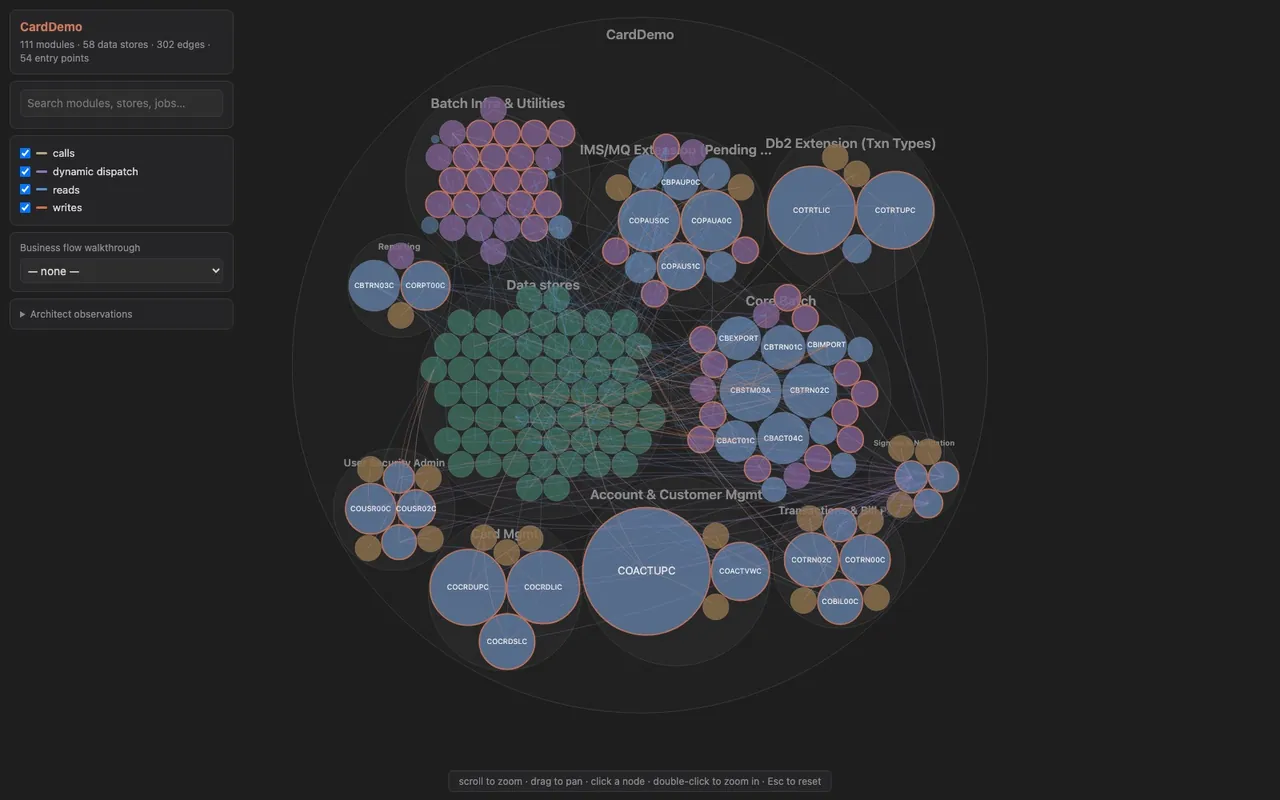
Understanding the current system is often a good first step toward defining the target. Extracting what the old code actually does and creating an inventory of current behavior makes it easier to decide which parts should be changed or dropped, and therefore whether the modernization is a transform or a reimagine. This work also frequently reveals unknown business logic and edge cases.
Claude can handle much of that discovery by mapping dependencies and documenting workflows that nobody remembers building. The code modernization plugin's assess, map, and extract-rules commands mine business rules with source citations that engineers can review.
Claude's discovery alone may not capture how a legacy system fully behaves, however. Interviews with business users and developers, along with internal documentation, can fill those gaps. Context gathering may take time upfront, but the quality of that context shapes every decision the workflow makes later.
For a reimagine, defining the target requires additional work: a detailed behavioral spec should be written down and agreed with user groups.
Establish the project's justification and goals
Alongside defining the target, the organization should consider why the modernization is worth undertaking at all. Modernizing legacy systems can reduce ongoing maintenance and operational costs. In Anthropic's experience, however, cost reduction has not been the driving goal of most modernization projects.
Risk reduction is often the most important modernization benefit. Consider the risk of not doing the modernization when debating whether or not to undergo the project.
For example, a system carrying unpatched vulnerabilities can create a cyber breach or an outage severe enough to put the business itself at risk. An unsupported runtime or a shrinking pool of engineers who understand the system makes that risk worse.
Agentic coding tools such as Claude Code have shortened modernization timelines, but budgets remain hard to estimate, which leads to inertia. Anthropic has published the costs of some large-scale modernizations, and others such as LG CNS have done the same. These figures can serve as a rough baseline.
The main challenge in starting these projects is usually building internal consensus and commitment from both the teams that own the system and the teams that depend on it. Building the business case and setting project goals, often at the leadership level, makes this part of the process easier. It also anchors the tradeoffs in the certificate and promotion policy that follow. When stakeholders disagree about how much risk a change can carry, the risk of not modernizing is the counterweight.
Step 2: Define the certificate
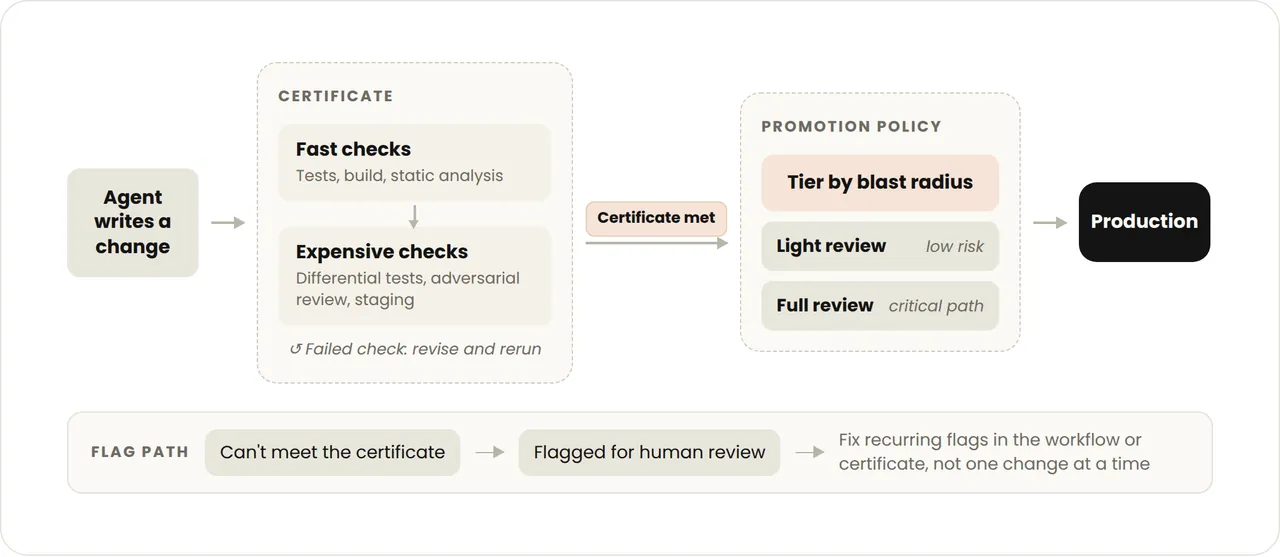
The certificate is the set of conditions or tests that every modernization change must meet. Choose the conditions that provide the strongest cumulative evidence that a change is correct against the target.
Each condition should be checkable without a human in the loop, so the agentic workflow can keep iterating on a change until it meets the certificate—or flag it for human review if it cannot.
What goes into the certificate depends on the target, but it will usually draw from this list:
- The original test suite passes.
- Claude-authored tests written during the modernization all pass.
- Test coverage meets an agreed threshold.
- Performance benchmarks stay within an agreed bound.
- Independent adversarial reviews by Claude, each in a fresh context window, find no blocking issues.
- For user interfaces, Claude-driven computer use finds no regressions.
- Current and target versions produce the same output from the same input, which can be live, recorded, or Claude-generated.
- Persisted state and wire formats round-trip between current and target versions.
- Changes run in staging for an agreed period with no regressions in error rates, latency, or alerts.
- Static analysis and security scans show no new findings.
- For compiled targets, the build is clean and type checks pass.
Write the certificate with the people who will review and promote changes into production. Bring in the developers, user groups, and business leads who depend on the codebase now, while the certificate and agentic workflow are still being designed.
Their expertise shapes what the certificate measures, and their early involvement earns their buy-in when changes reach review. A good test of the finished certificate is whether those reviewers would be comfortable merging based on the certificate's evidence alone. If they see their own bar reflected in it, the promotion policy in Step 3 can be lighter.
What the certificate checks against, and how, depends on the modernization type.
- For an uplift modernization, parity is measured against the original codebase, and the original test suite can be the core of the certificate.
- For a transform modernization, parity is also measured against the original codebase, but the original test suite rarely runs on the new stack. Replay of production traffic, differential testing between old and new, and a prod-parallel deployment do most of the work instead.
- For a reimagine modernization, the certificate is anchored in the behavioral spec. This is the hardest case. A spec is less objective than an existing system to diff against, so a larger degree of model judgment is involved, which can lead to more variable outcomes. Here, the certificate leans on tests written from the spec, independent adversarial reviews by Claude that check each change against the spec, and differential checks where the new system retains the old system's behavior. Expect to revise the certificate as the spec becomes clearer: gaps in the spec show up here first.
Older systems often have thin test coverage, flaky tests, and little telemetry. Part of defining the certificate is identifying those gaps. If a strong certificate will be difficult to support, one of the most useful things to do at this stage is use Claude to build the missing evidence—whether that means standing up a prod-parallel environment, building a replay harness, or writing more tests.
Step 3: Set the promotion policy
Agents will produce changes far faster than any human team can review them diff by diff. The promotion policy is a tiered review path—written down and agreed in advance—that sets the required depth of human review for a change so the modernization can finish on an acceptable timeline.
Like the certificate, work on this step with the reviewers, and fit it into the organization's existing change-management process wherever possible. The details will differ by organization and its risk tradeoffs, but a few rules hold everywhere:
- Tier changes by blast radius and agent confidence. Use the organization's own change or risk classification if one exists. Keep full human review for critical paths.
- Fix recurring flags at the source. Group and analyze flagged changes over time. When the same kind of flag keeps recurring, fix the cause in the agentic workflow or certificate rather than reviewing each one individually.
- Design the output format with the reviewers. Agree on what information and format make review fastest, and which signals provide more confidence than others. Have reviewers examine early sample outputs in Step 5.
- Allocate SME time effectively. Subject-matter experts will not read every final diff, but their judgment is still the scarce input. Make it easy for them to go straight to the highest-risk changes and the flagged agent decisions within each tier without wading through large diffs. A small number of expert hours can then cover the changes that carry the most risk.
Many of these rules front-load SME hours by engaging experts early in the project. Their feedback tunes the certificate and agentic workflow before full-scale modernization begins.
Their sign-off on samples also becomes further justification for a lighter review path where confidence is high. This reverses the traditional, non-agentic pattern, where review happens at the end.
The promotion policy should also reflect where the modernization sits on the spectrum between speed and review depth. A modernization racing toward a hard deadline, such as a runtime losing support, needs a faster policy with lighter human review and an explicit agreement to accept more risk per change.
A modernization on a longer timeline can afford deeper human review and a slower cutover. Stakeholders will land at different points on this spectrum depending on their risk appetite and constraints, so it is worth locking in before the work starts.
In a regulated environment, taking a lighter human review path for any change can cause real discomfort. Individual approvers hesitate to sign off because they carry the risk of a bad change, while leadership carries the larger risk of an aging system.
In Anthropic's experience, it is best for the directive on the promotion policy to come from the top of the organization. It is also better to agree on the policy beforehand so responsibility for a bug that reaches production is shared, rather than pinned on whoever approved the change.
All of this still depends on a certificate detailed enough to serve as real evidence, and on reviewers who understand how Claude arrived at a change well enough to trust it.
Step 4: Put the prerequisites in place
Much of this step runs through teams outside the modernization: platform or infrastructure for the host, QA or release engineering for test capacity, and security and compliance for approvals. Each team often has its own backlog or approval process, so open the conversations early, as soon as requirements are identified—often while Steps 1 through 3 are still underway.
Environment
- A dedicated remote host for running the workflow, with the codebase and other relevant sources reachable by Claude.
- Test capacity as required by the certificate.
- Anything that strengthens the certificate: production telemetry, a prod-parallel setup, or production data for replay.
Codebase and CI/CD
- A dependency map of the codebase, grounded in build and compile logs, import analysis, or runtime traces. The plugin's map command is a good starting point, but larger or older codebases may require more extensive upfront work.
- A planned treatment for dependencies and packages as part of the target definition.
- A compatibility check ready to add to CI/CD if needed.
- An agreed code-freeze policy if you are modernizing in place.
- A communication plan for active developers covering code freezes and new compatibility requirements.
Teams and review
- Agreement from other teams that depend on the codebase on how they will participate, such as signing off on the certificate or reviewing under the promotion policy, with reviewer time set aside.
Security and compliance
- A model access path for Claude Code that is approved for source code.
- Least-privilege access for the agentic workflow: write only to modernization branches, with no production credentials.
- Secrets and PII scrubbed or masked from the modernization branch.
- Every change traceable, with each PR linked to an agent transcript and certificate evidence.
- License and vulnerability checks on new dependencies.
Step 5: Build and refine the agentic workflow
Use Claude Code to develop a customized dynamic workflow for modernizing the codebase.
Start with the code modernization plugin, and put everything the workflow may need on the file system or behind MCP where Claude can reach it. This includes the target, certificate, promotion policy, codebase, documentation, and any data sources or tooling the certificate requires. The article itself can also be given to Claude as context. Together, these materials form the project's central knowledge base.
With that foundation in place, building the modernization workflow is the easy part. Have SMEs review Claude's work as needed, including any codebase-specific skills or extracted rules, before anything downstream relies on it.
Refine the workflow by applying it to small parts of the codebase, with SMEs reviewing the changes it produces, the agents' process, and the evidence that the certificate was met.
When issues surface, modify the workflow, not each individual change. The goal is confidence that, once scaled, changes will meet the certificate almost everywhere and reviewers will be comfortable merging under the promotion policy.
Step 6: Run the modernization
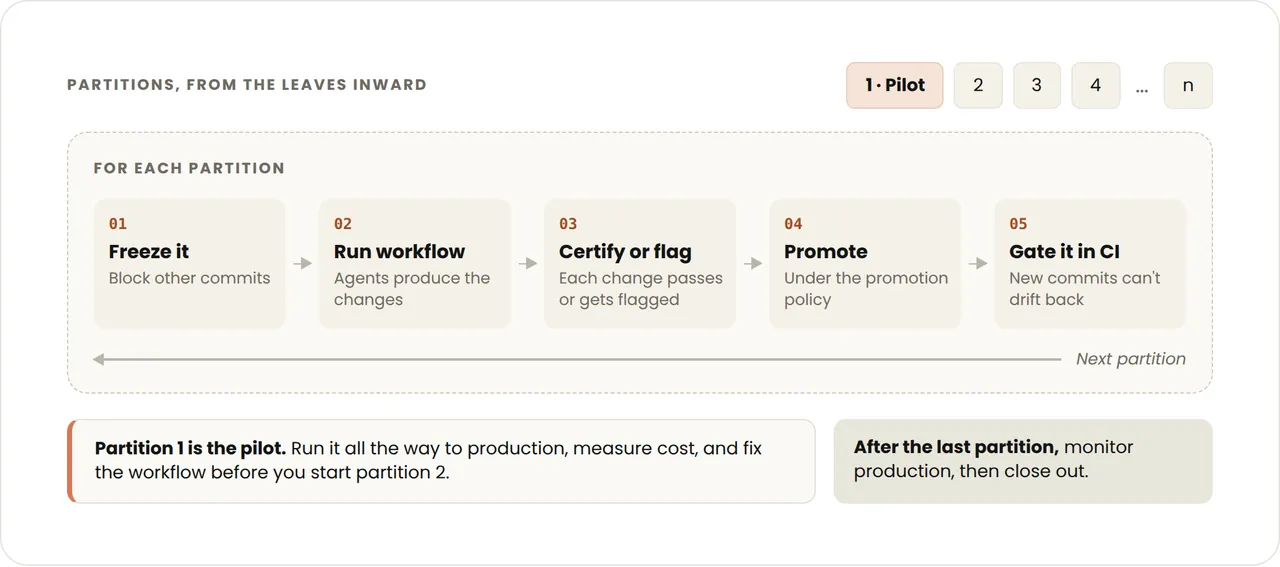
First, complete the modernization end to end on a small part of the codebase, including reviewing and landing changes through the promotion policy. Fix anything that does not work while it is still cheap, repeat the process until you are confident, then scale to the full codebase.
Transform and reimagine modernizations involve building the target alongside the existing system and cutting over once it is complete. An uplift has a second option: modernizing in place on the live codebase while development continues.
This is usually the right choice when the system cannot be taken down, or when the codebase changes so quickly that keeping a separate modernized copy up to date is difficult. A pattern that has worked is splitting the codebase into logical partitions from the leaves inward; freezing and modernizing one partition at a time; and gating CI/CD so new commits cannot undo a partition once it has been modernized.
A note on cost
A common question is how much a modernization like this will cost in tokens. Every effort is different, but the main cost drivers include:
- How much of the codebase must be read versus changed.
- How involved the certificate is. In a regulated environment, verification—not writing the change—is usually the larger share.
- How much new test writing and test repair the certificate demands.
- How much reconciliation work comes from other teams merging changes while the run is in progress.
When completing the modernization on a small part of the codebase, measure token usage and use it to extrapolate for the rest of the run. Treat anything the pilot could not see, such as reconciliation on a live codebase, as an unknown. This produces an estimate for the cost floor of the full modernization.
Pilot measurements also show where to optimize the agentic workflow for cost. Find the parts of the workflow that consume the most tokens and consider how to make them more efficient. Move compute-heavy verification signals behind cheaper gates so they run only after easier checks pass.
Consider using models such as Sonnet that balance cost and capability for mechanical, high-volume work that the certificate fully checks. Reserve more intelligent models for difficult transformations and adversarial reviews that verify correctness.
You can also escalate to a more expensive model when a less expensive one fails to meet the certificate, but analyze retry rates carefully during the pilot. Several cheap attempts can cost more than one expensive attempt. If Claude has access to both the workflow and the pilot data, it can perform much of this analysis with you.
Beyond the modernization
The modernized codebase is only one output. The others are the workflow that produced it, a written certificate defining what counts as correct, a promotion policy already accepted by the change-management process, and an evidence trail for every change that landed. Codify the playbook as a reusable asset so the pattern is ready for the next upgrade or rewrite.
Additional resources
- The public code modernization plugin for Claude Code
- The AI-Native SDLC playbook
- Code modernization playbook
- COBOL modernization with AI: Breaking the cost barrier
Source: How to prepare for AI-driven code modernization projects, published by Anthropic on September 23, 2026.