Skip to content
Tags

#Communication (2)

Robot Learning to Communicate through Projected Visual Abstractions

Robot Learning to Communicate through Projected Visual Abstractions

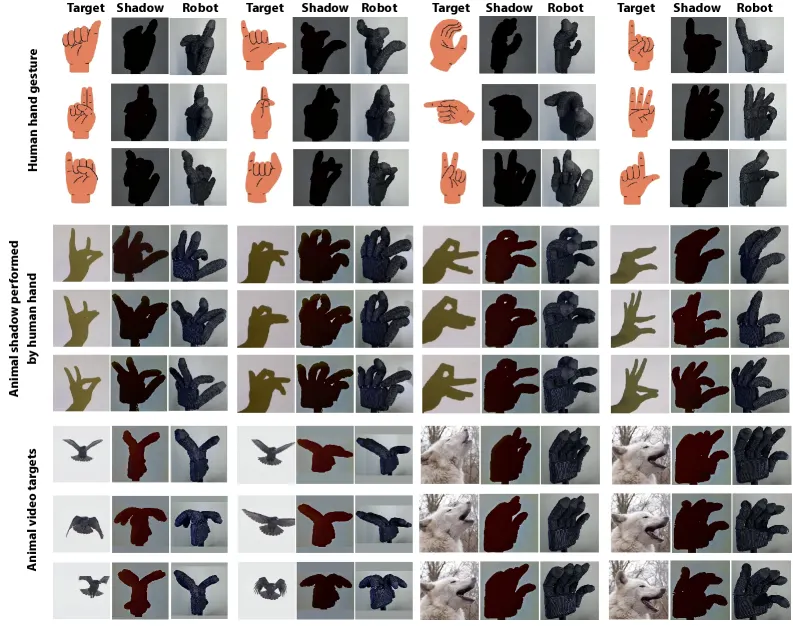
Humans routinely communicate through abstractions of their bodies, including shadows, silhouettes, and reflections. Yet robots remain largely confined to expressing themselves through their physical morphology. Enabling robots to communicate through such projected visual abstractions requires reasoning not only about bodily motion but also about how that motion is transformed into an external representation perceived by an observer. Among these abstractions, shadows provide a particularly compelling example because they emerge directly from the robot's embodiment while remaining visually distinct from the body itself. Here, we present a robotic system capable of dynamic shadow expression using a 21-degree-of-freedom dexterous hand with compliant soft skin and a learned shadow self-model. The soft-skinned embodiment reduces light leakage to produce visually continuous silhouettes, while the differentiable self-model learns the mapping between hand configurations and projected shadow appearance through task-agnostic self-exploration. Given a target shadow image or video, the robot optimizes its hand configurations through gradient-based search over 1 the learned self-model and refines the solution through collision-aware simulation to obtain physically feasible motions. For dynamic shadow performance, we further introduce expressive-region objectives, temporal smoothness regularization, and keyframe-based optimization to preserve visually important motion cues while reducing optimization complexity. We demonstrate robotic shadow expression across sign-language gestures, hand-shadow puppetry, and animal motion imitation in both simulation and physical experiments. These results establish a framework for enabling robots to manipulate projected visual abstractions of themselves for communication and visual storytelling.
Danyang Yan, Boyuan Wang, Jiaxun LiuJul 24, 2026
Robot LearningVisual AbstractionCommunicationJul 24, 2026
Dreamer-CPC: Message Learning with World Models for Decentralized Multi-agent Reinforcement Learning

Dreamer-CPC: Message Learning with World Models for Decentralized Multi-agent Reinforcement Learning

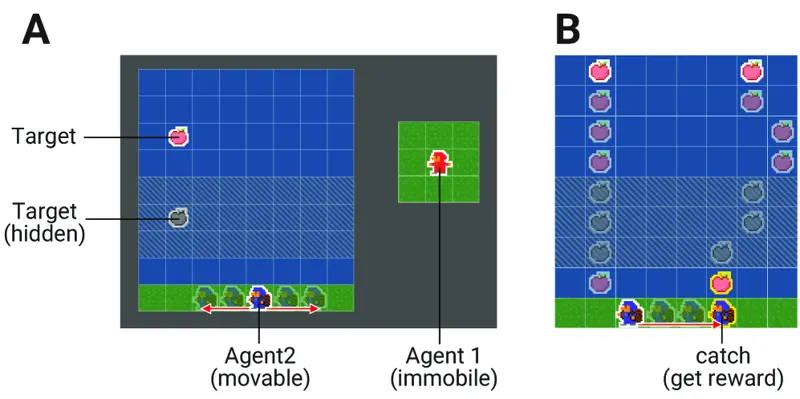
In multi-agent reinforcement learning (MARL), inter-agent communication is effective for improving performance under partial observability. Representation learning-based approaches enable decentralized agents to learn messages grounded in their own observations, but they rely only on current observations and cannot convey information accumulated over time. We propose Dreamer-CPC, a decentralized model-based MARL method that integrates message learning based on Collective Predictive Coding (CPC) into the world model of DreamerV3. Each agent independently maintains a world model and a message module, and infers and exchanges messages from the latent states of the world model that reflect the history of past observations and actions. We evaluated Dreamer-CPC in two environments: Observer, a non-cooperative information-sharing task, and CatchApple, a newly introduced task in which task-relevant observations are temporarily missing. In both environments, Dreamer-CPC outperformed IPPO-CPC, an existing CPC-based method that generates messages from current observations, as well as no-communication baselines. In particular, in CatchApple, Dreamer-CPC achieved 4 to 5 times the episode return of IPPO-CPC, demonstrating effective coordination where other methods fail due to missing observations. These results suggest that communication grounded in the latent dynamics of world models can support decentralized decision-making when current observations alone are insufficient.

Taisuke Takayama, Naoto Yoshida, Tadahiro TaniguchiJul 22, 2026
DreamerWorld ModelsMulti-agentJul 22, 2026