Skip to content
Tags

#Attention Mechanism (2)

DELTA: Deformable Elevation-Based Local Terrain Attention Encoder for Sparse-Terrain Quadrupedal Locomotion

DELTA: Deformable Elevation-Based Local Terrain Attention Encoder for Sparse-Terrain Quadrupedal Locomotion

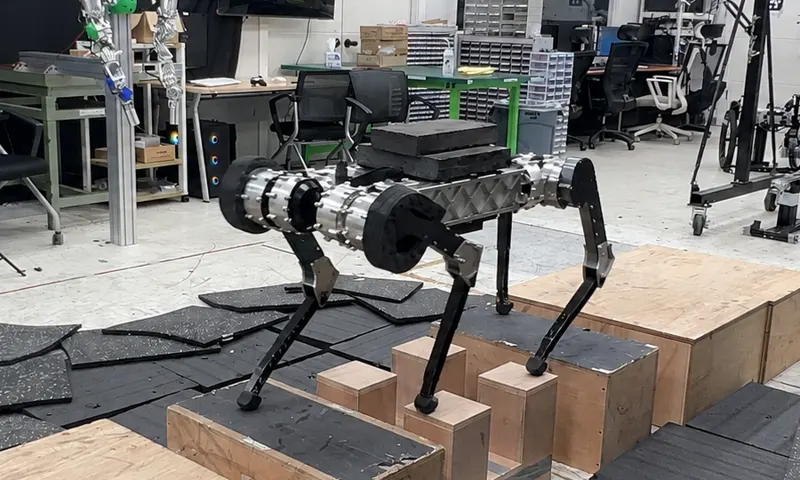
Stable quadrupedal locomotion on sparse terrain requires selecting state-relevant terrain evidence for precise foot placement. Model-based foothold planners provide precise foothold selection but rely heavily on explicit model assumptions. Recent attention-based map encoding (AME) studies show that end-to-end reinforcement learning (RL) can learn implicit foothold guidance. However, the computational cost of dense AME encoding grows with map resolution, limiting its scalability to fine-grained sparse terrain. We propose DELTA, a Deformable Elevation-Based Local Terrain Attention encoder. DELTA predicts state-conditioned sampling locations, forms terrain evidence tokens from adaptive local elevation patches, and attends only to a fixed-size token set. With fixed sampling and patch settings, DELTA's encoder cost is independent of map resolution. Experiments show that DELTA achieves final traversal performance comparable to AME at the standard resolution while improving learning efficiency. This fixed encoder cost enables the use of higher-resolution terrain maps, improving traversal on fine-grained sparse terrain. DELTA also demonstrates strong generalization to unseen mixed evaluation courses composed of continuous and discrete terrain elements. Beyond simulation, DELTA demonstrates successful sim-to-real transfer on RAIBO2. Analysis of the learned sampling offsets and attention weights shows that DELTA samples steppable regions and attends to terrain evidence relevant to future touchdowns without foothold labels or attention supervision.
Sanghyun Park, Moonkyu Jung, Jemin HwangboAug 22, 2026
Sim-to-RealQuadruped robotsLocomotionAug 22, 2026
Global-Local Attention Decomposition for Terrain Encoding in Humanoid Perceptive Locomotion

Global-Local Attention Decomposition for Terrain Encoding in Humanoid Perceptive Locomotion

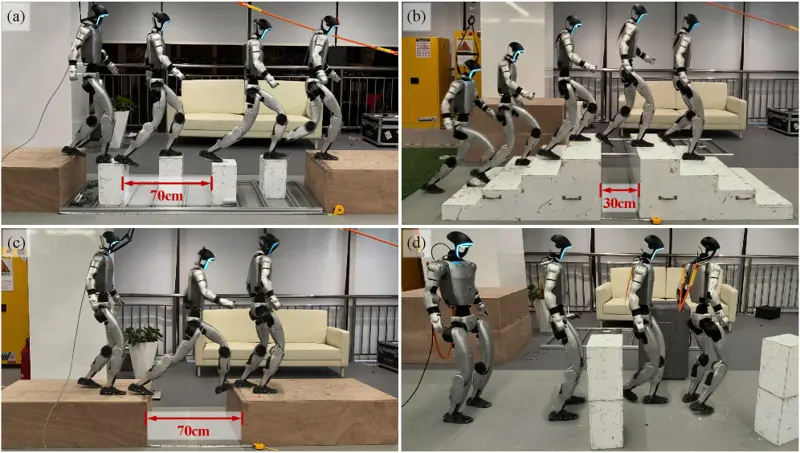
Although reinforcement learning has significantly advanced humanoid locomotion, perceptive policies still struggle on sparse-foothold terrain and constrained environments. Success in these scenarios requires both broad terrain awareness and precise foothold selection, two perceptual roles that conventional encoders often entangle. To address this challenge, we propose Global-Local Attention Decomposition (GLAD) for terrain encoding in humanoid locomotion. Realized by a coarse-to-fine encoder over a robot-centric elevation map, GLAD explicitly separates these objectives: a global attention branch utilizes attention pooling to summarize the surrounding terrain context, while a state-conditioned local attention branch sparsifies and encodes precise foothold-relevant geometry. This explicit attention decomposition prevents the dilution of fine-grained spatial cues while reducing training overhead. Experiments demonstrate that GLAD enables reliable locomotion over challenging gaps, stepping stones, and stairs. Furthermore, the learned policy exhibits emergent terrain-responsive behaviors, autonomously following narrow paths and avoiding obstacles under simple velocity commands without explicit navigation planners. In real-world deployment on a Unitree G1 humanoid robot using onboard LiDAR, the proposed method achieves robust zero-shot sim-to-real transfer across diverse sparse-foothold and obstacle-rich domains.

Shengcheng Fu, Yang Zhang, Zhanxiang CaoMay 30, 2026
HumanoidAttention MechanismTerrain EncodingMay 30, 2026